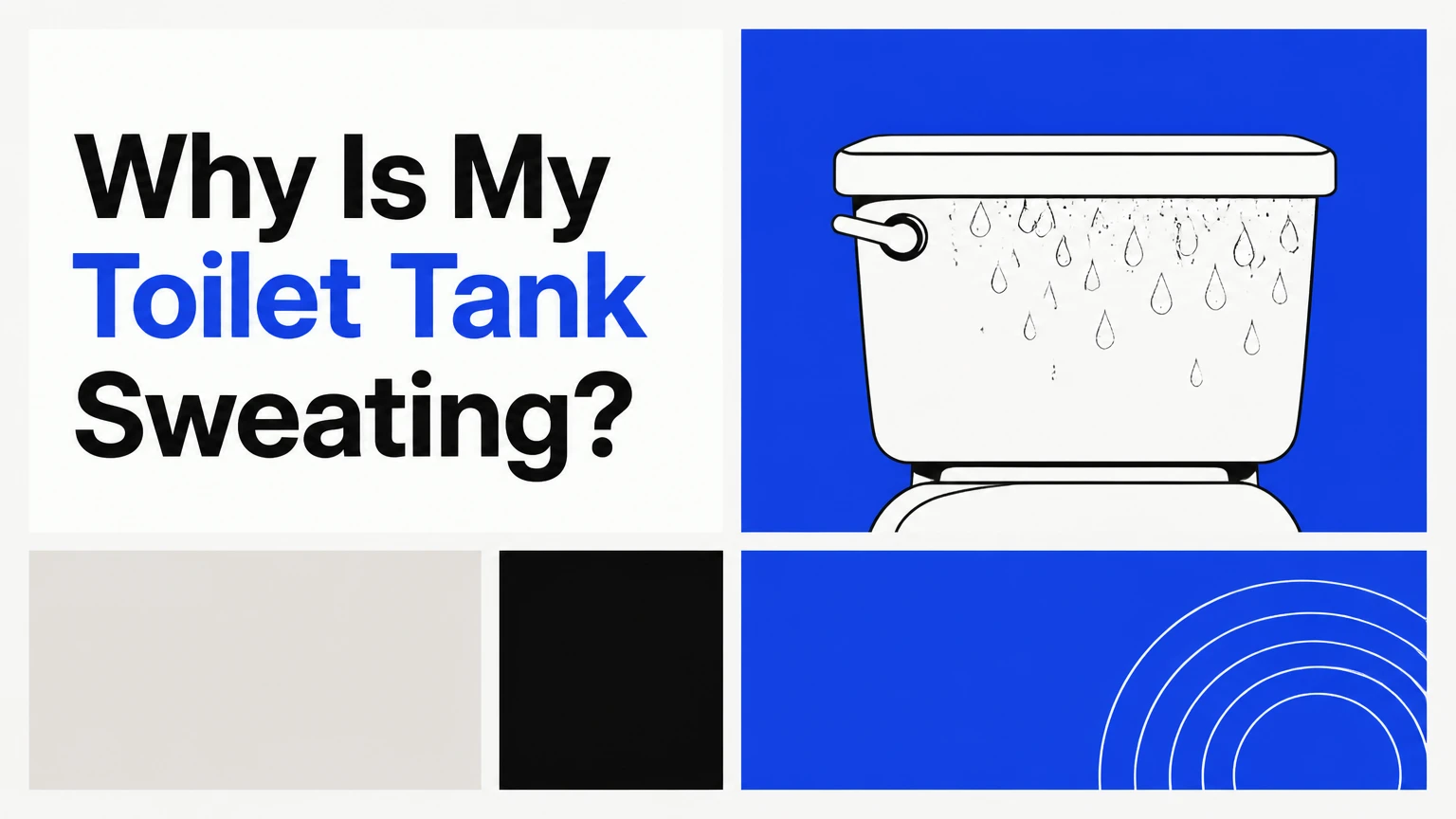
Your toilet tank is sweating because cold water inside the tank lowers the porcelain surface temperature below the dew point of the surrounding warm, humid bathroom air. This temperature gap forces moisture in the air to convert into liquid water droplets on the outside of the tank.
At a Glance
- Condensation begins when the water inside the tank is 15 to 20 degrees Fahrenheit colder than the room.
- A standard bathroom at 75 degrees Fahrenheit with 60 percent humidity will trigger condensation on any surface below 60 degrees.
- Slow flapper leaks cause continuous sweating by preventing the water inside the tank from warming up to room temperature.
- Factory-insulated tanks prevent external condensation by creating a thermal barrier between the cold water and the porcelain.
- Installing an anti-sweat mixing valve permanently solves the issue by injecting hot water into the toilet fill line.
How much water does toilet condensation produce daily?
Toilet condensation produces up to half a gallon of water per day in highly humid environments. The exact volume depends entirely on ambient room humidity, flush frequency, and the temperature of your incoming water supply.
A bathroom running hot showers without adequate ventilation will generate heavy condensation quickly. This moisture collects on the cold porcelain and eventually drips down the sides of the bowl. During peak summer humidity, a single toilet tank can easily pool 16 to 32 ounces of water onto the floor in just 24 hours. The accumulation is rarely a steady stream. You will see heavy accumulation right after a morning shower, followed by slow evaporation during the day.
Will a sweating toilet tank damage my bathroom floor?
Yes, a sweating toilet tank will damage your bathroom floor and the underlying structure if left unchecked. Over time, constant dripping rots the subfloor, ruins vinyl tiles, promotes drywall mold, and rusts the steel toilet bolts.
Water damage occurs because gravity pulls the condensation directly down to the base of the toilet. Moisture seeps under the caulk line and saturates the wooden subfloor. “A subfloor exposed to chronic toilet condensation can lose 60 percent of its structural integrity within six months,” reports the National Association of Home Builders (2021). You might not notice the rot until the toilet begins to wobble or the ceiling in the room below shows water stains. Fixing a rotted bathroom floor typically requires removing the toilet entirely and replacing the damaged joists.
How can I tell the difference between a leak and condensation?
Perform the tank towel test to instantly determine whether the moisture is a physical plumbing leak or environmental condensation. You must isolate the source of the water before attempting any repairs.
- Turn off the water supply valve located behind the toilet.
- Flush the toilet to empty the tank.
- Dry the entire outside of the porcelain tank thoroughly using a clean cotton towel.
- Wrap a dry, light-colored towel tightly around the outside of the tank and secure it with tape.
- Wait exactly one hour.
- Inspect the wrapped towel.
If the towel is damp uniformly across the entire surface, you are dealing with condensation. If the towel is soaked in one specific spot near the bottom bolts or the supply line connection, you have a physical leak requiring a new gasket or washer.
What is the ideal bathroom humidity level to stop condensation?
Maintain a relative bathroom humidity level below 50 percent to prevent most toilet condensation. When humidity drops below this threshold, the air holds less moisture, requiring a much colder surface to trigger the dew point.
The relationship between room temperature, water temperature, and humidity dictates when sweat forms. Condensation is governed entirely by thermodynamics. Groundwater often enters the home at 45 to 55 degrees Fahrenheit during winter or in cold regions. If your bathroom sits at 75 degrees, lowering the humidity increases the margin of safety.
| Room Temp (F) | Relative Humidity | Dew Point (F) | Condensation Risk on 50F Tank |
| 75 | 40% | 49.0 | Low |
| 75 | 50% | 55.1 | Moderate |
| 75 | 60% | 60.1 | High |
| 75 | 80% | 68.3 | Severe |
Do high-efficiency toilets sweat less?
Yes, newer high-efficiency toilets that use 1.28 gallons per flush sweat significantly less than older 3.5-gallon models. The reason lies in the sheer volume of cold water sitting inside the porcelain structure.
Older toilets hold up to five gallons of icy groundwater after every flush. This massive cold sink takes hours to warm up to room temperature. High-efficiency toilets draw in only a fraction of that cold water. Because the volume is smaller, the ambient room air warms the water inside the tank much faster. The porcelain spends less time below the dew point, drastically reducing the window of time where condensation can form. If you live in an older home with original fixtures, upgrading the toilet is a passive way to combat bathroom condensation.
Does flushing less often prevent toilet sweat?
Yes, reducing your flush frequency allows the water inside the tank more time to warm up to room temperature. Every time you flush, you introduce a fresh batch of freezing groundwater into the porcelain vessel.
If you flush five times in an hour, the tank remains permanently cold. If you allow the water to sit undisturbed for several hours, the temperature of the water gradually equalizes with the ambient air in the bathroom. Once the tank surface temperature rises above the room’s dew point, condensation instantly stops. Many homeowners in humid, coastal climates adopt a “let it mellow” policy during the hottest parts of the day strictly to manage severe tank condensation.
Why does my toilet run cold water constantly?
A slow leak in the flapper valve forces the toilet to constantly draw fresh, icy groundwater to maintain the water level. This internal leak prevents the tank from ever reaching room temperature, creating a perpetual condensation cycle.
The flapper is the rubber seal at the bottom of the tank. When this rubber degrades from hard water or bleach tablets, water silently seeps into the bowl. Data from the EPA WaterSense program (2023) states that repairing a leaky flapper valve saves up to 200 gallons of water per day. You can detect this micro-leak by placing three drops of food coloring into the upper tank. If the water in the lower bowl changes color after 15 minutes without flushing, your flapper is leaking. Replacing the five-dollar flapper often cures chronic tank sweating instantly.
Are insulated toilet tanks worth the extra cost?
Factory-insulated toilet tanks are highly effective and easily justify their 50 to 100 dollar premium for homes in humid climates or properties relying on deep wells. The factory installs a polystyrene liner seamlessly against the interior porcelain walls.
This foam barrier prevents the cold water from physically touching the outer porcelain shell. The outer shell remains at room temperature, making condensation thermodynamically impossible. While you can buy aftermarket foam kits, factory-installed liners perform better because they lack seams where water can penetrate.
| Solution | Installation Time | Material Cost | Effectiveness Rating |
| Factory Insulated Tank | 2 hours | $200 – $400 | Excellent |
| Anti-Sweat Mixing Valve | 3 hours | $30 – $60 | Excellent |
| DIY Foam Tank Liner | 45 minutes | $15 – $25 | Moderate |
Can I use an anti-sweat tank liner on an old toilet?
Yes, you can install a drop-in anti-sweat tank liner on an older toilet, but the interior porcelain must be completely clean and 100 percent dry before installation. If the porcelain is slimy, wet, or calcified, the adhesive backing will fail within days.
Poor preparation is the main reason DIY liners fail. Water gets trapped behind the loose foam panels, creating a hidden breeding ground for mold while the tank continues to sweat outside. You must drain the toilet completely. Scrub the inside with white vinegar to remove mineral deposits. Finally, you must blow dry the bare porcelain with a hair dryer on high heat for at least ten minutes. The surface must be warm to the touch before you apply the foam panels.
Can I paint the inside of my toilet tank to stop sweating?
No, painting the inside of a toilet tank with rubberized sealant will not prevent sweating and often causes severe internal clumbing clogs. Paint does not provide adequate thermal resistance to stop the temperature transfer.
Many internet forums recommend spraying liquid rubber into an empty tank. The layer of paint is too thin to act as an effective thermal barrier against 45-degree groundwater. Furthermore, the constant submersion in chlorinated tap water breaks down the paint binders. The rubberized coating will eventually peel off in large strips. These strips get sucked into the flush valve, ruining the seal and causing catastrophic continuous running. Never apply liquid coatings to the inside of plumbing fixtures.
Why does my bathroom fan make toilet sweating worse?
In deeply humid climates without central air conditioning, running a bathroom exhaust fan pulls wet outdoor air into the house, actively fueling the condensation on the toilet tank.
Fans do not create dry air. They simply exchange indoor air for outdoor air. “Standard bathroom exhaust fans pull roughly 50 to 100 cubic feet per minute of outside air into the home,” according to the Home Ventilating Institute (2023). If you live near the coast and the outdoor humidity is 90 percent, running the fan replaces your conditioned indoor air with saturated outdoor air. The moisture in that fresh air immediately seeks the coldest surface in the room, which is the porcelain toilet tank. In these specific environments, keeping the bathroom door open to the air-conditioned hallway is much more effective than running the exhaust fan.
How do you install a toilet mixing valve?
Installing an anti-sweat mixing valve requires splicing into both the hot and cold water lines to deliver slightly tempered water to the toilet tank. This permanent mechanical fix raises the tank water temperature above the room’s dew point.
“The constant introduction of 45-degree well water against a 75-degree porcelain barrier creates a perpetual condensation machine,” notes the American Society of Plumbing Engineers (2022). A mixing valve solves this by injecting a tiny stream of hot water into the cold supply.
- Turn off the main water supply to the bathroom.
- Locate the hot and cold water pipes directly beneath the floor or behind the wall near the toilet.
- Cut into both pipes using a pipe cutter.
- Solder or push-fit the mixing valve into place, connecting the hot line to the hot inlet and the cold line to the cold inlet.
- Connect the mixed output line directly to the toilet supply valve.
- Adjust the valve dial to deliver water at approximately 65 degrees Fahrenheit.
How much does it cost to fix a sweating toilet?
Fixing a sweating toilet tank costs between 15 dollars for a simple DIY flapper replacement and 350 dollars for a professionally installed mixing valve. The final price depends entirely on the root cause of the condensation.
If your problem stems from an internal leak, a new flapper is a negligible expense. If your problem is purely environmental and requires plumbing modifications, the labor costs escalate quickly.
| Fix Material | DIY Cost | Professional Cost | Estimated Time |
| Replacement Flapper | $5 – $15 | $75 – $125 | 15 minutes |
| Foam Tank Liner Kit | $15 – $25 | N/A (Rarely done by pros) | 45 minutes |
| Anti-Sweat Mixing Valve | $30 – $60 | $250 – $350 | 2-3 hours |
| Insulated Toilet (Full unit) | $200 – $400 | $400 – $600 | 2 hours |
Do drip trays work for toilet condensation?
Drip trays catch falling condensation to protect your floor, but they do not solve the root thermodynamic problem causing the sweat. They are a temporary bandage, not a mechanical cure.
A plastic tray placed around the base of the toilet will protect your vinyl flooring and subfloor from immediate water damage. However, the standing water in the tray quickly stagnates. Dust and bathroom debris collect in the puddle, creating an ideal environment for mildew and foul odors. You must empty and sanitize the tray weekly. While a drip tray is an excellent emergency measure to prevent structural rot, you should immediately begin planning for a permanent thermal solution like a mixing valve or an insulated tank.
The Bottom Line
A sweating toilet tank is a thermodynamic problem caused by the temperature gap between cold water and humid air. You can eliminate minor condensation by lowering room humidity below 50 percent or fixing slow flapper leaks that keep the porcelain permanently cold. For homes on cold deep wells or in tropical climates, installing an anti-sweat mixing valve or upgrading to a factory-insulated tank provides the only guaranteed, permanent fix. Addressing the sweat immediately is necessary to prevent thousands of dollars in subfloor rot.