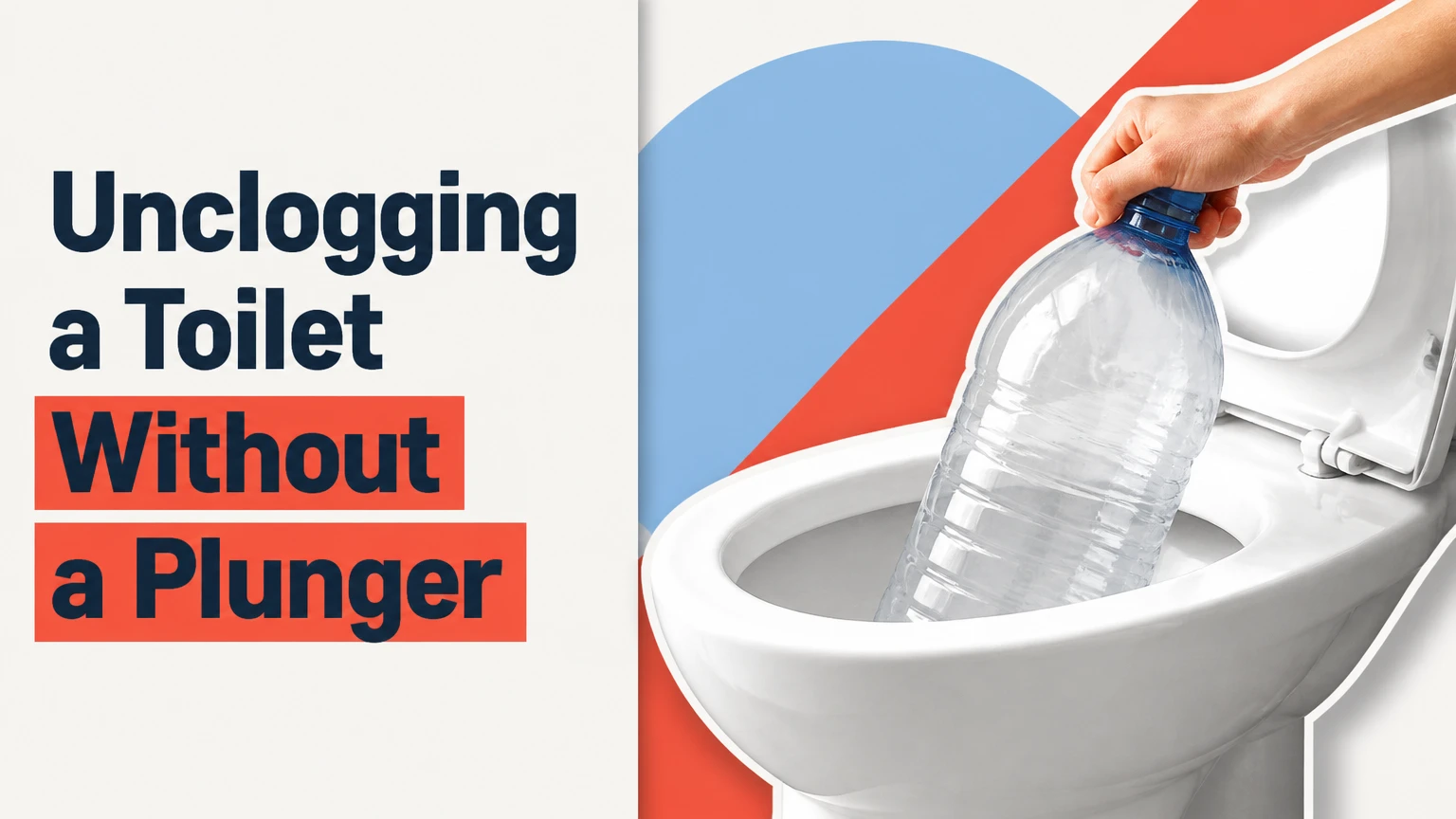
Unclogging a toilet without a plunger usually takes five to 60 minutes using dish soap, hot but nonboiling water, controlled water pressure, or a toilet brush. The best method depends on whether the blockage consists of toilet paper and waste, a compacted soft clog, or a solid foreign object.
Key Facts at a Glance
- Stop the tank from refilling before attempting any unclogging method.
- Dish soap and hot water work best on toilet paper and organic waste.
- Water should be hot enough to soften the blockage but never boiling.
- Baking soda and vinegar produce fizz but little sustained pressure.
- Solid objects should be pulled out rather than forced deeper.
- Repeated clogs may indicate a trapway, drain-line, vent, or sewer problem.
Before You Start
Most household methods are suitable only for soft obstructions within the toilet trapway. They cannot reliably remove toys, wipes, sanitary products, cloth, excessive mineral buildup, roots, or blockages farther down the building drain.
Home Depot classifies unclogging a toilet without a plunger as a beginner task that normally takes less than two hours. Its guidance recommends first stopping an overflow, removing excess water, and trying hot water or dish soap before more invasive methods.
| Requirement | Typical amount or condition | Purpose |
| Working time | 5-30 minutes | Active preparation and clearing |
| Total elapsed time | 10-60 minutes | Includes soaking time |
| Difficulty | Beginner | No plumbing disassembly |
| Typical cost | $0-$15 | Household supplies or basic brush |
| Rubber gloves | 1 pair | Protects hands from contaminated water |
| Bucket | 1, holding 2-5 gallons | Removes or adds water safely |
| Dish soap | 1/4-1/2 cup | Lubricates soft waste |
| Hot water | 1/2-1 gallon | Softens toilet paper and adds pressure |
| Old towels | 2-4 | Controls splashes and overflow |
Identify the Likely Type of Clog
The suspected material determines whether you should soften, pressurize, break apart, or retrieve the blockage. Applying pressure to a solid object can lodge it beyond the toilet trap, turning a simple retrieval into a toilet-removal job.
| Suspected cause | Typical clues | Best first action | Avoid |
| Excess toilet paper | Water rises after a large flush, then drains slowly | Dish soap and hot water | Repeated flushing |
| Organic waste | Recent normal toilet use, no object missing | Hot water or controlled bucket pour | Boiling water |
| Flushable or wet wipes | Repeated slow draining, wipes recently used | Toilet auger | More wipes or chemicals |
| Toy or toiletry item | Sudden complete blockage, object missing | Hand retrieval or auger | Pushing with a hanger |
| Sanitary product or cloth | Abrupt blockage, little water movement | Retrieval or professional removal | Soap and vinegar |
| Drain-line obstruction | Other fixtures gurgle or back up | Stop using plumbing and call a plumber | Adding more water |
Step 1: Stop the Toilet From Overflowing
Prevent additional water from entering the bowl before testing any remedy. Remove the tank lid, push the rubber flapper closed if water is flowing, and turn the shutoff valve behind the toilet clockwise until it stops.
Do not flush again simply to check whether the clog remains. Each flush may release another full tank of water into a bowl that has no available capacity.
If the water is already near the rim, put on gloves and scoop it into a bucket with a disposable container. Lower the level until the bowl is approximately half full. Home Depot likewise advises manually removing water when the bowl is too full for another treatment.
Success checkpoint: The bowl level remains stable, with at least 3-4 inches of empty space below the rim.
Common mistake: Relying only on the wall shutoff valve. Water already stored in the tank can still enter the bowl unless the flapper remains closed.
Step 2: Add Dish Soap to Lubricate the Clog
Pour 1/4-1/2 cup of liquid dish soap into the center of the bowl. Allow it to sink toward the trapway for 15-30 minutes before adding water.
Dish soap reduces friction around compacted toilet paper and waste. It may also help water penetrate the obstruction, although it does not chemically dissolve plastic, cloth, wipes, or solid objects.
American Standard recommends liquid dishwashing soap followed by hot, nonboiling water and about a 10-minute waiting period.
Shampoo or liquid hand soap can work when dish soap is unavailable. Use approximately 1/2 cup because these products may contain fewer grease-cutting surfactants. Avoid bar-soap chunks because they can become part of the blockage.
Success checkpoint: The water level begins to drop slowly, or small bubbles rise from the drain opening.
Common mistake: Adding several cups of soap. Excess detergent creates foam, consumes bowl capacity, and complicates cleanup without producing more clearing force.
Step 3: Pour Hot Water With Controlled Force
Heat 1/2-1 gallon of water until it is hot but not boiling. A practical target is approximately 120-150°F, or 49-66°C. Pour it steadily from 1-2 feet above the bowl, stopping before the water reaches the rim.
The water performs two functions. Heat softens toilet paper and compacted organic material, while the falling water adds modest hydraulic pressure. Leave the mixture undisturbed for another 10-20 minutes.
Home Depot’s warning is direct: “Do not use boiling hot water.” The company explains that excessive heat may crack a porcelain toilet.
A full gallon is unsuitable when the bowl is already more than half full. Remove more standing water or add only the volume the bowl can safely hold.
Success checkpoint: The bowl returns toward its normal water level without being flushed.
Once the level falls, perform a safer bucket test. Pour two to three quarts of plain water into the bowl. A clear toilet should accept the water rapidly and initiate a normal siphoning action.
Common mistake: Pouring too slowly. A weak trickle adds volume without enough momentum to move the obstruction.
Step 4: Try Baking Soda and Vinegar Carefully
Use baking soda and vinegar only when the toilet drains slowly and the bowl has substantial empty capacity. Add one cup of baking soda, then slowly add one cup of white vinegar. Let the mixture fizz and remain in the bowl for 20-30 minutes before adding hot tap water.
The visible reaction produces carbon dioxide bubbles, but it does not create powerful pressure in an open toilet bowl. Its practical value comes mainly from agitation, wetting, and the later addition of water. It is less dependable than dish soap for tightly packed toilet paper.
Home Depot includes baking soda and vinegar as a potential remedy, specifying that the bowl should be about half full before the ingredients are added.
Do not combine this mixture with bleach, toilet-bowl cleaner, acid, caustic drain cleaner, or any unidentified product already in the bowl.
Success checkpoint: The water level falls noticeably during the waiting period.
Common mistake: Pouring vinegar quickly into a nearly full bowl. Foam can rise and overflow even though the clog has not moved.
Step 5: Use a Toilet Brush as a Pressure Tool
Insert a sturdy toilet brush into the drain opening and work it forward and backward in short, controlled strokes. Keep the brush head underwater to direct pressure toward the trap instead of splashing contaminated water.
A round, dense brush head can create a temporary seal and behave like an imperfect plunger. It can also break apart toilet paper lodged close to the bowl outlet.
Use 10-15 strokes, pause, and watch the water level. Do not strike the porcelain or force the handle around a sharp bend.
For a better seal, place the brush head inside a strong plastic bag and secure the bag tightly around the handle. The bag increases the surface area, but it must be firmly attached so it cannot detach and become another obstruction.
Success checkpoint: Water moves rhythmically with each stroke and then drains rapidly.
Common mistake: Using a weak disposable brush whose head can separate inside the toilet.
Step 6: Retrieve a Visible Foreign Object
Remove a visible object by hand while wearing long waterproof gloves. Grip it and pull upward slowly, following the curve of the bowl outlet rather than twisting aggressively.
Do not pour soap, vinegar, or additional water when you know a toy, phone, air freshener, comb, cloth, or toiletry container caused the clog. Liquid remedies cannot dissolve these materials.
A flexible grabber tool may retrieve an object located just beyond finger reach. A toilet auger can sometimes hook or reposition an obstruction, but its primary design is to break through or retrieve material inside the trapway.
A wire coat hanger is a last-resort option. Straighten it, fold the end into a rounded loop, and cover it securely with cloth and waterproof tape. Bare metal can scratch the glazed porcelain, leaving a permanent gray mark and a rough surface that collects stains.
Success checkpoint: The object comes out intact and water passes through the bowl normally.
Common mistake: Pushing until the object disappears. It may move beyond the toilet into the branch drain, where retrieval becomes more difficult.
Step 7: Use a Controlled Bottle or Bucket Method
Pressure methods may clear a soft clog when soap and soaking do not work. They carry more splash and overflow risk, so prepare the floor with towels and wear gloves and eye protection.
Plastic-Bottle Method
Fill a flexible plastic bottle with warm water. Place the bottle opening underwater against the toilet drain, remove your thumb from the opening, and squeeze firmly to direct water into the trap.
Some versions use a two-liter bottle with the bottom removed and the cap attached, turning the bottle body into a piston. That method can create stronger movement but exposes the user to contaminated splashes and sharp cut plastic.
Bucket-Pressure Method
Begin with a bowl at its normal or slightly lower water level. Pour 1-2 gallons of water quickly but controllably into the center of the bowl. Stop immediately if the level approaches the rim.
A bucket pour is most appropriate when the toilet is draining slowly rather than completely blocked. It can also confirm whether an earlier treatment succeeded.
| Method | Best clog type | Typical time | Main limitation |
| Dish soap and hot water | Toilet paper and organic waste | 25-50 minutes | Cannot remove solid objects |
| Baking soda and vinegar | Mild, slow-draining soft clog | 30-45 minutes | Weak mechanical force |
| Toilet brush pressure | Near-surface soft blockage | 5-15 minutes | Splash risk |
| Warm-water bottle | Soft clog in trapway | 5-10 minutes | Requires a partial seal |
| Fast bucket pour | Loosened or partial clog | Under 5 minutes | Can overflow a fully blocked bowl |
| Toilet auger | Deep trapway obstruction | 10-30 minutes | May not retrieve every object |
Which Method Should You Try First?
The safest sequence is overflow control, dish soap, hot water, a pressure method, and then a toilet auger. Skip directly to retrieval or an auger when a solid object, wipes, cloth, or a sanitary product probably caused the blockage.
| Situation | First choice | Second choice | Escalation point |
| Water drains very slowly | Dish soap and hot water | Bucket test | No improvement after 60 minutes |
| Water remains stationary | Remove excess water, then use a brush | Toilet auger | Auger cannot pass the trap |
| Toilet paper caused clog | Hot water and soap | Brush pressure | Two failed cycles |
| Object is visible | Gloved hand or grabber | Toilet auger | Object moves out of reach |
| Several fixtures back up | Stop using water | Licensed plumber | Immediate |
| Toilet clogs weekly | Toilet auger and fixture inspection | Drain camera | Cause remains unidentified |
Methods That Can Damage the Toilet or Plumbing
Do Not Use Boiling Water
Boiling water can expose cool porcelain to abrupt temperature change. Use hot tap water or water allowed to cool below boiling instead. Both Home Depot and American Standard specify hot but nonboiling water for toilet clogs.
Avoid General-Purpose Chemical Drain Cleaner
Many drain-opening products are intended for sinks, tubs, or showers rather than toilets. For example, the product directions surfaced for Drano Max Gel state that it should not be used in a toilet.
Chemicals may remain trapped in the bowl when they fail. Any later plunging, augering, or toilet removal can expose the homeowner or plumber to corrosive liquid.
Do Not Mix Cleaning Products
Never mix bleach with vinegar, acids, ammonia, toilet-bowl cleaner, or drain opener. Remove or identify any existing chemical before adding another substance.
Avoid Repeated Flushing
One unsuccessful flush is enough evidence that the toilet is obstructed. Use a controlled bucket test only after the bowl level has fallen.
Common Mistakes and How to Fix Them
| Mistake | Likely result | Recovery |
| Flushing repeatedly | Bowl overflow | Close flapper and shutoff valve |
| Using boiling water | Porcelain damage risk | Use 120-150°F water |
| Overfilling the bowl | Contaminated spill | Scoop water into a bucket |
| Using pressure on a toy | Object moves deeper | Stop and attempt retrieval |
| Mixing chemicals | Toxic gas or corrosive reaction | Leave the room and seek emergency guidance |
| Using bare metal wire | Scratched porcelain | Cover the end or use an auger |
| Testing too soon | Treatment has no soaking time | Wait 10-30 minutes |
| Assuming every clog is local | Repeated backups | Check other fixtures and call a plumber |
Why Is the Toilet Still Clogged?
A toilet may remain blocked because the material is nondegradable, the obstruction lies beyond the trapway, or the apparent clog is part of a larger drainage problem. Household liquid remedies are poor tools for wipes, cloth, solid objects, roots, collapsed pipes, and heavy mineral deposits.
Listen for gurgling in a bathtub, shower, or nearby sink. Check whether another toilet drains slowly. Multiple affected fixtures suggest a branch drain or main sewer obstruction rather than an isolated toilet clog.
A toilet that swirls without emptying may also have insufficient tank water, blocked rim holes, a restricted siphon jet, or poor venting. Manufacturer troubleshooting guidance identifies the trapway, soil pipe, vent pipe, water level, and supply flow as possible causes of poor flushing.
When Should You Use a Toilet Auger?
Use a toilet auger when two safe household methods fail, when the blockage is deep within the trapway, or when wipes and dense paper are suspected. A toilet auger has a protective sleeve and a curved guide designed to pass through the toilet without exposing the porcelain to a bare steel cable.
Extend the cable only after seating the curved guide in the drain opening. Rotate the handle while applying light forward pressure. Retract the cable slowly so hooked debris does not fall back into the bowl.
Stop if the auger repeatedly reaches the same hard point and cannot advance. The object may be tightly wedged, or the obstruction may lie beyond the auger’s working length.
When Should You Call a Plumber?
Call a plumber when the toilet contains a solid object that cannot be retrieved, household methods and a toilet auger fail, or more than one fixture backs up. Professional help is also appropriate when sewage enters a shower or tub, water leaks around the toilet base, or the same toilet clogs repeatedly.
Urgent warning signs include:
- Wastewater emerging from another fixture.
- Several drains slowing at the same time.
- Sewage odor combined with gurgling.
- Water leaking through a ceiling below the bathroom.
- A toilet that rocks or leaks at its base.
- A suspected object lodged beyond the toilet trap.
A plumber may auger the branch line, remove the toilet, inspect the trapway from below, access a cleanout, or use a drain camera. Those steps address obstructions that household bowl treatments cannot reach.
How Can You Prevent Another Toilet Clog?
Flush only human waste and toilet paper. Products marketed as flushable may remain intact longer than toilet paper and can accumulate at bends, joints, and rough sections of pipe.
Use smaller amounts of paper per flush, particularly with older low-flow toilets or toilets that already flush weakly. Keep toys, air fresheners, wipes, sanitary products, cotton swabs, floss, and cleaning cloths away from the bowl.
Recurring clogs deserve diagnosis rather than stronger DIY treatment. The underlying problem may be a narrow trapway, an object lodged inside the toilet, inadequate tank water, mineral restriction, poor venting, or a partially blocked drain line.
Frequently Asked Questions
Can shampoo unclog a toilet?
Shampoo can lubricate a toilet-paper or organic-waste clog when dish soap is unavailable. Pour approximately 1/2 cup into a half-full bowl, wait 20-30 minutes, and add hot nonboiling water. Shampoo will not dissolve wipes, sanitary products, cloth, plastic, or other solid objects.
Can salt unclog a toilet?
Salt alone provides little clearing action. Epsom salt may create agitation as it dissolves, but water pressure, lubrication, and mechanical movement are more useful. Use dish soap and hot water first. Avoid filling the bowl with granular material that may settle into an already compacted obstruction.
Will a clogged toilet eventually unclog itself?
A toilet-paper clog may soften and drain after several hours, especially if no more water enters the bowl. A solid object, wipe, cloth, or sanitary product is unlikely to disappear. Waiting is acceptable only when the bowl level is stable, no sewage is backing up elsewhere, and the toilet remains unused.
Can I leave dish soap in the toilet overnight?
Dish soap can remain in the bowl overnight without harming ordinary porcelain or plumbing. Use a moderate quantity, approximately 1/4-1/2 cup. In the morning, add hot nonboiling water and observe whether the level drops before performing a bucket test or normal flush.
How do I know whether the clog is in the toilet or sewer?
An isolated toilet problem usually affects only one fixture. A sewer or branch-line blockage often causes multiple toilets or drains to slow, gurgle, or back up. Sewage appearing in a shower or tub is a strong reason to stop using water and contact a licensed plumber.
Can I use a regular drain snake in a toilet?
A bare drain snake can scratch visible porcelain and may be difficult to guide through the toilet’s curved trapway. A toilet auger is safer because its protective tube shields the bowl and its cable follows the trap. Use a regular snake from an appropriate drain access point instead.
The Bottom Line
Unclogging a toilet without a plunger is most successful when you first prevent overflow, identify the likely material, and use the least invasive suitable method. Start with dish soap and hot nonboiling water for soft waste, use controlled pressure only when the bowl has capacity, and retrieve solid objects rather than pushing them deeper.
Stop after two unsuccessful household attempts. A toilet auger is the correct next tool for a trapway obstruction, while backups affecting several fixtures require professional drain-line diagnosis.