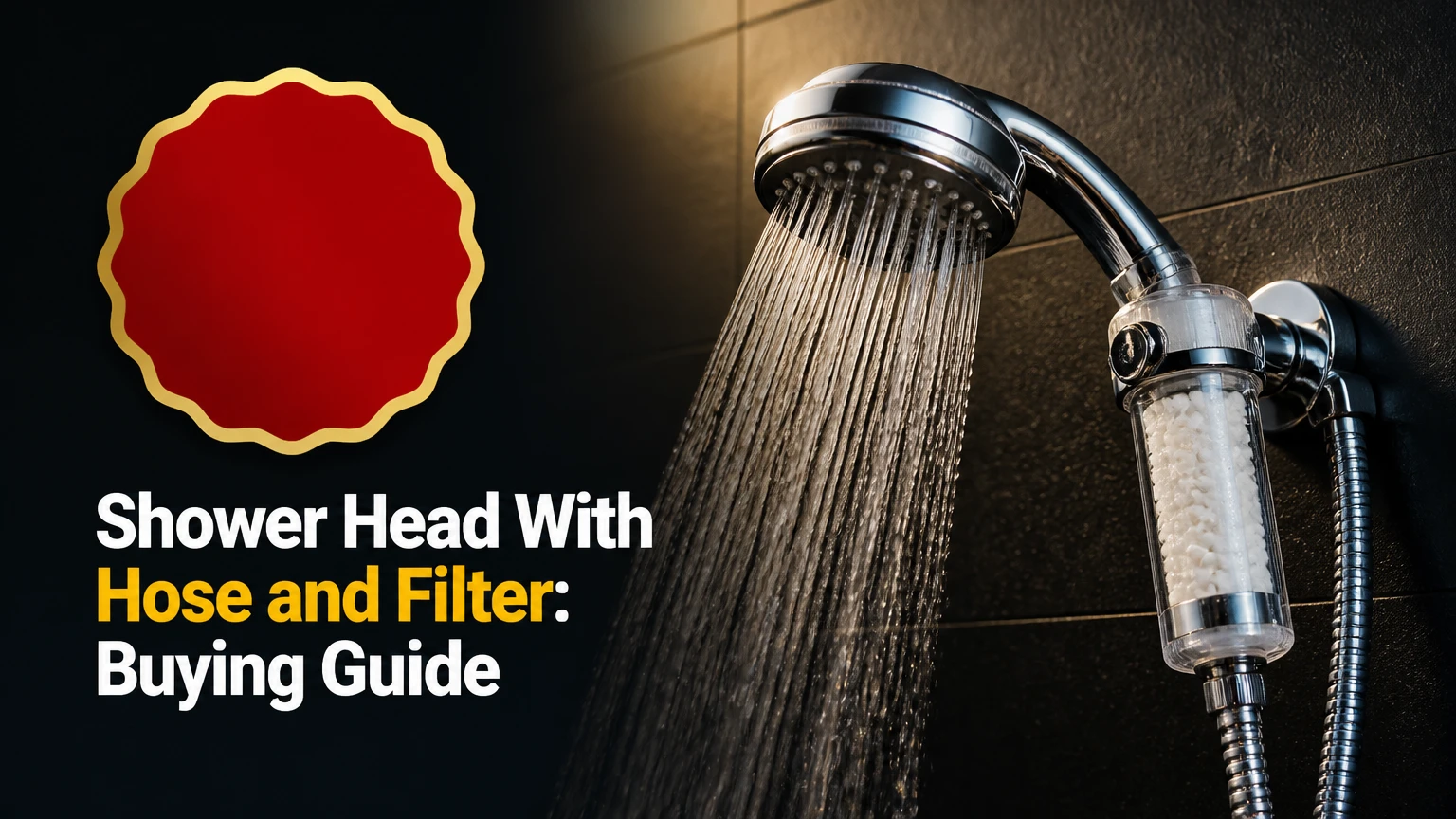
A shower head with hose and filter combines a handheld spray wand, flexible hose, mounting bracket, and replaceable water-treatment cartridge. The most useful models reduce free chlorine and sediment at the shower outlet, but they generally do not soften hard water, lower TDS, or guarantee heavy-metal removal unless an independently certified product provides that specific claim.
Key Facts
A filtered handheld shower head usually connects to a standard 1/2-inch shower fitting.
Typical hose lengths measure 59-72 inches, while common flow rates range from 1.8-2.5 GPM.
NSF/ANSI 177 addresses reduction of free available chlorine in shower filtration systems, not universal contaminant removal.
KDF, calcium sulfite, activated carbon, and vitamin C target different water compounds.
A shower filter can reduce chlorine odor while leaving dissolved calcium, magnesium, and TDS largely unchanged.
Cartridge life depends on incoming water quality, flow volume, household size, and the manufacturer’s rated capacity.
What Is a Shower Head With Hose and Filter?
A shower head with hose and filter is a point-of-use shower fixture that treats water immediately before spray output. The handheld wand moves through a flexible hose, while the cartridge may sit inside the wand, above the hose connection, or in a separate inline housing between the shower arm and bracket.
The configuration combines two separate functions. The hose provides reach for seated bathing, children, pets, mobility assistance, and cleaning; the cartridge exposes incoming water to sediment media or chemical-treatment media. A filter does not automatically make the entire bathroom water supply cleaner because only water passing through the shower assembly receives treatment.
The most important buying distinction is the treatment claim. A product described as “20-stage” or “30-stage” may contain several layers, but stage count does not measure capacity, contact time, chlorine reduction, or lead removal. Look for the exact contaminant, test condition, rated gallons, and certification rather than a large stage number.
What Does a Shower Filter Actually Remove?
A shower filter can reduce free chlorine, some sediment, and selected compounds when its media and test data support those claims. Most compact shower cartridges cannot reliably remove dissolved hardness minerals, fluoride, bacteria, all chloramines, or heavy metals across normal shower flow without a specific validated design.
Free chlorine is the most realistic target because chlorine-treatment media can react rapidly in warm water. Sediment screens can capture visible rust flakes or sand, although a shower filter is not a substitute for a whole-house sediment filter when the plumbing produces heavy debris.
Heavy-metal language requires caution. KDF media may reduce some soluble metals under appropriate conditions, but a consumer should treat “removes lead” as unverified unless the product has a recognized certification or accessible laboratory data for the actual cartridge and flow rate.
How Does a Filtered Handheld Shower Head Work?
Water enters the shower arm or diverter, travels through the filter housing and hose, and exits through the spray plate. Depending on the design, filtration occurs before the water enters the hose or inside the handheld handle, so the cartridge location affects replacement access, weight, and pressure loss.
A typical flow path is:
Shower arm or diverter → filter housing → hose → handheld wand → spray nozzles
A polypropylene or mesh layer traps larger particles first. KDF copper-zinc media can support oxidation-reduction reactions, calcium sulfite reacts quickly with free chlorine, and activated carbon adsorbs certain organic compounds and odors. Vitamin C media uses ascorbic acid chemistry and is commonly marketed for chlorine or chloramine treatment.
The cartridge must contact the water long enough for the reaction or adsorption to occur. A high-flow shower cartridge has less contact time than a low-flow drinking-water filter, which is why capacity and independent testing matter more than the number of media layers.
Where Should the Filter Be Located?
An inline filter above the hose usually offers easier cartridge replacement and keeps the handheld wand lighter. A handle-integrated cartridge creates a cleaner installation but can make the wand bulky, increase hand fatigue, and require replacement of a proprietary insert.
| Filter location | Typical replacement time | Handheld effect | Main limitation |
|---|---|---|---|
| Inline above bracket | 5-10 minutes | Keeps wand near 0.5-1.0 lb | Adds 3-6 inches of assembly height |
| Inside handheld handle | 5-15 minutes | May add 4-10 ounces | Can increase grip diameter |
| Behind fixed shower head | 5-10 minutes | No added wand weight | Does not filter a separate handheld outlet |
| Separate wall cartridge | 10-20 minutes | Depends on hose routing | Requires more wall clearance |
Which Filtration Media Should You Choose?
Calcium sulfite is usually the strongest choice for free-chlorine reduction in hot shower water, while activated carbon adds odor and organic-compound adsorption when the cartridge provides enough contact time. KDF can complement other media, and vitamin C is worth considering when a manufacturer documents chloramine treatment.
| Media | Primary target | Typical strength | Important limitation |
|---|---|---|---|
| Calcium sulfite | Free chlorine | Fast reaction in hot water | Does not soften water or remove TDS |
| KDF-55 | Free chlorine and selected metals | Durable redox media | Results depend on flow, pH, and contact time |
| Activated carbon | Odors and some organic compounds | Broad adsorption capability | Short shower contact time can limit capacity |
| Vitamin C | Free chlorine and some chloramine claims | Rapid chemical neutralization | Cartridge life and chloramine data vary widely |
| Polypropylene or mesh | Rust, sand, visible sediment | Physical particle capture | Does not remove dissolved chemicals |
Is KDF Better Than Calcium Sulfite?
KDF is not universally better than calcium sulfite. Calcium sulfite generally has a faster reaction with free chlorine in hot water, whereas KDF may provide broader media functionality when combined with sediment filtration and carbon.
KDF-55 consists of copper-zinc granules that support redox reactions. Product performance changes with pH, temperature, flow rate, chlorine concentration, and bed depth. A small shower cartridge operating at 2.5 GPM cannot be judged by laboratory performance from a much slower filter.
Does Vitamin C Remove Chloramine?
Vitamin C can neutralize chlorine, and ascorbic-acid systems may also address chloramine, but the claim requires product-specific evidence. Chloramine is more persistent than free chlorine, so a cartridge that only lists chlorine reduction should not be assumed to treat chloramine.
Ask the water supplier whether the distribution system uses free chlorine or chloramine. In the United States, annual consumer confidence reports identify the disinfectant used by many public systems, although treatment can vary by utility and season.
What Specifications Matter Before You Buy?
The most useful specifications are certified contaminant reduction, rated cartridge capacity, actual flow rate, hose length, connection type, replacement cost, and cartridge availability. A 1/2-inch connection is common, but thread and washer arrangements still require inspection before installation.
| Specification | Typical range or value | Buying implication |
|---|---|---|
| Flow rate | 1.8-2.5 GPM | Higher flow uses capacity faster and may reduce contact time |
| Hose length | 59-72 inches | 72 inches improves reach for pets and seated users |
| Connection | 1/2-inch shower fitting | Confirm regional thread and included washers |
| Cartridge interval | 3-6 months typical | Replace sooner with sediment-heavy or high-use water |
| Entry price | $25-$45 | Usually plastic housing and basic media |
| Premium price | $60-$120 | Often stronger fittings, finish, or cartridge design |
| Replacement cartridge | $10-$25 | Calculate annual ownership cost before purchase |
Flow rate deserves special attention. In the United States, federal showerhead standards commonly use 2.5 GPM as the maximum at 80 psi, while WaterSense-labeled models use no more than 2.0 GPM and must meet spray-force and coverage criteria. Local plumbing rules can differ.
Hose material also affects daily use. Stainless-steel exterior hoses resist abrasion, while nylon-braided hoses are often lighter and less likely to scratch a tub. A swivel connection reduces twisting, and a conical nut at the handheld end usually fits the wand more naturally than two identical straight couplings.
How Much Does a Filtered Shower System Cost?
A complete filtered handheld system typically costs $25-$120, with replacement cartridges adding approximately $20-$100 per year depending on replacement frequency and pack size. A low purchase price can become expensive when proprietary cartridges cost $20 each and last only eight weeks.
| Ownership tier | Fixture price | Cartridge price | Typical first-year total |
|---|---|---|---|
| Basic plastic | $25-$45 | $10-$18 | $45-$99 |
| Midrange inline | $45-$80 | $12-$22 | $69-$168 |
| Premium metal-finish | $60-$120 | $15-$25 | $90-$220 |
| Nonfiltered handheld | $15-$60 | $0 | $15-$60 |
These are typical retail ranges, not a guaranteed market quote. Installation usually costs nothing for a do-it-yourself replacement, while a plumber may charge a minimum service fee if the shower arm is corroded, seized, or improperly supported.
Which Users Benefit Most From a Filtered Handheld Shower Head?
Renters, pet owners, seated bathers, and households bothered by chlorine odor usually gain the clearest practical benefit. People with hard-water scale should treat a shower filter as a chlorine-control accessory, not as a water softener.
| User situation | Recommended configuration | Reason | Avoid if |
|---|---|---|---|
| Renter | Inline cartridge, 59-inch hose | Reversible connection and compact installation | Shower arm has damaged threads |
| Pet owner | 72-inch hose, pause button | Reach and water control during rinsing | Hose cannot hang without kinking |
| Seated bather | Lightweight wand, large bracket | Lower hand strain and easier reach | Wand exceeds comfortable grip size |
| Chlorine odor | Calcium sulfite or tested carbon | Targets free chlorine near the outlet | Utility uses chloramine without test data |
| Hard-water scale | Filter plus separate softener plan | Addresses chlorine and odor separately | Expectation is mineral removal |
| Low-pressure shower | 1.8-2.0 GPM, open spray plate | Preserves available pressure | Supply pressure is already inadequate |
A filtered shower head may reduce odor and irritation associated with disinfectant exposure, but it should not be presented as a treatment for eczema or other medical conditions. The American Academy of Dermatology recommends short, warm showers and regular moisturizer for dry skin; a filter cannot replace those measures or clinical care.
How Do You Install a Shower Head With Hose and Filter?
Most replacements take 10-20 minutes and require an adjustable wrench, cloth, fresh PTFE tape, and the supplied rubber washers. The success factor is identifying which joints seal with washers and which joints use tapered pipe threads before applying force or tape.
Step 1: Shut Off the Shower Water
Close the shower valves and open the existing shower head briefly to release residual pressure. Place a cloth over the fitting if the finish is easy to scratch.
Checkpoint: Water stops flowing before the old fitting is removed.
Common mistake: Turning the handle hard against a damaged valve instead of using the local shutoff.
Step 2: Remove the Existing Shower Head
Unscrew the old head by hand first, then use an adjustable wrench over a cloth if mineral scale has seized the connection. Hold the shower arm with a second wrench when necessary so the arm does not rotate inside the wall.
Checkpoint: The shower arm remains fixed and its exposed threads are undamaged.
Common mistake: Twisting the wall-mounted arm, which can loosen the concealed fitting and create a leak inside the wall.
Step 3: Clean and Inspect the Threads
Remove old tape, gasket fragments, and mineral deposits with a nylon brush. Inspect the exposed shower-arm threads, the bracket inlet, hose couplings, and every supplied washer.
Checkpoint: Threads are clean, and each washer sits flat in its coupling.
Common mistake: Reusing a flattened washer because it appears intact.
Step 4: Apply PTFE Tape Only to Tapered Threads
Wrap PTFE tape clockwise when facing the end of the male shower-arm threads, using three to five overlapping turns. Do not tape a hose coupling that seals against a rubber washer; tape can prevent the washer from seating correctly.
Checkpoint: Tape remains tight while the female fitting starts by hand.
Common mistake: Wrapping counterclockwise, which causes the tape to bunch during installation.
Step 5: Install the Filter Housing and Bracket
Thread the inline filter or mounting bracket onto the shower arm by hand. Tighten only enough to orient the outlet and stop leakage, usually an additional quarter-turn with a wrench if the manufacturer permits tool tightening.
Checkpoint: The bracket points downward and does not rotate under the weight of the wand.
Common mistake: Over-tightening a plastic housing until the inlet cracks.
Step 6: Connect the Hose and Handheld Wand
Place a flat rubber washer into both hose couplings, then attach one end to the bracket and the other to the wand. Hand-tighten each coupling; use a wrench only when the instructions specifically permit it.
Checkpoint: Both washers remain centered after tightening.
Common mistake: Installing the hose without a washer and trying to compensate with extra tape.
Step 7: Flush and Leak-Test the Cartridge
Run cool or warm water through the assembly for 60-120 seconds, or follow the cartridge instructions when they specify a longer flush. Hold the wand over the drain and inspect every joint while switching spray modes.
Checkpoint: Water runs clear, carbon dust disappears, and no joint forms a bead after two minutes.
Common mistake: Taking a first shower before flushing loose carbon fines.
How Should You Maintain the Cartridge and Hose?
Replace the cartridge according to the rated gallon capacity or the manufacturer’s time limit, whichever occurs first. For typical two-person use, three to six months is a reasonable planning interval, but a visibly clogged sediment layer, odor return, or pressure decline can require earlier replacement.
Do not rinse disposable carbon, KDF, or calcium-sulfite cartridges under a faucet unless the manufacturer explicitly permits it. Rinsing can redistribute fines without restoring exhausted chemical capacity. Clean reusable spray nozzles with a soft brush, and use a manufacturer-approved descaling method rather than soaking unknown finishes in vinegar.
The hose needs a separate inspection. Replace it when the braid frays, coupling corrodes, inner tubing kinks permanently, or water appears at the crimp. A good shower filter cannot compensate for a restricted hose.
Shower Filter Versus Water Softener: Which Is Better?
A shower filter is better for localized chlorine control and inexpensive installation, while a water softener is better for dissolved calcium and magnesium that create scale. A whole-house filter is better when sediment or disinfectant affects every fixture rather than only the shower.
| Option | Main target | Installation scope | Typical cost | What it does not solve |
|---|---|---|---|---|
| Filtered handheld | Chlorine, odor, sediment | One shower | $25-$120 | Hardness, TDS, whole-home water |
| Salt-based softener | Calcium and magnesium | Whole house | $500-$2,500 installed | Chlorine odor at every outlet |
| Whole-house carbon filter | Chlorine and organics | Main water line | $500-$2,000 | Hardness minerals |
| Unfiltered handheld | Reach and mobility | One shower | $15-$60 | Water chemistry |
| Under-sink drinking filter | Drinking-water contaminants | Kitchen cold line | $100-$600 | Shower water and mobility |
The distinction is measurable. A TDS meter may continue showing similar readings after a shower filter reduces chlorine because dissolved minerals remain in the water. That result does not prove the cartridge failed; it demonstrates that TDS is not a chlorine test.
What Problems Can Occur?
Low pressure, leaks, black carbon dust, cartridge bypass, and premature clogging are the most common failure modes. Each problem has a different fix, so replacing the cartridge without inspecting the installation can waste money.
Why Did Water Pressure Drop?
A clogged sediment layer, undersized cartridge, spray-plate buildup, kinked hose, or factory flow restrictor can reduce output. Test the shower with the cartridge removed only briefly for diagnosis, then reinstall the cartridge and preserve any restrictor required by local code or the product instructions.
A filter causing a gradual decline after weeks of use probably has exhausted or clogged media. A pressure problem present from the first use more often indicates a restrictive design, incorrect washer placement, a closed diverter, or low household supply pressure.
Why Is the Hose Connection Leaking?
A hose coupling usually leaks because its flat washer is missing, twisted, damaged, or misaligned. Remove the coupling, seat the washer flat, and retighten by hand; adding PTFE tape to a washer-sealed hose joint is usually the wrong repair.
Tape belongs on tapered pipe threads such as a shower arm connection. Washer-sealed couplings depend on compression, and extra tape can create a false sense of tightness while the rubber seal remains uneven.
Why Is Black or Gray Water Coming Out?
Loose activated-carbon fines can make first-use water appear gray or black. Flush the cartridge for the manufacturer’s stated duration, commonly 60-120 seconds, and continue until the water clears.
Persistent black particles after flushing suggest a deteriorating cartridge, broken media bed, or contaminated hose. Stop using the unit and replace the cartridge; do not treat continuing discoloration as normal.
Can a Shower Filter Grow Bacteria?
A wet cartridge can accumulate microbial growth when it remains installed beyond its rated life, especially where sediment and warm standing water are present. Replacement schedules reduce that risk, but a shower filter is not a sterilizer and does not make biologically unsafe water safe.
Replace a cartridge after prolonged nonuse, flooding, visible biofilm, or an unexplained odor. Households with immunocompromised occupants should follow medical and public-health advice rather than relying on a consumer shower cartridge.
How Do You Choose the Right Model?
Choose by verified contaminant claim first, cartridge economics second, and hose ergonomics third. A practical shortlist should include an independently certified chlorine-reduction model, a replacement cartridge available from a stable supplier, a 59-72 inch hose, and a bracket that supports the wand securely.
Before ordering, verify these points:
- The product lists free chlorine or chloramine specifically, not only “impurities.”
- Certification applies to the complete system, not merely a raw media ingredient.
- The replacement cartridge has a stated capacity and current retail availability.
- The connection uses the correct 1/2-inch fitting and supplied washers.
- The flow rate suits the home’s existing pressure.
- The hose length reaches the intended user without resting on the floor.
- The return policy covers leaks, cracked housings, and incompatible fittings.
- The cartridge can be changed without replacing the entire wand.
The best overall configuration for many households is an inline calcium-sulfite or mixed-media filter with a 72-inch swivel hose and a lightweight handheld wand. A renter may prefer a compact 59-inch model, while a hard-water household should budget for a genuine softening solution if mineral scale is the main complaint.
Frequently Asked Questions
Does a filtered shower head remove hard-water scale?
A filtered shower head generally does not remove the dissolved calcium and magnesium that cause hard-water scale. Calcium sulfite, KDF, carbon, and vitamin C target chemical disinfectants or selected compounds, whereas ion-exchange softeners remove hardness ions. Use a shower filter for chlorine concerns and a softener for persistent mineral deposits.
Are shower filters certified?
Some shower filtration systems carry certification to NSF/ANSI 177, which concerns reduction of free available chlorine. Certification does not automatically mean lead, fluoride, chloramine, bacteria, or hardness removal. Check the certifier’s listing and the exact model number, because a marketing statement about one tested component is not equivalent to certification of the complete fixture.
Is a 72-inch hose better than a 59-inch hose?
A 72-inch hose provides greater reach for bathing pets, washing children, and seated showering, but it weighs more and creates more opportunities for kinks or floor contact. A 59-inch hose is easier to manage in a compact enclosure. Select the shortest length that reaches the user comfortably, with a swivel coupling whenever possible.
Can you use a filtered handheld shower head in an apartment?
Most filtered handheld shower heads attach to the existing shower arm without permanent plumbing changes, making them suitable for renters. Keep the original fixture, avoid drilling, and inspect the shower arm before installation. A damaged or nonstandard fitting may require landlord approval or a plumber even when the filter itself is reversible.
Will a shower filter improve low water pressure?
A shower filter cannot create additional supply pressure. A spray plate may make the stream feel stronger by concentrating water, but clogged media, a restrictive cartridge, or a flow regulator can reduce actual flow. Measure the baseline, inspect the hose for kinks, and choose a 1.8-2.0 GPM model when the home already has weak pressure.
How often should you replace a shower filter?
Replace a shower filter every three to six months as a typical planning range, or sooner when the rated gallon capacity is reached, pressure falls, odor returns, or sediment blocks the cartridge. High-flow households, rusty plumbing, and chloramine treatment can shorten the interval. Record the installation date on the housing.
The Bottom Line
A shower head with hose and filter is a sensible localized upgrade when the goal is handheld reach plus reduced chlorine, odor, or visible sediment. Choose tested media, verify the 1/2-inch connection, calculate cartridge cost, and remember that a filter is not a softener, TDS reducer, or universal heavy-metal treatment.