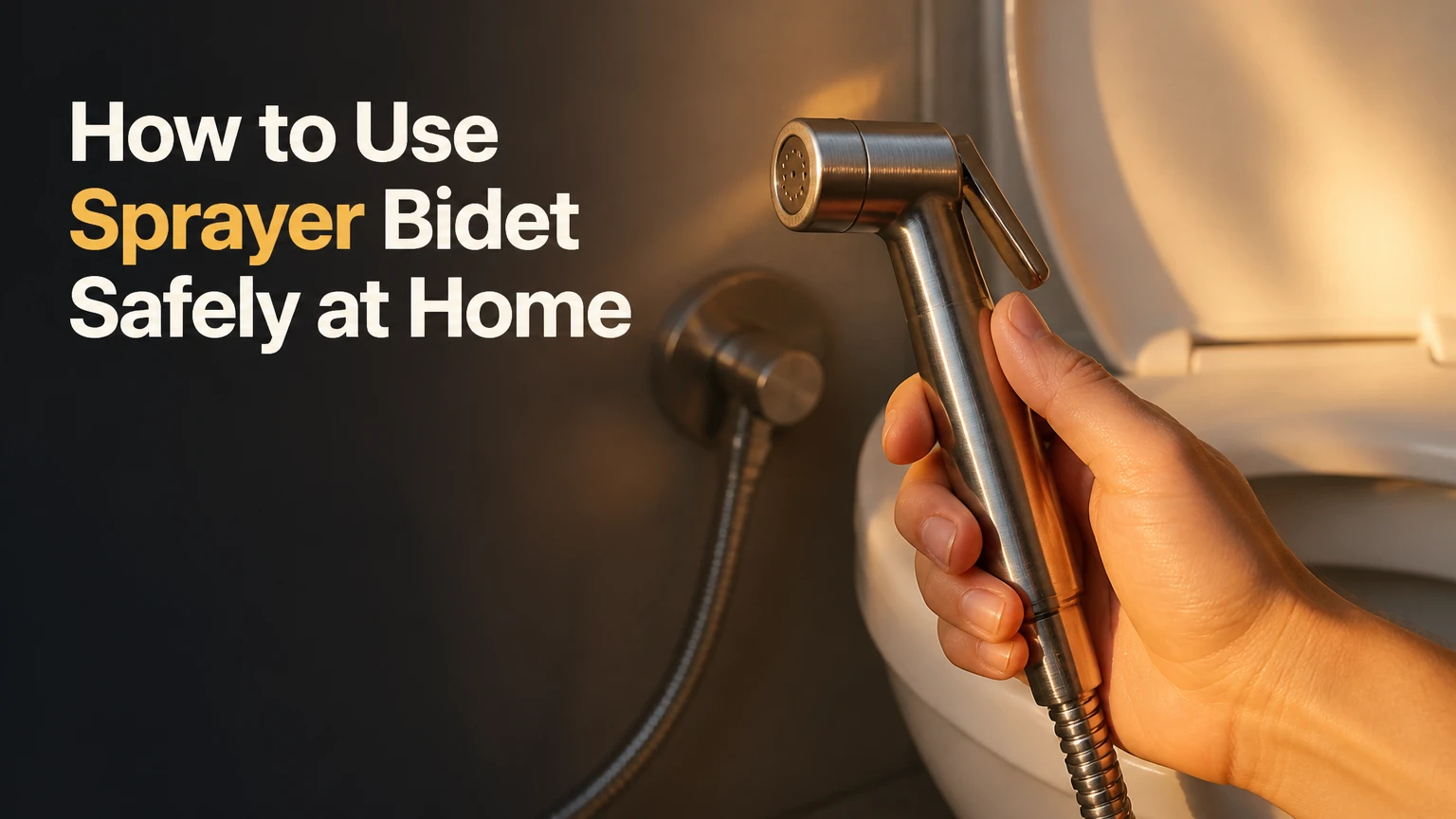
To use a sprayer bidet, point the handheld nozzle into the toilet bowl, test the stream, sit securely, aim from the front or rear without touching skin, and squeeze the trigger gradually. Rinse until clean, release the trigger, pat dry, close the supply shutoff valve, and return the wand to its holder.
Key Facts at a Glance
- A handheld sprayer bidet receives water through a T-adapter connected to the toilet’s cold-water supply line.
- The trigger controls flow at the wand, but the hose may remain pressurized while the wall shutoff valve is open.
- A typical first-use routine takes 2-5 minutes, including rinsing and drying.
- Gentle pressure is usually more comfortable and creates less splash than opening the trigger fully.
- Users should close the dedicated shutoff valve after use unless the product manufacturer specifically provides another safe procedure.
- A warm-water handheld system requires a suitable nearby hot-water connection, a mixing valve, and plumbing compatible with the installation instructions.
What Is a Sprayer Bidet and How Does It Work?
A sprayer bidet is a manually aimed personal cleansing nozzle connected by a flexible hose to a bathroom water supply. The same device may be called a handheld bidet, bidet shower, bum gun, shattaf, or health faucet. A spring-loaded trigger opens the valve in the handle and releases a directed stream.
Most toilet-mounted kits use this water path:
Wall shutoff valve → T-adapter → toilet fill valve and hose → handheld sprayer
The T-adapter divides the incoming water. One branch continues to the toilet tank, while the other branch feeds the bidet hose. The trigger changes the water flow, but it does not necessarily remove pressure from the hose when released. That distinction explains why a damaged hose can leak even when nobody is spraying.
A handheld sprayer is different from a bidet seat. A seat has a fixed nozzle under the rim, while a handheld wand depends on the user for aiming, distance, pressure, and timing. The extra control is useful for cleaning a toilet, washing reusable diapers, or reaching different body positions, but it also creates more opportunity for overspray.
How to Use Sprayer Bidet: 7 Steps
A safe handheld bidet routine has seven steps and normally takes 2-5 minutes. The factor that most affects success is initial water control: test the stream inside the bowl, then open the trigger slowly while keeping the nozzle several inches away from the body.
Before You Start
| Requirement | Typical specification | Why it matters |
|---|---|---|
| Time | 2-5 minutes per use | Allows rinsing, dripping, and drying |
| Difficulty | Low, moderate hand control | Requires aiming and trigger pressure |
| Water connection | 1 toilet supply line and 1 compatible T-adapter | Supplies the wand without removing the tank |
| Tools for setup | Adjustable wrench, cloth, bucket | Supports connection and leak testing |
| Drying material | 2-4 toilet-paper squares or 1 washable cloth | Removes residual water |
| Safety check | Shutoff valve, intact hose, seated washers | Reduces leak and pressure risk |
Read the sprayer instructions before connecting it. Check whether the kit includes a rubber washer, a backflow preventer, and a shutoff valve. A toilet with a rigid or unusual supply connection may need a different adapter, and a bidet should not be forced onto mismatched threads.
Step 1: Locate the Wand and Check the Valve
Take the sprayer from its holder and identify the small shutoff valve near the wall or toilet supply connection. Keep the valve partially open for the first test, especially if the sprayer has no separate pressure limiter.
Point the nozzle into the center of the bowl before touching the trigger. Squeeze for one second, release it, and inspect the stream. This test clears standing water from the hose and reveals whether the connection leaks.
You will know it worked when: water stays inside the bowl and the handle, hose, and T-adapter remain dry.
Common mistake: testing beside the toilet or aiming at the rim. A narrow jet can rebound from porcelain and wet the floor.
Step 2: Choose a Stable Position
Sit fully on the toilet seat and keep both feet supported by the floor. A person usually reaches the perineal or anal area from the front by leaning slightly forward, or from behind by reaching between or around the legs, depending on toilet shape and personal mobility.
Keep the nozzle outside the body. Aim toward the area being cleaned from a short distance, usually about 5-10 centimeters, and begin with a downward or shallow upward angle rather than an aggressive 45-degree jet. The correct angle depends on the bowl, seat height, nozzle shape, and anatomy.
For vulvar hygiene, direct water from front to back when rinsing the external area. For anal cleaning, aim the stream at the anus without directing contaminated water toward the urethra or vulva. The important rule is to prevent water and residue from traveling from the anal area toward the urinary or vaginal area.
You will know it worked when: the nozzle remains visible, controlled, and away from skin contact.
Common mistake: leaning too far forward and spraying the underside of the seat. Lower the nozzle and reduce the trigger opening.
Step 3: Squeeze the Trigger Gradually
Press the trigger slightly to start a low-volume stream. Hold the nozzle steady for a moment, then increase flow only if the initial pressure feels comfortable and remains inside the bowl.
Move the stream across the soiled area in small, controlled motions. Do not scrub skin with the nozzle, and do not press the sprayer against the anus or vulva. Most users need less water than expected because a focused stream loosens residue quickly.
A fixed 10-20-second duration is only a rough starting point. Stop when the rinse water and tissue test show that residue is gone; prolonged high-pressure spraying can irritate skin even when the water feels comfortable at first.
You will know it worked when: residue is removed without pain, stinging, or water leaving the bowl.
Common mistake: opening the trigger fully before aiming. Release the trigger, reset the nozzle inside the bowl, and restart at low pressure.
Step 4: Rinse in the Correct Direction
Use a short final rinse after the main residue has cleared. People with a vulva should avoid directing used rinse water from the anus toward the urethral opening, because mechanical transfer of fecal bacteria is an avoidable hygiene risk.
A sprayer bidet cleans external tissue. It should not be inserted into the vagina or rectum, and forceful internal rinsing is unnecessary. People with hemorrhoids, fissures, recent surgery, or sensitive skin should use low pressure and stop if bleeding or pain increases.
You will know it worked when: the skin feels clean without persistent irritation or a feeling of pressure.
Common mistake: treating the wand like an internal douche. Keep the nozzle outside the body and use only a gentle external rinse.
Step 5: Release the Trigger Completely
Let go of the trigger before moving the wand. Hold the nozzle over the bowl for several seconds so water in the head can drain, then place the sprayer in its holder without allowing the wet tip to touch the floor.
Check the handle while the trigger is released. A continuing stream indicates a stuck valve, debris, or a damaged cartridge. A drip from the hose connection may indicate a loose fitting or displaced washer.
You will know it worked when: flow stops immediately and the wand can be stored without dripping onto nearby surfaces.
Common mistake: returning the wand while still pressing the trigger. That can spray the wall, seat, or user’s clothing.
Step 6: Pat Dry
Allow excess water to drip into the bowl, then pat dry with a small amount of toilet paper or a dedicated washable cloth. Patting reduces friction compared with vigorous wiping, which matters for irritated skin, hemorrhoids, and postpartum sensitivity.
Do not share a reusable drying cloth between people. Wash personal cloths with detergent and dry them fully. Toilet paper can still be useful, but the usual amount is lower because the water performs the primary cleaning.
You will know it worked when: the skin is dry enough for clothing without rubbing or repeated wiping.
Common mistake: using a cloth that stays damp in the bathroom. Replace it with a clean, dry cloth and wash used ones regularly.
Step 7: Close the Shutoff Valve
After every use, turn the dedicated bidet shutoff valve toward the closed position, then release any residual pressure by briefly squeezing the trigger while the nozzle points into the bowl. Release the trigger and return the wand to its holder.
Some manufacturers provide pressure-rated hoses and instructions that differ from this routine, so follow the supplied manual when it specifies a different procedure. In general, removing static pressure from a flexible hose reduces the consequence of a failed washer, handle, or hose.
You will know it worked when: the valve is closed, the trigger produces no sustained stream, and the hose is not taut.
Common mistake: closing the trigger but leaving the wall valve open. The wand appears off, but the hose may remain connected to household line pressure.
How Should You Clean the Sprayer Bidet?
Clean the nozzle and handle weekly, or more often in a shared bathroom, with mild soap and water followed by a clean rinse. Do not immerse a trigger handle unless the manufacturer permits it, and do not use abrasive powders, bleach mixtures, or harsh descalers that can damage seals and finishes.
Wipe the hose and holder during routine bathroom cleaning. If mineral deposits restrict the nozzle, remove the head only when the supply valve is closed, then follow the product instructions for descaling. A short soak in diluted white vinegar may suit some metal components, but vinegar can damage certain finishes and should not be assumed safe for every kit.
The wand should never touch feces, the floor, or the inside of the toilet drain. If contact occurs, wash and disinfect the affected surface according to the cleaner label, then rinse the sprayer thoroughly to prevent chemical residue on skin.
Which Sprayer Bidet Type Fits Your Bathroom?
The best handheld bidet type depends on construction, temperature, connection, and the user’s control needs. Stainless steel or brass kits generally tolerate bathroom use better than inexpensive plastic, while a warm-water kit adds comfort but also adds installation complexity and another failure point.
| Sprayer type | Typical connection | Water temperature | Typical price | Best fit |
|---|---|---|---|---|
| ABS plastic kit | Toilet cold-water line | 10-25°C, plumbing dependent | $15-$30 | Low-cost trial or light use |
| Stainless steel kit | Toilet cold-water line | 10-25°C, plumbing dependent | $25-$65 | Frequent household use |
| Brass valve kit | Toilet line with metal valve | 10-25°C, plumbing dependent | $35-$80 | Durable valve and repairability |
| Dual-temperature kit | Toilet line plus sink hot-water line | 30-40°C, adjustable | $50-$120 | Cold climates and temperature-sensitive users |
| Portable squeeze bottle | No plumbing connection | Stored water temperature | $8-$35 | Travel and rental restrictions |
Product lifespans cannot be guaranteed from material alone. A plastic handle exposed to high pressure may fail sooner than a metal one, while a metal hose with poor connectors can still leak. Inspect the hose, washers, trigger, and shutoff valve rather than relying on a finish label.
Is Cold Water Comfortable and Safe?
Cold tap water is generally usable for external cleansing, but comfort varies with climate, plumbing temperature, skin sensitivity, and the user’s medical situation. A standard toilet-connected sprayer normally uses cold supply water, so test the temperature in the bowl before aiming at skin.
A warm-water system requires a mixing valve and a nearby compatible hot-water line, commonly beneath an adjacent sink. The installer must prevent excessively hot water, preserve correct flow, and follow local plumbing requirements. Never connect a hot line directly to a cold-only sprayer unless the product instructions explicitly allow that configuration.
Warm water improves comfort for some people, but it does not automatically improve cleaning. Pressure, aim, nozzle hygiene, and drying matter more than temperature.
How Does a Handheld Sprayer Compare With Other Bidets?
A handheld sprayer offers the lowest entry cost and the greatest aiming flexibility, while a bidet seat provides more consistent positioning and an electronic model adds heat and drying. The right choice depends primarily on dexterity, bathroom access, installation limits, and whether hands-free operation matters.
| Option | Typical cost | Installation time | Temperature features | Control requirement |
|---|---|---|---|---|
| Handheld cold-water sprayer | $15-$65 | 10-30 minutes | Ambient cold water | High hand and aiming control |
| Handheld warm-water system | $50-$120 | 30-90 minutes | Mixed warm water | High hand and aiming control |
| Non-electric bidet seat | $40-$150 | 20-45 minutes | Ambient or limited warm water | Moderate positioning control |
| Electronic bidet seat | $200-$1,000+ | 30-90 minutes | Heated water, seat, air dryer | Low manual control, electrical outlet needed |
| Portable bottle bidet | $8-$35 | Under 2 minutes | Stored water temperature | Moderate squeezing and aiming |
A handheld unit is particularly useful for renters, cloth-diaper washing, and users who want to control the exact spray location. It is a poor choice for someone who cannot safely reach behind or beside the toilet, cannot regulate trigger pressure, or needs a consistently positioned, hands-free wash.
What Changes for Renters, Families, and Mobility-Limited Users?
Renters should choose a reversible toilet-supply installation with no drilling, pipe cutting, or permanent wall attachment. Keep the original supply hose and valve parts so the bathroom can be restored when moving, and verify that the lease or building rules permit bidet plumbing.
Families using a sprayer for cloth diapers should use a dedicated diaper-spray setup if possible. A low-pressure control, splash shield, or laundry sink is safer than spraying a soiled diaper at full pressure over an open toilet, where aerosolized droplets and rebound water can spread contamination.
Older adults and people with limited mobility may find a handheld wand difficult because it requires grip strength, trunk rotation, and accurate aim. A non-electric or electronic bidet seat may provide safer positioning, but the seat height, transfer space, controls, and electrical protection still need evaluation.
Pregnant or postpartum users may prefer gentle external rinsing, but pain, heavy bleeding, fever, or worsening symptoms require medical advice rather than stronger spraying. A bidet is a hygiene tool, not treatment for infection or injury.
How Much Does a Sprayer Bidet Cost?
A basic cold-water kit typically costs $15-$65, while warm-water systems commonly cost $50-$120 before labor. Professional installation often adds approximately $80-$150 for a straightforward toilet connection, although access problems, replacement valves, and local rates can increase the total.
| Expense | Typical range | Main cost variable | Replacement interval |
|---|---|---|---|
| ABS cold-water kit | $15-$30 | Plastic quality and included valve | 2-5 years, highly variable |
| Stainless steel kit | $25-$65 | Hose, valve, and finish quality | 3-10+ years, highly variable |
| Warm-water mixing kit | $50-$120 | Mixing valve and second hose | 3-10 years, product dependent |
| Replacement hose | $10-$30 | Length, braid, and fittings | Replace at first bulge or leak |
| Replacement washers | $2-$10 | Size and material | Replace when flattened or cracked |
| Plumber labor | $80-$150 typical | Access and local rates | One-time installation |
These are typical consumer price ranges, not fixed market prices. A low purchase price is not economical if the kit lacks a shutoff valve, has incompatible threads, or uses a hose that cannot tolerate the home’s water pressure.
What Are the Most Common Mistakes?
The most serious user error is leaving a flexible bidet hose pressurized indefinitely, because a failed connection can release water when the bathroom is unattended. The most common hygiene error is aiming contaminated rinse water toward the urethra or vulva, while the most common comfort error is opening the trigger too quickly.
- Leaving the supply valve open: Close the dedicated valve after use and inspect it weekly for seepage.
- Starting at full pressure: Test in the bowl, then begin with a narrow stream.
- Aiming at the seat or rim: Keep the nozzle inside the bowl until flow is controlled.
- Touching skin with the nozzle: Maintain a small gap and clean the wand regularly.
- Using harsh cleaners: Use mild soap unless the manufacturer specifies a compatible descaler.
- Relying on a rigid direction rule: Rinse external vulvar tissue front to back, but aim anal cleaning directly at the anus without carrying water forward.
A practitioner rule of thumb is simple: if the spray feels forceful on the palm of your hand, reduce the valve opening or trigger pressure before using it on sensitive skin. Household pressure can differ substantially between homes, floors, and times of day, so a universal PSI setting is less useful than a controlled first test.
How Do You Fix Leaks and Pressure Problems?
Most sprayer leaks come from a loose fitting, a displaced washer, a cracked hose, or a worn trigger valve. Close the wall shutoff valve first, dry the assembly, identify the exact leak point, and replace the damaged seal or component rather than wrapping every connection with tape.
| Symptom | Likely cause | Safe first action | Escalate when |
|---|---|---|---|
| Drip at hose connection | Flat or displaced washer | Close valve and reseat washer | Drip continues after replacement |
| Leak from handle seam | Worn internal valve or crack | Replace handle assembly | Handle remains wet under pressure |
| Spray continues after release | Stuck trigger valve | Close supply valve immediately | Valve does not stop flow |
| Weak stream | Mineral deposits or partly closed valve | Open supply valve and clean nozzle | Flow remains weak after cleaning |
| Painful stream | Excessive household pressure | Partly close shutoff valve | Pressure remains unsafe |
| Hose bulge or split | Material failure | Stop use and replace hose | Water has reached wall or flooring |
Do not disassemble a pressurized handle. If water enters a wall, ceiling, vanity, or electrical outlet, shut off the bathroom supply if safe and contact a qualified plumber. A hose that has swollen, kinked, corroded, or developed a pinhole should be replaced, not patched.
What Should You Check Before Installing One?
Confirm that the toilet has an accessible shutoff valve, a removable supply hose, enough clearance for the T-adapter, and a holder location that keeps the wand above the floor. A compatible backflow-prevention device may be required by local plumbing rules or supplied by the manufacturer.
Turn off the toilet valve and flush before disconnecting the hose. Place a bucket and towel underneath because residual water will drain from the line. Hand-tighten the new connections first, then use a wrench for a small additional turn; over-tightening can deform a washer or crack a plastic fitting.
Restore water slowly and inspect every joint for at least five minutes. Flush the toilet, test the sprayer into the bowl, and inspect the connections again. If the toilet fill valve no longer operates, the tank does not refill, or the adapter threads do not match, stop and obtain the correct part instead of forcing the connection.
FAQ
Can a sprayer bidet replace toilet paper completely?
A sprayer bidet can remove most of the cleaning work, but many users still use a small amount of toilet paper or a personal cloth to dry. Complete elimination depends on comfort, bathroom layout, skin sensitivity, and whether the user can dry effectively without rubbing.
Can children use a handheld bidet?
Children can use a handheld bidet only with age-appropriate supervision and low pressure. An adult should teach the child to aim into the bowl, keep the nozzle outside the body, close the valve, and avoid spraying floors, walls, or other people.
Can a bidet sprayer cause a urinary tract infection?
A properly used sprayer does not inherently cause a urinary tract infection, but contaminated water direction and poor nozzle hygiene can transfer bacteria. Users with a vulva should rinse external tissue front to back, keep the nozzle clean, and seek medical care for burning, fever, or persistent urinary symptoms.
Should you use soap with a bidet sprayer?
Soap is usually unnecessary for routine genital or anal rinsing and can irritate sensitive tissue. Use clean water for the body, then mild soap on the external handle and nozzle during cleaning, following the manufacturer’s instructions for materials and finishes.
Why does the bidet spray water everywhere?
Splashing usually results from excessive pressure, a nozzle held too close to the bowl surface, or an angle aimed at the rim or seat. Reduce the shutoff opening, keep the nozzle inside the bowl, and begin with a short low-pressure test.
How often should you replace the hose?
Replace a bidet hose immediately when it shows corrosion, bulging, kinks, cracking, or seepage. Without visible damage, inspect it monthly and follow the manufacturer’s service guidance, because lifespan varies more by material, pressure, water quality, and installation than by a universal calendar interval.
The Bottom Line
To use a sprayer bidet safely, test the nozzle in the bowl, sit securely, aim externally, start with low pressure, rinse in a direction that avoids contamination, pat dry, and close the supply valve afterward. The routine takes only a few minutes, but correct positioning, leak checks, and pressure control determine whether a sprayer bidet is comfortable and safe.