To fix cloudy hot water, first fill a clear glass and watch whether the whiteness disappears from the bottom upward within 1-2 minutes. Rising-and-clearing bubbles usually require no repair, while persistent cloudiness, particles, discoloration, or odor points to scale, sediment, corrosion, bacteria, or a water-supply problem that needs targeted service.
Key facts at a glance
Dissolved air is the most common cause of hot water that looks white but clears quickly.
Bottom-up clearing indicates microbubbles; particles that remain or settle indicate suspended material.
Cloudy water with a rotten-egg odor, brown tint, or metallic taste should not be treated as harmless air.
A pressure reading above 80 PSI requires plumbing evaluation and may indicate a failed pressure-reducing valve.
Tank water heaters may need flushing, but opening an old drain valve can create a leak.
Never restore power to an electric water heater until the tank is completely full and purged of air.
How to Fix Cloudy Hot Water: Start With Diagnosis
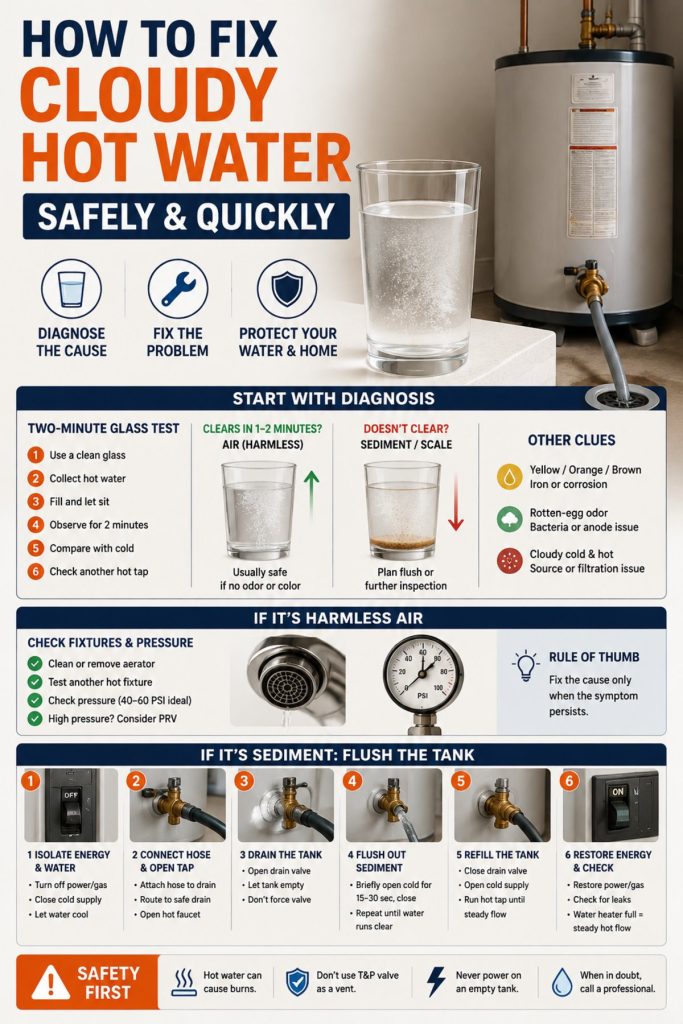
Cloudy hot water should be diagnosed before the water heater is flushed or parts are replaced. A clean glass, a cold-water comparison, and observations about clearing, particles, color, taste, and odor usually identify the correct branch of the repair.
A common mistake is assuming every white appearance means hard-water scale. Air bubbles often appear only in heated water because temperature changes reduce gas solubility, while mineral particles remain visible after the sample stands. The correct repair differs completely: air needs observation or aerator service, whereas sediment may require tank maintenance.
Step 1: Run the two-minute glass test
- Use a clean, transparent glass with no detergent residue.
- Collect water from the affected hot tap without disturbing the sample.
- Fill the glass and place it on a level surface.
- Start a timer and observe the glass for two minutes.
- Take a second sample from the cold side of the same fixture.
- Compare the hot sample with water from another hot fixture.
You will know the sample contains mostly air when the glass clears from the bottom upward, often within 30-120 seconds. You may see a fine layer of bubbles cling to the glass, and the water should become transparent without leaving grit.
Common mistake: judging the water while it is still flowing. Faucet aerators can inject air into the stream, so the glass must be observed after collection.
How should the clearing pattern be interpreted?
The clearing pattern is more useful than the word “cloudy.” Air bubbles rise and disappear, while sediment settles, remains suspended, or leaves a visible residue on the glass.
| Observation in glass | Likely cause | Immediate action | Typical urgency |
|---|---|---|---|
| Clears bottom-up in 30-120 seconds | Dissolved air | Retest another fixture; inspect aerator | Low |
| Fine white grains settle in 2-10 minutes | Calcium carbonate or tank sediment | Plan flush or professional inspection | Moderate |
| White flakes remain floating | Scale, anode residue, or dip-tube plastic | Stop assuming air; inspect heater | Moderate |
| Yellow, orange, brown, or red tint | Iron, corrosion, or disturbed sediment | Avoid drinking until source is identified | Moderate-high |
| Rotten-egg odor from hot side | Hydrogen sulfide, bacteria, or anode reaction | Arrange heater and water-quality diagnosis | High |
| Cloudy cold and hot water throughout home | Utility, well, or whole-house filtration issue | Contact supplier or test source water | Variable |
A sample that clears rapidly is generally safe for drinking only when the cold supply is already potable and the water has no unusual odor, color, taste, or contamination advisory. Air itself is not a contaminant, but appearance alone cannot certify water safety.
Why does hot water turn cloudy?
Hot water turns cloudy when dissolved gases leave the water as microscopic bubbles after heating and pressure changes. Cold mains water can hold more dissolved air than warm water, and opening a faucet lowers pressure enough for that air to come out of solution.
The process resembles bubbles in a freshly opened carbonated drink, although household water is not carbonated. Water enters a pressurized service line, passes through a heater or hot-water pipe, and reaches the faucet after its temperature and pressure have changed. The tiny bubbles scatter light, creating a white or milky appearance.
A faucet aerator can make the effect more visible because its screen mixes air into the stream. Winter water, well-pump aeration, a recently disturbed supply line, and elevated static pressure can increase the amount of visible bubbling. Air cloudiness does not usually damage a water heater.
Which symptoms indicate scale instead of air?
Scale or sediment is more likely when cloudiness persists beyond two minutes, leaves powder at the bottom, clogs faucet screens, or appears after a tank heater has been disturbed. Heated hard water can deposit calcium and magnesium minerals inside the tank, especially near the heating element or burner region.
The diagnosis becomes stronger when hot water is affected at every fixture but cold water remains clear. A tank that rumbles, pops, heats slowly, or produces reduced hot-water volume may contain a substantial mineral layer. Scale reduces heat transfer and can raise energy use, although the amount varies by heater design and water chemistry.
Can a faucet aerator cause cloudy hot water?
A faucet aerator can intensify visible cloudiness, but it usually does not create a water-quality problem by itself. Remove the aerator by turning it counterclockwise, rinse its screen, and collect a new sample from the faucet with the aerator removed.
If the stream becomes visibly clearer without the aerator, replace a clogged screen or choose a laminar-flow aerator. Laminar-flow models produce a more coherent stream and generally mix less air than standard “cache” aerators. This is a low-cost test, not a substitute for investigating odor, color, or persistent particles.
What should you do if the cloudiness is harmless air?
Leave air-bubble cloudiness alone if the water clears completely within two minutes and has no unusual color, taste, or odor. Aerator cleaning, a pressure check, and comparison with another fixture can reduce the appearance when the bubbles are inconvenient.
Step 2: Check the fixture and household pressure
- Remove and clean the affected aerator.
- Run the hot tap for 30 seconds, then collect another glass.
- Repeat the test at a bathtub spout or another hot fixture.
- Attach a screw-on pressure gauge to a hose connection.
- Record pressure when no fixtures are running and while a tap flows.
A typical residential pressure range is approximately 40-60 PSI. Many plumbing authorities treat sustained pressure above 80 PSI as excessive, and the International Plumbing Code commonly limits system pressure to 80 PSI unless appropriate control equipment is installed. Pressure above that threshold does not prove that pressure caused cloudy water, but it warrants a pressure-reducing valve inspection.
Practitioner rule: fix the cause only when the symptom persists. Replacing a water heater because a glass clears in one minute wastes money and can introduce new installation problems.
When does a tank water-heater flush make sense?
A tank water-heater flush makes sense when white or gray particles persist, sediment settles in the glass, hot flow is restricted, or the heater has never been maintained and shows scale symptoms. A flush will not remove dissolved-air bubbles, correct a failed anode, or repair a deteriorated dip tube.
Before you start
| Requirement | Typical specification |
|---|---|
| Time | 45-90 minutes for a tank; longer if the drain is restricted |
| DIY difficulty | Moderate; high for gas, electrical, or corroded equipment |
| Materials | 1 garden hose, drain path, bucket, adjustable wrench |
| Safety conditions | Cool water, stable drain connection, accessible shutoffs |
| Energy isolation | Electric breaker off; gas control set according to manufacturer instructions |
| Main risk | Failed drain valve, scalding water, flooding, dry-fired element |
Do not flush a heater if the drain valve is brittle, leaking, inaccessible, or heavily corroded. A plumber can install a serviceable brass drain valve during maintenance, but valve replacement on an old tank also carries leak and tank-disturbance risk.
Step 3: Isolate energy and water
Turn off the electric water-heater breaker, or place a gas control in the manufacturer-specified safe position. Close the cold-water supply valve above the tank, and allow the water to cool before draining.
Do not use the temperature-and-pressure relief valve as a vent. Old relief valves may fail to reseat and can continue dripping after the service is complete.
Step 4: Connect the drain hose
Attach a garden hose tightly to the drain valve at the tank bottom. Route the hose to a floor drain or a safe outdoor discharge point that can handle hot water and sediment.
Open a nearby hot-water faucet to admit air into the tank. Keep the faucet open during draining. Never leave an unattended hose connection on a questionable plastic valve.
Step 5: Drain and flush the tank
Open the drain valve and let the tank empty. If flow stops, sediment may be blocking the valve; do not force a brittle valve or remove it while the tank is full.
Briefly open the cold-water supply for 15-30 seconds, then close it and allow the discharge to run. Repeat the short flushing cycles until the water carries little visible sediment. A completely clear hose discharge is useful, but it does not prove that all internal scale has been removed.
Step 6: Refill and restore energy
Close the drain valve, remove the hose, and open the cold-water supply fully. Leave a hot faucet open until water flows without sputtering, which confirms that the tank has filled and air has escaped.
Inspect the drain valve and all disturbed connections for leaks. Restore gas operation according to the appliance instructions, or turn on the electric breaker only after the tank is full. An exposed electric heating element can burn out within seconds if energized without water.
Success checkpoint: the water heater is full when a hot faucet produces a steady stream without air.
Common mistake: turning on an electric heater immediately after closing the drain.
Should you replace the anode rod?
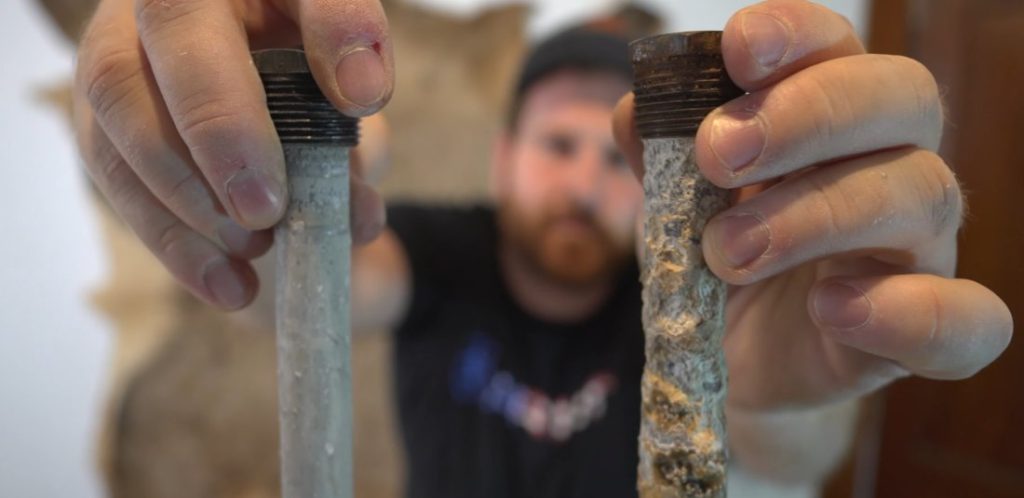
Replace or inspect the anode rod when cloudy hot water has a sulfur odor, metallic taste, rusty tint, or recurring corrosion symptoms. An anode rod protects the steel tank by corroding preferentially, but its service life depends on water chemistry, temperature, tank volume, and usage.
Magnesium anodes can react with sulfate-reducing bacteria and produce hydrogen sulfide, the gas associated with a rotten-egg smell. Aluminum or zinc-aluminum rods may reduce that reaction in some systems, while powered anodes can be an alternative where compatible with the heater. Rod selection should follow the manufacturer’s specifications.
| Symptom | Likely anode or heater condition | Recommended response | Typical service range |
|---|---|---|---|
| Sulfur odor only in hot water | Magnesium-anode reaction or bacteria | Test, disinfect if appropriate, consider compatible rod | 1-3 hours |
| Rusty hot water after standing | Corroded tank or depleted anode | Inspect anode and tank interior | Same day |
| White gelatinous residue | Aluminum hydroxide or mineral reaction | Inspect anode and flush residue | 1-3 hours |
| No odor, clear water, normal taste | Air bubbles more likely | Do not replace rod solely for whiteness | No repair |
| Exposed core wire or heavily wasted rod | Anode near end of service | Replace with approved size and material | Often 3-5 years |
Anode replacement requires shutting down the heater, draining enough water to lower the level, loosening a usually tight hex head, and sealing the new threaded rod. Many tanks use a 1-1/16-inch socket, but the exact fitting and clearance vary. A plumber is the safer choice when the rod is seized, the tank is corroded, or overhead clearance is limited.
A new anode cannot repair a tank that is already leaking. A tank leak from the shell usually means replacement rather than internal repair.
How do scale, anode replacement, and filtration compare?
The correct remedy depends on whether the problem originates inside the tank, at the fixture, or in incoming water. Flushing removes accumulated loose sediment, anode service addresses corrosion chemistry, and softening or filtration reduces future mineral or particulate entry.
| Remedy | Primary target | Typical cost | Typical time | Main limitation |
|---|---|---|---|---|
| Aerator cleaning | Stream-introduced air and grit | $0-15 | 5-15 minutes | Does not treat tank sediment |
| Tank flush | Loose scale and sediment | $0 DIY; $150-400 professional | 45-90 minutes | May expose a weak drain valve |
| Anode replacement | Odor and tank corrosion protection | $150-500 installed | 1-3 hours | Cannot fix a leaking tank |
| Whole-house sediment filter | Well or line sediment | $100-800 installed | 1-4 hours | Cartridge or screen needs maintenance |
| Water softener | Calcium and magnesium hardness | $800-3,000 installed | 3-8 hours | Salt, regeneration, and installation costs |
| Tankless descaling | Heat-exchanger scale | $100-300 professional | 45-90 minutes | Requires manufacturer-approved solution |
A water softener is not the first response to one glass of air-filled hot water. Softening may help when hardness repeatedly causes scale, but it does not remove bacteria, dissolved gases, or corrosion from an already damaged tank.
What if cloudy hot water smells, changes color, or contains flakes?
Cloudy hot water with odor, color, or persistent flakes requires source isolation before normal use for drinking or cooking. Compare hot and cold samples, test more than one fixture, and contact a licensed plumber, water utility, or certified water-testing laboratory when the abnormality continues.
Rotten-egg odor
A sulfur odor limited to hot water often points to the heater, anode, or bacteria rather than the municipal supply. A plumber may flush and disinfect the tank, evaluate the anode material, and check temperature settings and plumbing dead legs.
Do not pour household bleach into a water heater without following the manufacturer’s procedure or professional guidance. Improper concentration, contact time, or incomplete rinsing can damage components and leave unsafe residual disinfectant.
Brown, yellow, or rusty water
Brown water can result from iron, a disturbed main, galvanized-pipe corrosion, or tank corrosion. If the discoloration affects cold and hot taps, contact the water utility before servicing the heater. If only hot water is discolored, the tank, anode, or hot-water piping becomes more likely.
Stop drinking the water until the source is identified when discoloration is sudden, severe, or accompanied by an official advisory. Boiling does not remove metals or sediment.
White plastic-like flakes
White flakes that feel flexible or plastic-like can indicate a disintegrating dip tube, the internal tube that directs incoming cold water toward the tank bottom. Scale flakes are usually brittle and chalky, while dip-tube fragments may clog aerators and reduce hot-water performance.
Dip tubes in older heaters can fail because of material degradation, heat, or chlorinated water exposure. The repair requires access to the cold inlet and replacement of the tube; a very old or already corroded heater may be more economical to replace.
How do tankless and well-water systems change the fix?
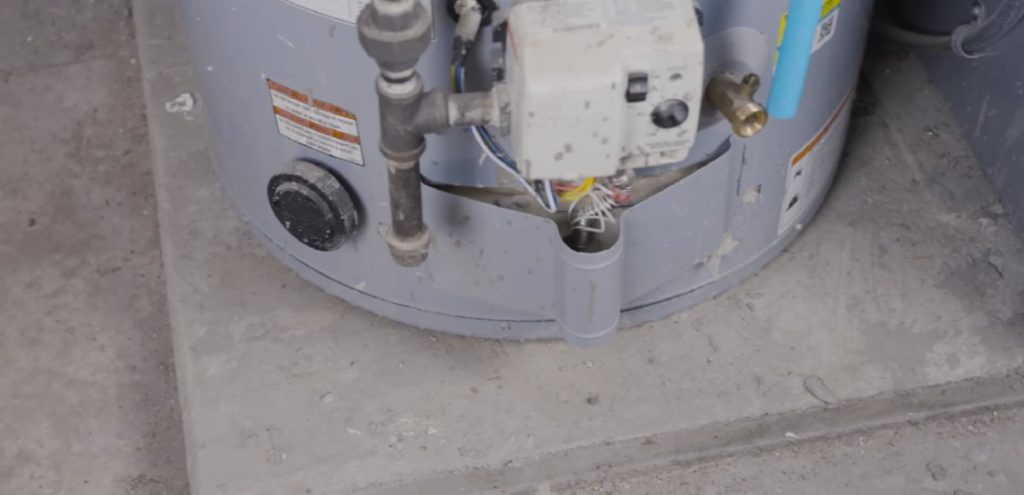
Tankless heaters do not store a large volume of water, so persistent cloudiness usually requires fixture inspection, inlet filtration, source-water testing, or heat-exchanger descaling rather than a storage-tank flush. Private wells add possible causes such as pump aeration, sediment intrusion, and a fluctuating water table.
Tankless heater troubleshooting
Clean the faucet aerator first, then inspect the heater’s inlet filter according to the manual. If scale is suspected, use the manufacturer-approved isolation valves and descaling solution; never assume a tank-heater drain procedure applies to a tankless unit.
A tankless system that produces cloudy water only during high demand may have disturbed scale or an overloaded filtration stage. A service technician should evaluate flow, temperature, error codes, and heat-exchanger condition.
Private well troubleshooting
Collect hot and cold samples after the water has run for several minutes. If both samples are cloudy, install or service an appropriately sized spin-down sediment filter, inspect the pressure tank and pump, and arrange laboratory testing for turbidity, bacteria, iron, manganese, and other locally relevant contaminants.
Air entering through a cracked drop pipe, low well level, suction-side leak, or pump problem can create persistent bubbles. A pressure-tank or well contractor should diagnose those faults because repeated pump cycling and air ingestion can damage equipment.
What does cloudy hot-water repair cost?
Typical repair costs range from $0 for an air-bubble diagnosis to $3,000 or more for whole-house hardness treatment. Local labor rates, heater access, valve condition, water chemistry, and whether the equipment is under warranty create larger differences than the cloudiness symptom itself.
| Repair or investigation | Typical DIY cost | Typical professional cost | Expected duration |
|---|---|---|---|
| Glass and fixture diagnosis | $0-10 | $75-150 service visit | 10-30 minutes |
| Aerator replacement | $5-25 | $75-175 installed | 15-30 minutes |
| Tank flush | $0-40 | $150-400 | 45-90 minutes |
| Anode rod replacement | $40-150 | $150-500 | 1-3 hours |
| Dip-tube replacement | Parts vary by model | $200-600 | 1-3 hours |
| Well sediment prefilter | $75-400 | $300-1,000 | 1-4 hours |
| Water softener | Not usually suitable | $800-3,000 | 3-8 hours |
These are typical North American ranges, not fixed quotes. A failed drain valve, seized anode, inaccessible heater, or tank leak can increase the final bill substantially.
Common mistakes and how to avoid them
- Flushing air bubbles: A sample that clears in 60 seconds does not need a tank flush. Diagnose first.
- Energizing an empty electric tank: Confirm steady hot-water flow before switching on the breaker.
- Opening the relief valve: Use a hot faucet for controlled venting; disturbing an old T&P valve can create a persistent leak.
- Forcing a brittle drain valve: Stop when the valve cracks, binds, or leaks. A plumber can isolate and replace it safely.
- Replacing the anode for every white symptom: Anodes address corrosion and odor, not ordinary dissolved air.
- Installing a softener without testing: Hardness treatment cannot correct bacterial contamination, iron corrosion, or pump aeration.
- Ignoring cold-water cloudiness: A whole-house issue can originate in the utility, well, service line, or filter rather than the heater.
One counterintuitive point matters: a water heater can be functioning normally while hot water looks cloudier than cold water. Heating changes gas solubility, so visual appearance alone is a poor measure of heater condition.
When should you call a plumber or water professional?
Call a professional when cloudy water persists after fixture testing, contains odor or discoloration, produces plastic flakes, follows a tank leak, or involves gas, electrical, well, or pressure equipment. Renters should record the glass test and notify the landlord rather than opening the heater.
Professional help is also appropriate when the heater is more than 8-12 years old, the drain valve has never opened, the anode is seized, or the tank shows corrosion. The cost of a service visit is usually lower than flood damage from a failed valve or an incorrectly reassembled gas or electrical appliance.
A practical maintenance schedule
Preventive maintenance should match water chemistry and appliance type, not a universal calendar. Annual inspection is a reasonable baseline for a tank heater, while severe hardness, high sediment, or private-well service may justify more frequent checks.
| System condition | Inspection interval | Maintenance focus | Escalation trigger |
|---|---|---|---|
| Municipal water, low hardness | Every 12 months | Leak, valve, anode, temperature check | Persistent particles |
| Municipal water, hard water | Every 6-12 months | Sediment flush and hardness control | Slow heating or rumbling |
| Private well | Every 6-12 months | Filter, pump, laboratory water test | Cold and hot cloudiness |
| Tankless heater | Per manufacturer schedule | Inlet filter and descaling | Reduced flow or error code |
| Sulfur odor history | Every 6-12 months | Anode and bacterial evaluation | Odor returns after treatment |
FAQ
Is cloudy hot water safe to shower in?
Cloudy hot water caused solely by air bubbles is generally safe for showering when the source is potable and the sample clears quickly. Do not assume safety when water has a chemical, sewage, sulfur, fuel, or metallic odor, or when discoloration and particles remain. Identify the cause before drinking or cooking with it.
Why is the cold water clear but the hot water cloudy?
Clear cold water and cloudy hot water usually indicate dissolved air released by heating and pressure reduction inside the hot-water system. A tank can also add scale, corrosion, or anode residue, so persistent cloudiness requires the glass test, fixture comparison, and inspection for particles or odor.
Can low water pressure cause milky hot water?
Low pressure by itself is not a typical cause of milky hot water. Pressure changes can release dissolved air, while excessively high static pressure above about 80 PSI can indicate a plumbing-control problem. Measure pressure with a gauge rather than replacing parts based only on the appearance of the stream.
How often should a water heater be flushed?
A tank water heater is commonly inspected and flushed about once every 12 months, with a 6-12-month interval often more practical in hard-water or high-sediment locations. Follow the manufacturer’s instructions, and have a professional assess older tanks whose drain valves are brittle or heavily scaled.
Can a water filter remove cloudy hot water?
A filter can remove suspended sediment, but it cannot remove dissolved air bubbles and may not correct heater corrosion or sulfur-producing bacteria. Whole-house filters belong on the incoming supply, while point-of-use filters should be rated for the temperature and purpose of the water they treat.
Should I replace my water heater if hot water is cloudy?
Replace a water heater when the tank leaks, corrosion is extensive, the dip tube or controls are failing on an old unit, or repair costs approach replacement value. Do not replace a sound heater solely because air bubbles make hot water look white for one minute.
The Bottom Line
To how to fix cloudy hot water, begin with the two-minute glass test, not a blind water-heater flush. Bottom-up clearing within 1-2 minutes usually means harmless dissolved air; persistent particles call for sediment or scale service; odor, color, flakes, or whole-house cloudiness require targeted plumbing or water-quality diagnosis.