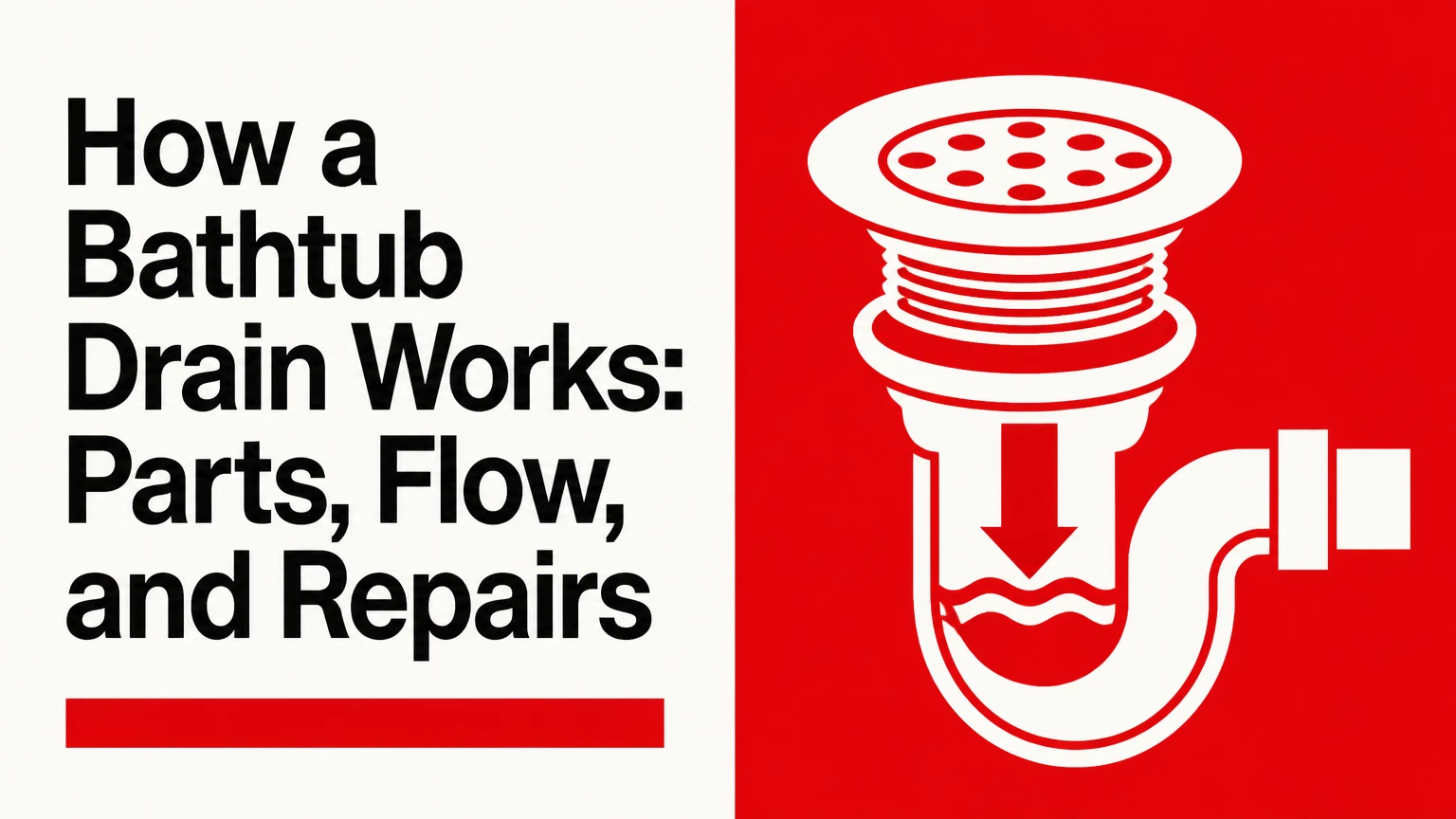
A bathtub drain is a split-drain plumbing assembly that carries water from the tub basin or overflow opening into a trap and then the household waste line. When the stopper is open, gravity moves water through the drain shoe and waste tee; the P-trap retains water to block sewer gases, while the overflow provides a secondary drainage path.
Key Facts at a Glance
- A standard bathtub drain assembly usually uses a nominal 1 1/2-inch waste connection.
- The bottom drain and overflow opening join inside the waste tee before reaching the P-trap.
- A P-trap normally retains water after bathing to block sewer gases from entering the room.
- An overflow opening reduces the risk of flooding, but it cannot prevent flooding when flow exceeds its capacity.
- Trip-lever stoppers operate a concealed plunger or gate inside the overflow tube.
- Typical replacement costs range from $15-$75 for parts and $325-$700 for professional assembly work.
What Is a Bathtub Drain System?
A bathtub drain system is a waste-and-overflow assembly with two water entry points and one downstream outlet. The main drain sits in the tub floor, while the overflow opening is installed on the vertical tub wall several inches below the rim.
The two paths normally meet in a waste tee behind or beneath the bathtub. From that junction, wastewater travels through a short tailpiece into the P-trap, then through the drain waste line toward the building drain and sewer or septic system.
The bathtub drain does more than remove water. The stopper controls retention, the overflow handles rising water, the trap blocks sewer odors, and the vent system allows air to enter the drainage network so water can flow without excessive pressure changes.
Which Parts Make Up the Assembly?
| Component | Typical location | Primary function | Common problem |
|---|---|---|---|
| Drain flange | Inside tub floor | Covers and connects the main drain opening | Failed seal or stripped threads |
| Drain shoe | Directly below tub | Receives the flange and directs water sideways | Cracked fitting or leaking gasket |
| Overflow plate | Tub wall near rim | Covers the secondary water entry point | Loose screws or damaged gasket |
| Overflow tube | Behind tub wall | Carries overflow water downward | Misalignment or corrosion |
| Waste tee | Behind or below tub | Combines drain and overflow paths | Joint leak or blockage |
| Tailpiece | Below waste tee | Connects tee to trap inlet | Loose slip joint |
| P-trap | Beneath floor or tub | Holds a water seal against sewer gas | Dry trap, siphoning, or clog |
| Drain waste arm | Downstream of trap | Carries water toward building drain | Poor slope or obstruction |
| Vent connection | Usually behind wall | Balances air pressure in the waste system | Gurgling or slow drainage |
The drain flange is the visible metal or plastic ring, but it is not the entire drain. A replaceable strainer may sit within the flange, and a stopper may seal against the flange, a gasket, or an internal barrel depending on the design.
How a Bathtub Drain Works
A bathtub drain works through gravity, controlled openings, merged flow paths, and a water-filled trap. Opening the stopper lets water fall through the drain flange, move through the drain shoe, join overflow flow at the waste tee, pass through the P-trap, and continue into the building drain.
Water pressure from the depth of water above the outlet creates the initial driving force. As the tub empties, the available pressure decreases, so the final water may drain more slowly than the first surge.
The plumbing vent matters because wastewater moving through a pipe needs replacement air. A blocked or poorly configured vent can cause gurgling, slow drainage, or trap-water movement even when the visible drain opening is clean.
What Happens When the Stopper Opens?
- The stopper lifts, rotates, or retracts, depending on its mechanism.
- Water flows through the strainer and drain flange.
- The drain shoe turns the flow horizontally beneath the tub.
- The waste tee receives water from the drain shoe and the overflow tube.
- The combined flow drops through the tailpiece.
- Water passes through the P-trap and pushes some existing trap water downstream.
- A portion of clean water remains in the curved trap after flow stops.
The P-trap does not normally prevent drainage. Its curved shape retains a limited water seal while allowing incoming wastewater to displace the standing water and continue downstream.
How Does the Overflow Prevent Flooding?
A bathtub overflow reduces flooding risk by accepting water through an opening below the rim and routing it down the overflow tube. The overflow route usually joins the main drain route at the waste tee, so water can leave even when the bottom stopper is closed.
An overflow is not a guaranteed flood barrier. Its capacity depends on the opening size, tube design, downstream blockage, incoming faucet flow, and how quickly the tub fills. A severely obstructed waste line can cause water to rise through the overflow opening instead of draining away.
The overflow gasket is positioned behind the tub wall, typically between the overflow fitting and the tub shell. A deteriorated or poorly centered gasket can leak into the wall whenever the water reaches that opening, even though the visible plate looks dry.
Why Does the P-Trap Hold Water?
The bathtub P-trap holds water to create a physical barrier against sewer gases. A properly installed trap retains water in its curved section after the tub drains, while the vented waste system prevents normal flow from pulling the seal out.
A trap can lose its seal in several ways:
- Evaporation in a rarely used bathtub
- Siphoning caused by poor venting or incorrect pipe configuration
- A downstream obstruction that alters pressure
- A leak at the trap or a nearby fitting
- Continuous negative pressure in the drainage system
A dry trap often produces a sewage odor, but odor can also come from biofilm, a leaking joint, or a vent defect. Adding water may temporarily restore the barrier without correcting the underlying plumbing fault.
For an unused tub, slowly pour about 1-2 gallons of water into the drain. If the odor returns within days, inspect for leakage, siphoning, or a venting problem rather than repeatedly adding water.
Which Stopper Types Are Common?
Bathtub stopper types differ mainly in where the operating mechanism is located and how easily the assembly can be cleaned. Lift-and-turn, toe-touch, and push-and-pull models operate at the drain opening, while trip-lever and cable systems use the overflow plate.
| Stopper type | Operating method | Typical maintenance | Main weakness | Typical application |
|---|---|---|---|---|
| Lift-and-turn | Lift knob, then twist | Remove stopper and clear hair | Cap may seize on threads | Family bathroom |
| Toe-touch | Press to close, press again to open | Clean spring and stopper seal | Spring can fail | Modern tub installation |
| Push-and-pull | Pull up or push down | Remove rod and clean flange | Body can loosen | Rental or guest bathroom |
| Trip-lever plunger | Move overflow lever | Remove linkage and plunger | Rod adjustment is sensitive | Older alcove tub |
| Cable-operated | Turn overflow dial | Flush and inspect cable | Higher replacement cost | Deep or freestanding tub |
How Does a Trip-Lever Stopper Work?
A trip-lever stopper uses a lever on the overflow plate to move a concealed plunger or gate inside the overflow tube. In one common arrangement, lowering the lever drops the plunger over the waste tee opening; raising the lever lifts it and allows water to drain.
Trip-lever systems are easy to operate but harder to service because the working parts are hidden. A linkage rod may bend, corrode, separate, or become incorrectly adjusted. A stopper that fails to hold water often needs linkage inspection rather than drain-flange replacement.
How Does a Cable-Operated Stopper Work?
A cable-operated stopper uses a rotating dial or handle on the overflow plate to move a flexible cable. The cable transfers movement to a stopper at the drain opening, allowing the user to control the drain without reaching into the tub.
Cable systems suit deep tubs and some freestanding installations because the control remains accessible near the overflow. Replacement parts cost more than simple mechanical stoppers, and a kinked or seized cable can require access behind the tub.
Which Stopper Type Fits Each Situation?
A push-and-pull or lift-and-turn stopper is usually the practical choice for landlords because both designs have few moving parts and can be removed from above the tub. Toe-touch models suit users who prefer foot operation, but their springs and seals create additional wear points.
| User or installation | Suitable choice | Reason | Avoid when |
|---|---|---|---|
| Rental property | Push-and-pull | Few internal parts, quick cleaning | Frequent tampering is expected |
| Mobility limitation | Toe-touch | Foot-operated drain control | Spring replacement access is poor |
| Deep soaking tub | Cable-operated | Overflow-mounted control | Replacement parts are unavailable |
| Older alcove tub | Trip-lever | Matches existing overflow layout | Linkage adjustment is undesirable |
| DIY replacement | Lift-and-turn | Simple above-tub mechanism | The existing shoe is damaged |
| High-hair household | Removable lift-and-turn | Easy access for manual cleaning | A fixed decorative cover is required |
No stopper type removes the need to clean hair and soap residue. A simpler mechanism generally reduces adjustment problems, but the correct choice must also match the drain flange, overflow configuration, tub material, and available access.
What Size Is a Bathtub Drain?
Most modern bathtub drain assemblies use a nominal 1 1/2-inch waste connection, equivalent to about 38 millimeters. The visible flange, stopper body, and threaded shoe must still match the manufacturer’s dimensions, because nominal pipe size does not guarantee universal component compatibility.
Some older assemblies use different thread patterns, including legacy 1 1/4-inch configurations. Drain-flange threads are commonly specified as NPSM, meaning National Pipe Straight Mechanical, but the exact thread, shoe depth, gasket shape, and overflow alignment should be verified before purchase.
Measure the existing flange diameter, thread type, overflow opening, center-to-center dimensions, and waste-line material. A universal kit may fit a common steel or acrylic tub while failing to seal a deeper cast-iron or proprietary freestanding-tub assembly.
What Does Replacement Involve?
A simple stopper replacement can take 10-15 minutes and usually requires no work below the tub. Replacing the complete above-floor waste-and-overflow assembly typically takes 1-2 hours when the drain shoe and overflow connections are accessible.
A concealed P-trap or drain-line replacement commonly takes 3-5 hours because the plumber may need to open a ceiling, wall, crawlspace, or finished access panel. The factor that most affects the job is access, not the visible drain hardware.
Typical Cost and Time Ranges
| Work scope | Parts range | Typical duration | Main cost variable |
|---|---|---|---|
| Stopper replacement | $15-$50 | 10-15 minutes | Stopper compatibility |
| Drain flange replacement | $20-$75 | 45-90 minutes | Seized flange or damaged shoe |
| Complete waste-and-overflow kit | $40-$150 | 1-2 hours | Tub access and material |
| Professional assembly replacement | $325-$700 | 1-3 hours | Labor and local rates |
| P-trap or concealed repipe | $100-$300 parts | 3-5 hours | Wall, floor, or ceiling access |
| Access-panel construction | $150-$300 | 1-3 hours | Finish material and location |
These are typical North American planning ranges, not fixed prices. Local labor rates, emergency service charges, cast-iron removal, tile repair, and code-required changes can move the final invoice substantially.
Which Installation and Cleaning Mistakes Cause Leaks?
The most damaging bathtub drain mistakes involve gasket position, sealant compatibility, excessive tightening, and incomplete leak testing. A drain flange gasket normally sits beneath the tub shell, between the tub and drain shoe, while the flange seals from the finished tub surface.
Use the tub manufacturer’s sealant instructions. Plumber’s putty is common with many metal fixtures, but petroleum-based putty may stain or degrade some acrylic and fiberglass products; 100% silicone is often specified for those materials.
Expert Installation Rules
- Hand-tighten the drain flange with the correct drain wrench, then tighten only enough to compress the gasket without distorting the tub shell.
- Center the overflow gasket before tightening the plate, because a gasket touching one side can leak when the tub reaches the overflow level.
- Test both routes separately: fill the tub above the main drain while the stopper is closed, then add water until it reaches the overflow opening.
- Never treat a dry exterior as proof of a sound seal; hidden leaks often appear only when the overflow is active.
- Do not use a wire hanger aggressively inside a plastic waste tee, because it can scratch seals, snag linkage, or push a soft obstruction deeper.
Acrylic and fiberglass tubs can crack under flange pressure, while cast-iron tubs tolerate more force but often conceal corrosion at old threaded shoes. The correct torque is the amount that seals the joint, not the maximum force a wrench can deliver.
Why Is the Tub Draining Slowly?
A bathtub usually drains slowly because hair, soap, body oil, or mineral deposits restrict the stopper area or trap inlet. The obstruction commonly collects around stopper crossbars, the drain flange, or the first bend rather than deep in the building sewer.
Start with the least invasive method:
- Remove the stopper or strainer.
- Pull visible hair and residue with a plastic barbed drain tool.
- Flush with hot tap water, not boiling water in a plastic tub assembly.
- Cover the overflow opening with a wet cloth.
- Add enough water to cover a cup plunger’s rim.
- Plunge with short, controlled strokes.
- Recheck drainage and inspect for leaks.
Chemical drain cleaners are a poor first choice for a bathtub. Residual caustic liquid can injure anyone removing the stopper, damage some metal finishes and seals, and remain in a blocked trap where a later repair exposes the plumber or homeowner.
If manual cleaning fails, a hand auger may reach a deeper obstruction. Stop when the cable meets firm resistance, because forcing it can damage older fittings or become difficult to retrieve through a tub drain with a crossbar.
Why Won’t the Bathtub Hold Water?
A bathtub that will not hold water usually has a worn stopper seal, a stopper installed at the wrong height, or a misadjusted trip-lever linkage. Cleaning the sealing surface and replacing the rubber gasket often resolves simple drain-opening failures.
For a trip-lever assembly, remove the overflow plate carefully and withdraw the linkage without dropping the plunger into the pipe. Inspect the rod joints, corrosion, and plunger seal; adjust the linkage in small increments, then test the tub with several inches of water.
A stopper that slowly leaks may be functioning normally if the tub drain, flange, or shoe is cracked. Place a dry paper towel around accessible joints below the tub, fill the basin, and check for moisture before assuming the stopper is the only fault.
What Causes a Sewage Smell at the Tub?
A sewage smell at a bathtub most often indicates a dry or compromised P-trap, although decomposing hair and a defective vent can create similar odors. A rarely used tub may lose its water seal through evaporation, while a faulty drain connection can leak trap water away.
Run water into the tub and observe whether the smell disappears for several hours. Clean the stopper and strainer, then inspect accessible trap joints for dampness or mineral deposits.
Persistent odor requires further diagnosis. A plumber may test for a leaking trap, blocked vent, improper trap configuration, or negative pressure that siphons water from the curve. Do not permanently remove the P-trap to improve drainage, because that trades a flow problem for direct sewer-gas entry.
How Can You Check a Tub Drain for Leaks?
A bathtub drain leak test takes about 15-20 minutes and should test the flange, overflow, waste tee, and trap separately. Leak testing is especially important after replacing a drain assembly because concealed water can damage subflooring before stains appear indoors.
Use this sequence:
- Dry the accessible plumbing and place paper towels beneath each joint.
- Fill the tub 2-3 inches above the drain opening with the stopper closed.
- Wait 10 minutes and inspect the flange and drain shoe.
- Add water until it reaches the overflow opening.
- Wait another 10 minutes and inspect the overflow gasket and tube.
- Drain the tub while watching the waste tee, tailpiece, and trap.
- Repeat the drain test if any joint shows moisture.
A leak that appears only during draining usually points to the drain shoe, waste tee, tailpiece, trap, or downstream connection. A leak that appears only at the overflow level strongly suggests the overflow gasket or overflow fitting.
When Should a Plumber Handle the Problem?
A plumber should handle a bathtub drain when the leak is concealed, the P-trap is inaccessible, the tub shell is cracked, the waste line is corroded, or repeated clearing does not restore flow. Professional help is also appropriate when a drain replacement requires cutting finished tile, opening a ceiling, or modifying vented plumbing.
Homeowners can usually clean a removable stopper, replace a compatible above-floor stopper, and perform a controlled leak test. They should stop when the drain flange will not turn, the tub material begins to flex, or a chemical cleaner may still be present.
A slow drain with multiple affected fixtures indicates a larger branch-line or building-drain problem. A single tub with visible hair at the stopper is more likely a local obstruction.
Frequently Asked Questions
Does a bathtub drain need a vent?
Yes, a bathtub drain normally connects to a properly configured plumbing vent, although the vent may be hidden inside the wall. Venting admits air and helps stabilize pressure as wastewater moves through the trap and drain line. Gurgling, slow drainage, or trap odor can indicate a venting problem, but those symptoms also have other causes.
Can an overflow drain work when the stopper is closed?
Yes, the overflow can accept water while the bottom stopper is closed because the overflow opening normally connects to the waste tee independently of the stopper seal. The overflow cannot handle unlimited faucet flow, and a blocked downstream line can prevent both the main drain and overflow from carrying water away.
Is a bathtub drain the same as a sink drain?
No. A bathtub drain usually combines a bottom outlet and overflow in one waste-and-overflow assembly, while a basic sink drain has one basin outlet and a separate overflow arrangement when provided. Tub assemblies also commonly use a concealed trip-lever or cable mechanism that sink drains do not require.
How often should a bathtub drain be cleaned?
Inspect and manually clean a bathtub drain whenever drainage slows, and remove visible hair every few weeks in a high-hair household. Preventive cleaning is safer than repeated chemical treatment because hair and soap residue can be removed before they harden in the flange, trap, or branch line.
Can boiling water damage a bathtub drain?
Boiling water can soften or deform some plastic components and may stress acrylic or fiberglass surfaces, especially when poured into a cold tub. Use hot tap water for routine flushing unless the drain and tub manufacturer specifically permits higher temperatures. A plastic drain snake is more useful for hair than extreme heat.
The Bottom Line
How a bathtub drain works becomes straightforward when the system is viewed as two entry paths joining one trapped waste line. The drain flange handles ordinary basin water, the overflow accepts rising water, the waste tee combines both routes, and the P-trap retains a sewer-gas seal.
Most routine failures involve hair, worn stopper seals, misadjusted linkages, dry traps, or aging gaskets rather than a mysterious defect in the entire plumbing system. Identify the stopper type, test the overflow separately, use manual cleaning first, and verify access before buying a replacement kit. Understanding how a bathtub drain works helps you choose the correct repair without confusing a visible stopper problem with a concealed waste-line failure.