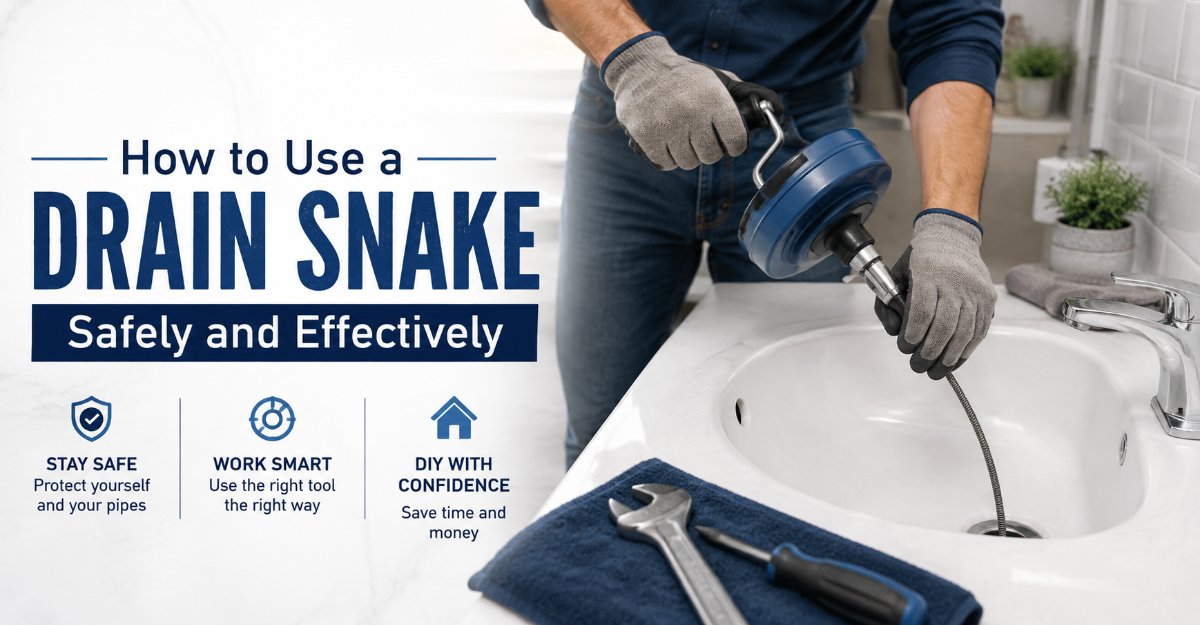
To use a drain snake, select the correct auger for the fixture, remove the stopper or trap, feed the cable until it meets resistance, then rotate while applying gentle forward pressure. Retrieve the cable slowly, remove the debris, and test the drain with controlled water flow. Most accessible sink, tub, and shower clogs take 15-45 minutes.
Key Facts at a Glance
A manual hand auger with a 15-25-foot cable suits most sink, tub, and shower clogs.
A toilet requires a closet auger with a protective guide, not a bare metal hand snake.
Never snake a drain that contains liquid chemical cleaner because the cable can splash corrosive chemicals.
Gentle rotation and steady pressure clear more clogs than force, which can kink the cable or damage fittings.
A drain snake can open a passage without removing a grease mass, so a drain that remains slow needs a second treatment or inspection.
Multiple slow fixtures usually indicate a branch or main-line problem rather than a local stopper obstruction.
What a Drain Snake Does
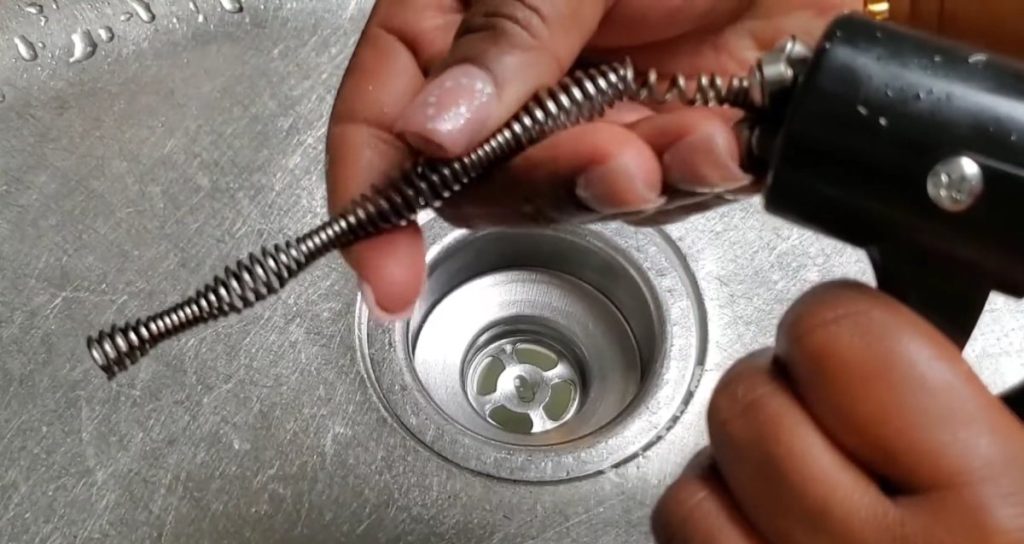
A drain snake, also called a plumbing auger or drain auger, is a flexible cable that enters a pipe and mechanically engages an obstruction. The rotating cable can hook hair, scrape buildup, bore through soft material, or push a blockage far enough for water to pass.
The tool does not dissolve a clog. Its result depends on the head shape, cable diameter, pipe geometry, and obstruction type. Hair tends to wrap around a corkscrew tip, while grease may yield temporarily when the cable makes a narrow channel through it.
A hand auger usually operates through a sink, tub, or shower opening. A powered drain machine carries a longer cable and greater torque, but its rotating force increases the consequences of a snag, damaged pipe, or incorrect access point.
Which Drain Snake Should You Use?
The correct drain snake depends on the fixture, the distance to the obstruction, and whether the cable has a protected path. A 15-25-foot manual auger is the practical first choice for household sink and shower clogs, while a 3-6-foot toilet auger protects porcelain and follows the toilet trap.
| Tool type | Typical cable or reach | Suitable fixtures | Typical purchase or rental cost |
|---|---|---|---|
| Manual hand auger | 15-25 ft; 1/4-3/8 in cable | Bathroom sink, kitchen sink, tub, shower | $15-$50 purchase |
| Toilet or closet auger | 3-6 ft; protected cable | Toilet bowl and integral trap | $25-$80 purchase |
| Drum auger | 25-50 ft; 3/8-1/2 in cable | Longer branch drains and floor drains | $40-$150 purchase |
| Electric drain machine | 50-100 ft; 1/2-3/4 in cable | Large branch lines and main drains | $50-$100 per day typical rental |
| Flat tape auger | 25-50 ft; flat steel strip | Some straight, narrow waste lines | $15-$60 purchase |
The cable length is not the same as usable reach. A 25-foot snake may lose several feet in the drum, trap, and pipe bends, and forcing the remaining cable after the drum empties can create a kink.
Flat tape tools are useful where a narrow, relatively straight path matters, but their flat profile usually hooks hair less effectively than a corkscrew-ended round cable. Electric equipment is also a poor first choice for a plastic bathroom sink trap because the machine can twist fittings or drive a cable into a weak pipe.
Before You Start
Set aside 15-45 minutes, wear chemical-resistant gloves and eye protection, and keep a bucket and towels beneath the work area. The job is usually low to moderate difficulty when the clog sits within the trap or the first few feet of branch pipe.
Preparation checklist
| Requirement | Typical amount or specification | Why it matters |
|---|---|---|
| Manual auger | 15-25 ft cable, 1/4-3/8 in | Reaches common fixture clogs |
| Bucket | 10-20 L capacity | Catches trap water and sludge |
| Towels | 2-4 old towels | Protects cabinets and flooring |
| Gloves | 1 pair, chemical-resistant | Limits contact with sewage and residue |
| Eye protection | 1 pair with side coverage | Prevents splash injuries |
| Adjustable wrench | 1 tool, 6-10 in | Removes slip-joint nuts |
| Flashlight | 1 battery flashlight | Reveals cable position and leaks |
| Disinfectant | 1 household bathroom-safe product | Cleans contaminated surfaces |
Do not begin if chemical drain cleaner was recently poured into the fixture. Sodium hydroxide, sulfuric acid, and similar products can remain trapped in standing water or inside a P-trap; moving a cable through that liquid can splash it onto skin, eyes, or clothing.
If chemical cleaner is present, keep the area ventilated, avoid plunging or snaking, follow the product’s emergency instructions, and contact a plumber if the drain remains blocked. Do not mix a chemical cleaner with bleach, vinegar, ammonia, or another drain product.
How to Use a Drain Snake Safely
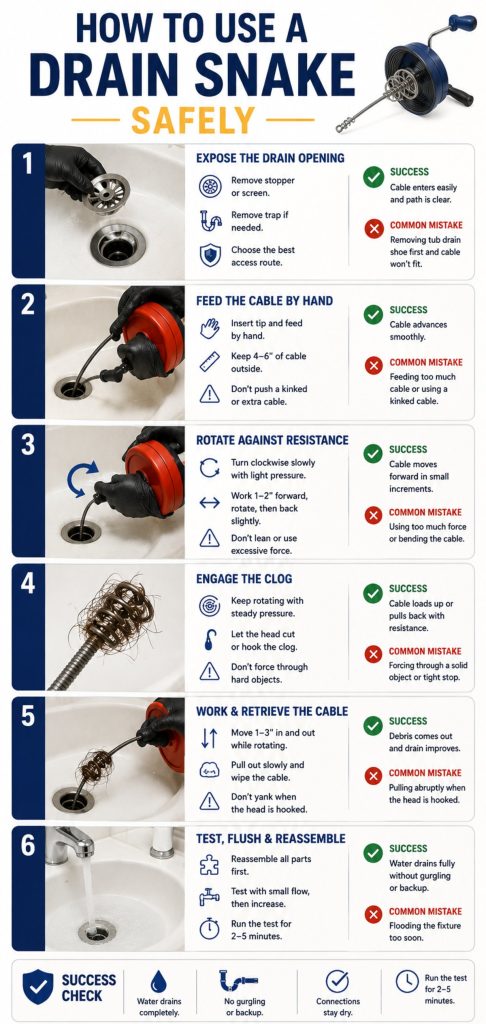
Use a drain snake in six controlled stages: expose the pipe, feed the cable, rotate into the obstruction, work the head through or around it, retrieve the cable, and test the drainage. Success depends on keeping the cable engaged with the clog without bending it against a fitting.
Step 1: Expose the Drain Opening
Remove the sink stopper, shower grate, or accessible drain screen. For a bathtub, the overflow opening is often a better route than the drain opening because the overflow gives the cable a straighter path into the trap.
Place a bucket under a sink P-trap before loosening either slip nut. Remove the trap when the obstruction is clearly inside it, when the drain opening blocks cable access, or when you need to prevent debris from being pushed deeper into the wall.
You will know the access is suitable when the cable enters without scraping a finished surface and the drain path remains visible or controllable.
Common mistake: Removing a tub drain shoe first and then discovering that the cable cannot negotiate the trap. Use the overflow plate when the manufacturer’s design allows it.
Step 2: Feed the Cable by Hand
Loosen the thumbscrew or locking collar, then insert the snake tip into the drain. Feed the first section by hand rather than immediately cranking, because manual feeding reveals whether the cable has entered the pipe or simply curled inside the opening.
Keep approximately 4-6 inches of cable between the tool and the drain opening. That short working loop gives the cable room to bend while preventing a long exposed section from whipping or forming a kink.
You will know the cable is advancing when the exposed length decreases smoothly and the tip does not spring back from the opening.
Common mistake: Feeding more cable after the drum is empty or pushing a cable with a visible kink. Stop, straighten the section, and continue only when the cable moves smoothly.
Step 3: Rotate Against Resistance
Tighten the locking screw enough for the drum or handle to grip the cable. Turn the crank clockwise slowly while applying light forward pressure, particularly as the cable passes through the P-trap or a sharp branch fitting.
A drain snake should rotate and advance in small movements. A useful practitioner rule is to work 1-2 inches forward, rotate several turns, then ease back slightly before advancing again; this lets the tip cut or hook material instead of wedging against the pipe wall.
You will know the technique is working when the cable advances incrementally and resistance changes from rigid to springy or gritty.
Common mistake: Leaning your full body weight onto the crank. Excessive force can deform a light-gauge cable, separate a cable coupling, or stress a plastic trap.
Step 4: Engage the Clog
When the cable stops at a consistent depth, keep rotating with firm, measured pressure. A corkscrew tip may hook hair or fibrous material, while a boring head may penetrate soap, paper, or a compact soft blockage.
Do not assume every hard stop is a clog. A solid stop near the expected trap location may be a fitting, baffle, cross connection, or the end of the tool’s usable path. If the cable will not advance after repeated gentle rotations, withdraw it slightly and try a different angle.
You will know the head has engaged the obstruction when the cable loads under tension, the handle feels textured, or the tip pulls back with material attached.
Common mistake: Forcing a cable through a suspected toy, stone, root, or collapsed pipe. A solid object may move farther into the system or become wedged more tightly.
Step 5: Work and Retrieve the Cable
Rotate the head several times while moving it 1-3 inches in and out. That motion enlarges the opening and helps a corkscrew tip collect debris. Pull the cable out slowly while keeping it aligned with the drain opening.
Wipe the cable with a rag as it emerges and drop the debris into the bucket, not back into the sink. If the tip returns clean but the drain improves briefly, the cable probably pierced the blockage rather than removed it.
You will know retrieval was effective when hair, grease, paper, or other material appears on the head and the pipe accepts a small test flow without backing up.
Common mistake: Pulling abruptly when the head is hooked. Rotate gently in the reverse direction for a few turns while applying light traction, then withdraw slowly.
Step 6: Test, Flush, and Reassemble
Reinstall the P-trap, stopper, or overflow plate before performing a full test. Run a small amount of cool or warm water first, inspect every connection for leaks, and then increase the flow gradually.
For a bathroom sink, warm tap water can carry loosened soap residue away. Avoid pouring boiling water into unknown plastic piping, acrylic fixtures, or porcelain toilets because thermal shock and material limits can cause damage.
You will know the drain is clear when a measured basin of water empties without gurgling, rising level, or delayed drainage. Run the test for 2-5 minutes rather than assuming one quick pour proves the blockage is gone.
Common mistake: Flooding the fixture immediately after snaking. A partial opening can accept a small flow but overflow under a faucet running at full rate.
How Do You Snake Different Fixtures?
Fixture geometry determines the safest entry point and the correct tool. A bathroom sink usually permits trap removal, a bathtub often needs overflow access, and a toilet needs a porcelain-safe closet auger with a curved protective shoe.
Bathroom and kitchen sinks
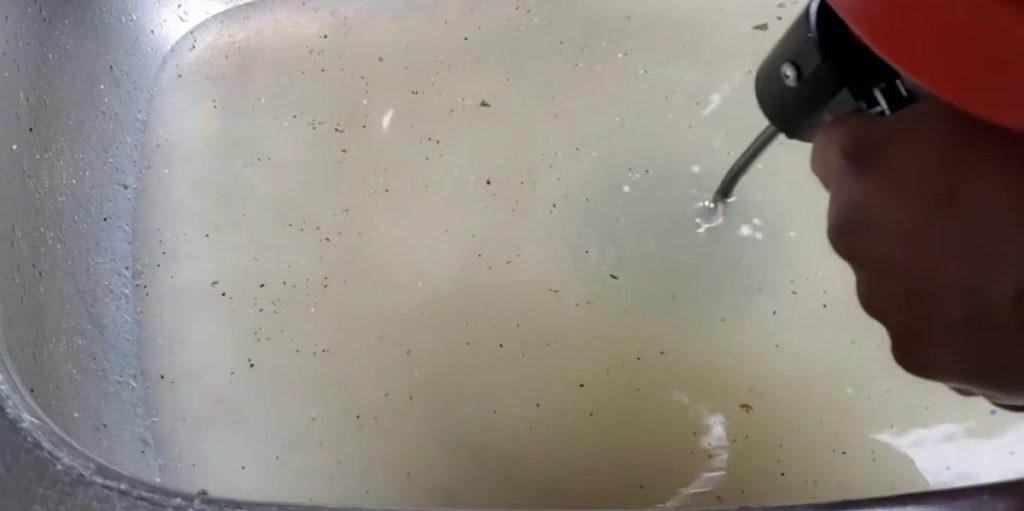
Remove the stopper, then feed a 1/4-inch or 5/16-inch hand auger through the drain. If the cable repeatedly stops at the trap, place a bucket below the P-trap, remove it, clean the trap separately, and snake the exposed wall tube only if the obstruction remains.
Kitchen sink clogs often contain grease, food particles, or fibrous vegetable matter. A snake may create a temporary channel through grease, so follow the mechanical pass with warm tap water and detergent rather than relying on a single puncture.
Bathtubs and showers
Remove the overflow cover and linkage if the design permits, then feed a small hand auger through the overflow opening. Shower and tub clogs commonly contain hair near the strainer or trap, making a corkscrew tip or dedicated hair-removal tool more effective than a flat tape.
Do not damage the stopper linkage while removing an overflow plate. Photograph the linkage before disassembly and reinstall the assembly at its original depth.
Toilets
Use a closet auger, not a standard exposed steel cable. The closet auger’s guide shoe follows the toilet’s internal curve and protects the porcelain from direct cable contact.
Crank the auger handle while applying gentle pressure, then retract it slowly. If the toilet contains a suspected toy, brush head, or other solid object, stop rather than pushing the object into the branch line.
What Should You Try First?
A plunger is the lowest-risk first tool for a localized, recent clog, while a drain snake is the better next step when plunging fails or hair is physically lodged in the trap. Chemical cleaners are a poor substitute for mechanical removal when the obstruction is a solid object, dense hair, or recurring buildup.
| Situation | First choice | Typical time | Reason |
|---|---|---|---|
| Sink holds water but no chemical is present | Cup plunger | 5-10 minutes | Uses pressure without cable contact |
| Shower drains slowly from hair | Hand auger or hair tool | 10-30 minutes | Removes fibrous material mechanically |
| Toilet bowl is blocked | Toilet plunger, then closet auger | 10-30 minutes | Matches the fixture’s curved trap |
| Kitchen drain has grease buildup | Hand auger plus warm water | 20-45 minutes | Opens the passage and carries residue away |
| Several fixtures back up together | Plumber inspection | Same day | Suggests a branch or main-line blockage |
A plunger needs enough standing water to cover its cup and a sealed overflow opening where applicable. Repeated plunging after chemical cleaner use is unsafe because pressure can propel corrosive liquid upward.
How to Avoid Pipe Damage
Prevent pipe damage by using a cable sized for the fixture, limiting exposed cable, rotating instead of ramming, and stopping at an unexplained solid obstruction. Older galvanized steel, brittle cast iron, clay sewer pipe, and poorly supported plastic assemblies deserve more caution than a modern accessible trap.
Never use a large powered machine through a small sink drain unless the machine and cable are specifically rated for that application. The motor can generate enough torque to twist a trap, split a weak fitting, or bind the cable beyond easy manual recovery.
Clockwise rotation is the normal working direction for many hand augers because it drives the head forward and maintains cable tension. Reverse rotation is appropriate briefly when releasing a snag, but continuously cranking backward can loosen some wound cables and reduce control.
Why Does the Drain Still Run Slowly?
A drain can remain slow after snaking when the cable pierced a grease layer, missed a side branch, encountered buildup across the pipe wall, or reached a structural defect. A clean cable tip does not prove that the blockage was removed.
Try one controlled second pass with a larger compatible head if the tool manufacturer permits it. If the drain improves only briefly, recurring symptoms point toward accumulated grease, scale, roots, a sagging pipe, or a damaged line rather than a simple hair plug.
Hydro-jetting uses pressurized water to scour interior pipe walls and can outperform a snake against broad grease deposits, but it requires correct pressure, access, and pipe assessment. A camera inspection is more informative when the same blockage returns after mechanical clearing.
What If the Snake Gets Stuck?
If a drain snake becomes stuck, stop forward pressure, rotate gently in reverse for a few turns, and pull back with steady light traction. Do not jerk the cable, use a vehicle, or keep applying motor torque because the cable may be hooked into the pipe, trapped in a fitting, or kinked.
| Symptom | Likely cause | Safe response |
|---|---|---|
| Cable springs back at opening | Cable curled in trap | Withdraw, straighten, and reinsert |
| Cable locks after grabbing debris | Tip hooked hair or fabric | Reverse gently, then pull slowly |
| Cable binds at one depth | Fitting, hard object, or kink | Stop forcing and change access point |
| Cable returns clean and drain remains blocked | Punctured soft clog | Make a controlled second pass |
| Multiple drains back up | Branch or main-line obstruction | Stop using fixtures and call a plumber |
If the cable cannot be recovered with gentle reverse rotation, leave the tool in place and seek professional help. Cutting or pulling a trapped cable can turn a recoverable obstruction into a pipe excavation.
When Is an Electric Drain Machine Appropriate?
An electric drain machine is appropriate for a long branch line or main drain when the operator understands cable control, has safe access, and has assessed the pipe condition. A powered machine is not automatically the correct upgrade for a stubborn sink or toilet clog.
Typical rental machines carry 50-100 feet of cable and may weigh more than 50 pounds, depending on the model. They require gloves designed for rotating equipment, eye protection, stable footing, and strict awareness that a rotating cable can catch clothing or hands.
Do not use powered equipment when sewage is backing up from several fixtures, the pipe may be collapsed, roots are suspected in fragile clay, or the access point is unknown. A plumber can combine cleanout access, a camera, a larger sectional machine, or hydro-jetting according to the diagnosis.
Common Mistakes and How to Fix Them
Using the wrong tool
A bare hand auger can scratch a toilet and may not follow its internal trap. Replace it with a closet auger. A large cable can also damage a small bathroom drain, so match cable diameter to the manufacturer’s fixture guidance.
Forcing the cable
Force does not compensate for a wrong angle or an impassable obstruction. Retract 2-4 inches, rotate, and re-approach. If the same hard stop returns at the same depth, stop treating it as an ordinary clog.
Removing only the stopper
A stopper can hold hair directly beneath the opening. Clean the stopper and strainer first, then snake farther only if the drain remains blocked; otherwise, the cable may push a nearby wad deeper into the trap.
Pouring boiling water after snaking
Boiling water can soften some grease, but it can deform vulnerable plastic components and damage some finished fixtures. Use warm tap water unless the plumbing and fixture manufacturer specifically allows higher temperatures.
Storing a wet cable
Rinse visible residue, wipe the cable, dry the drum and handle, and apply a light manufacturer-approved rust inhibitor if the tool’s instructions allow it. Store the auger retracted without sharp bends.
Repeating the same failed pass
A second identical pass rarely fixes a structural problem. Change the access point, use a compatible head, inspect the trap, or arrange a professional diagnosis when symptoms recur.
Typical Time and Cost
A simple sink or shower clog usually takes 15-30 minutes with an existing hand auger, while a trap removal, difficult tub access, or repeated pass can take 30-60 minutes. Costs vary by country and tool quality, so the ranges below are typical North American retail and rental figures rather than fixed prices.
| Job or equipment | Typical duration | Typical cost | Suitable use |
|---|---|---|---|
| Cup plunger attempt | 5-10 minutes | $5-$20 | Localized standing-water clog |
| Manual hand auger | 15-45 minutes | $15-$50 purchase | Sink, shower, and tub branches |
| Closet auger | 10-30 minutes | $25-$80 purchase | Toilet trap obstruction |
| Electric machine rental | 1-4 hours | $50-$100 per day | Longer branch or main-line access |
| Professional drain clearing | 1-3 hours | $150-$500 typical service range | Difficult, recurring, or multi-fixture blockage |
Service prices depend on access, after-hours charges, location, pipe condition, and whether camera inspection or hydro-jetting is required. A low equipment price does not make an electric machine economical if misuse damages a concealed pipe.
When Should You Stop and Call a Plumber?
Call a plumber when multiple fixtures back up, sewage reaches a floor drain, a toilet overflows without a local bowl obstruction, or the same blockage returns after one or two controlled clearing attempts. These signs can indicate a branch-line obstruction, root intrusion, pipe collapse, or a damaged sewer connection.
Stop immediately if the cable hits an immovable obstruction, the pipe begins leaking, the trap cracks, or chemical cleaner may be present. Professional access through a cleanout is safer than forcing a cable through a fixture that was never designed for that equipment.
A plumber is also the better choice for older clay, cast-iron, or heavily corroded galvanized systems. The cable may clear the symptom while leaving a structural failure that requires camera inspection, repair, lining, or replacement.
FAQ
Can a drain snake remove hair completely?
A drain snake can remove a substantial hair plug when its tip hooks and retrieves the material, but it may leave hair attached to the pipe wall or trap. Clean the stopper and strainer after extraction, then test drainage with controlled warm water. Recurring hair blockages often require a removable screen or routine cleaning.
How far should a drain snake go?
A household hand auger commonly travels 10-25 feet, but the useful distance depends on the trap, bends, cable diameter, and drum capacity. Stop when the cable is nearly fully extended or begins to kink. More reach is not automatically better if the access opening or pipe cannot safely guide the cable.
Can I snake a drain with standing water?
Standing water is manageable when it contains only normal wastewater and the cable can enter safely. Remove excess water into a bucket first, protect the work area, and wear eye protection. Do not snake standing water that may contain chemical drain cleaner because cable movement can produce a corrosive splash.
Should I use a drain snake or drain cleaner?
Use a drain snake for hair, solid obstructions, and accessible physical blockages; use chemical products only when their labels explicitly match the plumbing and blockage, and never combine them with another cleaner. Mechanical clearing gives you control over the removed material and avoids leaving corrosive liquid in the pipe.
Why does my drain snake keep hitting a bend?
A drain snake commonly meets resistance at a P-trap, a tight branch fitting, or an incorrectly aligned entry point. Retract slightly, rotate while applying light pressure, and try a straighter access route, such as a bathtub overflow or a removed sink trap. A rigid stop that never changes may not be a clog.
How often should a drain snake be cleaned?
Clean the cable after every use, even when the visible tip appears clear. Rinse off residue, wipe and dry the full cable, inspect it for kinks, and store it retracted. Regular cleaning reduces odor and corrosion while making the next obstruction easier to diagnose.
The Bottom Line
Use a fixture-specific drain snake with slow rotation, light forward pressure, and a controlled retrieval motion. A manual hand auger is the sensible first tool for most sink, shower, and tub clogs, while a closet auger belongs on toilets and powered equipment belongs on longer, properly accessed lines. Stop for chemical exposure, immovable resistance, pipe damage, sewage backup, or recurring multi-fixture symptoms. Used within those limits, knowing how to use a drain snake can clear a local blockage without turning a small plumbing problem into a concealed-pipe repair.