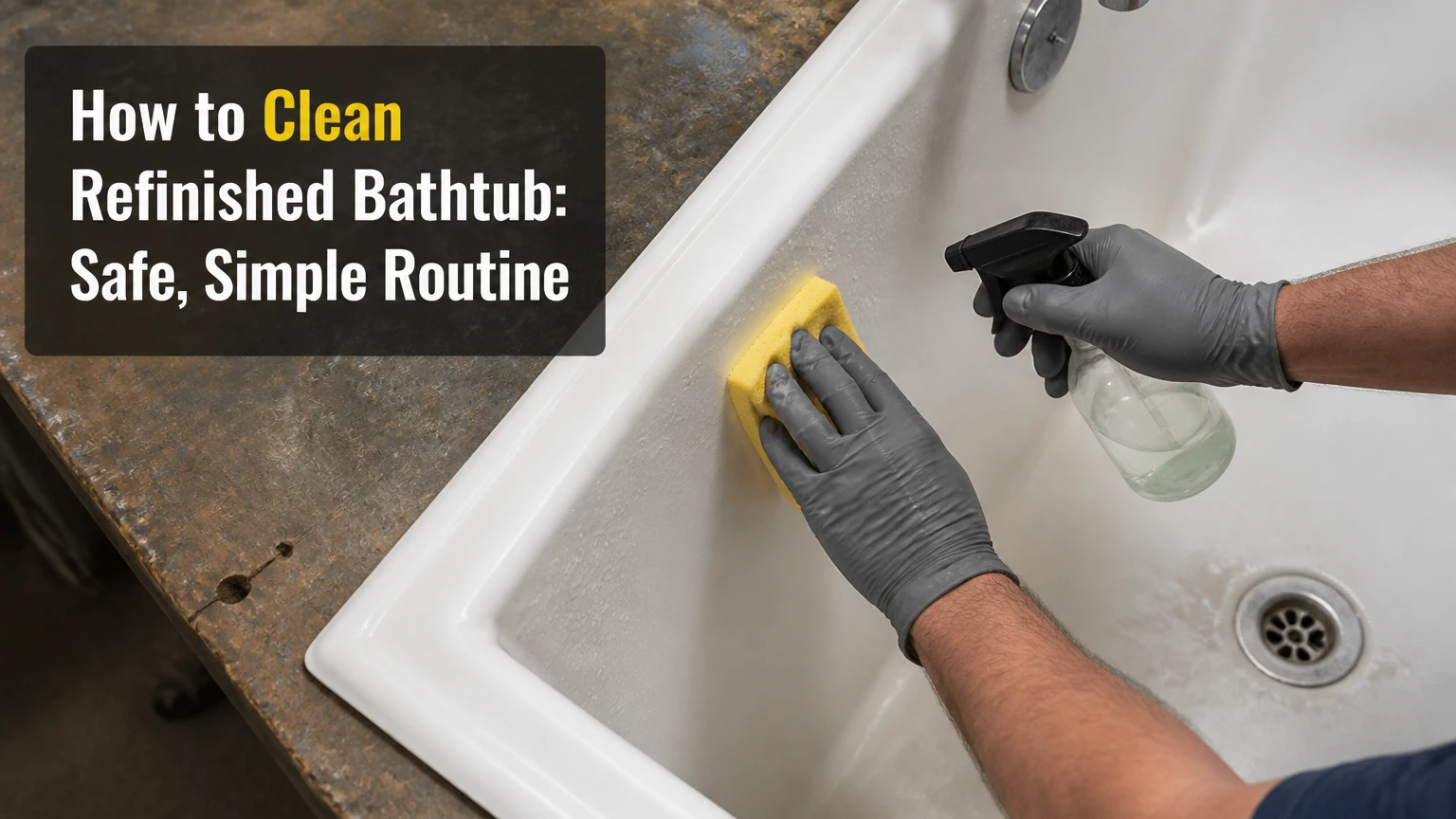
To clean a refinished bathtub, rinse away residue, apply a non-abrasive liquid cleaner, wipe with a soft microfiber cloth or sponge, rinse thoroughly, and dry the coating. The safest routine takes about 10-15 minutes and uses mild dish soap or a refinisher-approved bathroom spray, never abrasive powder, harsh scrubbers, or unapproved chemicals.
Key Facts at a Glance
- A refinished bathtub has a bonded coating, commonly acrylic urethane or epoxy-based, over the original tub surface.
- Soft microfiber, terry cloth, or a non-abrasive sponge is safer than melamine foam, steel wool, or stiff bristles.
- A weekly cleaning uses liquid cleaner, 3-5 minutes of contact time, gentle wiping, thorough rinsing, and immediate drying.
- The refinisher’s written curing instructions override generic advice because coating systems differ.
- Suction-cup mats, abrasive powders, razor blades, and concentrated drain openers can cause permanent coating damage.
- Typical annual supply costs are about $15-$40 for mild cleaner, microfiber cloths, and a soft sponge.
Why a Refinished Bathtub Needs Different Cleaning
A refinished bathtub is not the same as a factory-glazed porcelain fixture. Refinishing, also called reglazing or resurfacing, bonds a primer and topcoat to an existing fiberglass, acrylic, steel, cast-iron, or porcelain tub.
The new surface resembles a durable automotive paint system more closely than fired ceramic glaze. It can resist water and ordinary bathroom soil, but repeated abrasion or chemical exposure may dull the gloss, soften the coating, or weaken adhesion around chips and edges.
Miracle Method, a national bathtub refinishing company, directs customers to use non-abrasive cleaners and soft cleaning tools for refinished surfaces. The same principle appears in care instructions from refinishing contractors such as Florida Refinishing and Surface Doctors, although approved product lists vary by coating manufacturer.
The practical rule is simple: remove soil with chemistry and contact time, not force. A cleaner that is acceptable for an uncoated cast-iron tub can be unsuitable for a sprayed topcoat.
Before You Start
Prepare the right materials before water and cleaner touch the tub. A soft tool and a controlled product are more valuable than a powerful chemical.
| Item | Typical quantity or specification | Purpose |
|---|---|---|
| Liquid dish soap | 1-2 tablespoons per 16-ounce spray bottle | Routine soap-scum removal |
| Warm water | 14-15 ounces per 16-ounce bottle | Dilution and rinsing |
| Microfiber cloths | 2-3 cloths, 250-350 GSM | Wiping and final drying |
| Non-abrasive sponge | 1 soft cellulose or white sponge | Edges, corners, and textured areas |
| Silicone squeegee | 8-12-inch blade | Removing standing water |
| Nitrile gloves | 1 pair | Skin protection |
| Approved bathroom spray | Label-directed amount | Periodic heavier cleaning |
Do not start normal cleaning until the coating has cured according to the installer’s instructions. Many professional systems need approximately 24-48 hours before light use and up to 5-7 days before regular cleaning or full chemical exposure, but temperature, humidity, ventilation, product chemistry, and coating thickness change that schedule.
How to Clean a Refinished Bathtub
A standard refinished bathtub cleaning routine has six actions: clear the surface, rinse it, apply diluted cleaner, wait briefly, wipe without abrasion, then rinse and dry. A typical weekly clean takes 10-15 minutes, while heavy mineral deposits may require several controlled applications rather than harder scrubbing.
Step 1: Remove Bottles, Mats, and Loose Debris
Take shampoo bottles, soap dishes, toys, bath mats, and drain covers out of the tub. Hair and grit can scratch a glossy coating when dragged beneath a cloth.
Rinse loose particles toward the drain with warm water. Do not sweep grit across the floor with a dry towel, because dry friction can create fine marks that become visible under bright bathroom lighting.
You’ll know it worked when: no sand, hair, or product residue remains beneath the items you removed.
Common mistake: leaving bottles on the ledge, which creates a protected strip of soap film and prevents complete rinsing.
Step 2: Wet the Entire Surface
Run warm water over the walls, ledges, floor, overflow cover, and drain area. Full wetting loosens body oils and prevents concentrated cleaner from drying in isolated spots.
Avoid very hot water during routine cleaning if the refinisher specifically warns against it. Extremely hot water is not usually the main cause of failure, but repeated thermal stress can aggravate an already weak edge or repair area.
You’ll know it worked when: water forms a continuous film instead of isolated dry patches.
Common mistake: spraying cleaner onto a dry tub, which can produce uneven concentration and streaking.
Step 3: Apply a Diluted, Non-Abrasive Cleaner
For routine soil, mix 1-2 tablespoons of liquid dish soap with approximately 14-15 ounces of warm water in a clean spray bottle. Alternatively, use a bleach-free, non-abrasive bathroom spray that the coating manufacturer approves.
Apply a light, even layer rather than flooding the surface. Keep cleaner away from exposed chips, unsealed seams, and peeling edges unless the refinisher gives a specific repair-cleaning instruction.
Formula 409, Lysol bathroom spray, and foaming Scrubbing Bubbles products appear on some refinisher care lists. Product formulas change, and one contractor’s approved product is not a universal warranty guarantee, so read the label and the refinisher’s care sheet first.
You’ll know it worked when: the surface is evenly damp and covered, with no dry cleaner residue.
Common mistake: using a powder cleaner or a concentrated product because the tub looks heavily stained.
Step 4: Allow 3-5 Minutes of Contact Time
Let the cleaner sit for 3-5 minutes while the surface stays wet. This dwell period gives surfactants time to loosen oils, soap residue, and ordinary grime without requiring aggressive pressure.
Never allow the product to dry on the coating. If an area dries before the time is complete, mist it lightly with water or cleaner and continue.
You’ll know it worked when: soap film feels slippery and lifts with light cloth pressure.
Common mistake: wiping immediately, then compensating for the short dwell time by pressing harder.
Step 5: Wipe With Soft, Overlapping Passes
Use a damp microfiber cloth or the soft side of a non-abrasive sponge. Work from the upper walls toward the floor in overlapping S-shaped or straight passes, rinsing the cloth frequently so loosened grit does not remain in contact with the coating.
Use a separate cloth for the drain area if hair, rust particles, or gritty scale is present. Clean corners with a folded microfiber edge or soft cotton swab instead of a toothbrush with stiff bristles.
You’ll know it worked when: the surface feels smooth and no visible film remains after one light pass.
Common mistake: using a melamine foam eraser. Melamine foam removes marks through micro-abrasion, so it can dull a refinished topcoat even when the pad feels soft.
Step 6: Rinse Completely and Dry
Rinse all cleaner from the tub, ledges, fixtures, and overflow area. Residual soap can attract dust and create a hazy film.
Use a silicone squeegee or clean microfiber towel to remove standing water, then dry seams and corners. Drying reduces mineral deposits, especially where hard water evaporates around the drain and faucet end.
You’ll know it worked when: the finish is uniformly clean, dry, and free from cloudy streaks.
Common mistake: allowing the tub to air-dry after cleaning. Air-drying leaves dissolved minerals behind when local water hardness is high.
Which Cleaners and Tools Are Safest?
Mild dish soap and water are the lowest-risk starting point for a refinished bathtub. Specialty products can save time on soap film, but the product must be non-abrasive, compatible with the coating, and used at the label concentration.
| Product or tool | Typical use | Contact or use limit | Main risk |
|---|---|---|---|
| Diluted dish soap | Weekly soap film and body oil | 3-5 minutes wet | Poor performance on thick scale |
| Bleach-free liquid spray | Heavier bathroom residue | Label time, often under 10 minutes | Formula incompatibility |
| Foaming bathroom spray | Vertical walls and soap scum | Do not let dry | Fragrance or solvent residue |
| White microfiber cloth | Whole-tub wiping | Rinse after each section | Trapped grit can scratch |
| White non-abrasive sponge | Corners and spot soil | Light pressure only | Repeated friction can dull gloss |
| Melamine foam | Not recommended for routine care | Avoid on coating | Micro-scratches and hazing |
| Powder cleanser | Not recommended | Do not use | Mineral grit abrades finish |
“Non-abrasive” describes the cleaner’s physical action, not necessarily its chemical safety. A liquid product can still contain solvents, strong acids, chlorine compounds, or other ingredients that a particular refinishing system does not tolerate.
Test an unfamiliar liquid cleaner on a hidden 2-inch area, following the label’s full contact time. Rinse and inspect after the surface dries. A test reduces risk, but it does not replace the installer’s warranty instructions.
Which Products Should You Avoid?
Avoid any product or tool that removes soil primarily through grit, aggressive friction, concentrated oxidation, or strong chemical action. The most common damaging choices are Comet, Ajax, Bar Keepers Friend powder, steel wool, green Scotch-Brite pads, pumice stones, razor blades, and stiff scrub brushes.
Concentrated bleach, ammonia, chlorine-based cleaners, strong acidic descalers, and solvent-heavy products also require caution. The exact failure can depend on the coating, but yellowing, gloss loss, softening, discoloration, and edge lifting are more expensive than routine cleaning.
Never mix cleaners. In particular, combining bleach with ammonia or acids can release dangerous gases. Ventilate the room, wear gloves, and follow the label whenever a commercial product is used.
Why Are Suction-Cup Mats Risky?
Suction-cup bath mats can damage a refinished bathtub because trapped water prolongs coating exposure while repeated pulling applies localized stress to the finish. A mat may appear harmless for weeks, then lift a weak area when someone removes it.
Use a non-suction woven polymer mat outside the tub or a refinisher-approved bathmat inside it. Remove the mat after each use, rinse it, and allow both the mat and tub floor to dry.
Are Drain Openers Safe?
Chemical drain openers should not contact a refinished bathtub surface. Caustic or acidic drain products can discolor or soften the coating around the drain, where splashes often remain concentrated.
Prevent contact by using a hair catcher, removing a mechanical clog, or directing an approved drain treatment through a funnel straight into the drain opening. Wipe and rinse accidental splashes immediately, following the product’s safety instructions.
How Do You Remove Hard-Water Scale?
Remove light mineral deposits with a refinisher-approved acidic cleaner or a diluted white-vinegar compress, but avoid prolonged exposure and test first. A practical spot method is to dampen a paper towel with a 1:1 mixture of white vinegar and water, place it over the deposit for 10-15 minutes, then lift the softened residue with a soft cloth.
Do not scrape scale with a razor blade, putty knife, pumice stone, or abrasive pad. If one application does not work, repeat the short treatment rather than extending the contact time to an hour.
Vinegar is not automatically safe for every reglazed surface. Some refinishing warranties prohibit acidic cleaners, and repeated acid exposure can reduce gloss even when one brief application causes no visible damage.
Stop and ask the refinisher for guidance when: white scale surrounds a crack, the coating is already lifting, the deposit remains after two gentle treatments, or the tub has a textured floor that traps residue.
How Do You Remove Rust and Hair Dye?
Treat rust or hair-dye marks as localized stains, not as a reason to scour the whole tub. Begin with diluted dish soap and a soft cloth; if the mark remains, use a refinisher-approved stain product or a small amount of wet baking soda slurry with minimal pressure.
Some care guides recommend a wet paste of baking soda and hydrogen peroxide for organic stains, often with a short 10-15-minute dwell. That combination is not a universal warranty-safe treatment, so test it on an inconspicuous area, keep it away from damaged coating, and rinse it completely.
Hair dye should be addressed quickly because pigments can penetrate microscopic defects and seal lines. Do not use acetone, nail-polish remover, hair-dye remover, or abrasive whitening powder unless the refinisher explicitly approves the product.
| Problem | First treatment | Maximum gentle effort | Escalation point |
|---|---|---|---|
| Fresh hair dye | Dish soap and microfiber | 2-3 passes | Approved stain remover |
| Light rust film | Mild cleaner and soft sponge | 5 minutes wet | Refinisher-approved rust product |
| White scale | Tested 1:1 vinegar compress | 10-15 minutes | Manufacturer-approved descaler |
| Black mold-like spots | Soap, rinse, ventilation | One routine clean | Professional inspection |
| Yellowing in coating | No aggressive home treatment | Stop after washing | Refinishing assessment |
| Peeling around stain | Clean only with soft cloth | No rubbing edge | Repair consultation |
What If the Tub Looks Dull or Feels Rough?
A dull refinished bathtub usually has mineral film, micro-scratching, chemical damage, or coating wear. Clean and dry one section first; if the section remains cloudy under direct light, the problem is probably not removable soil.
Do not automatically apply automotive polish or carnauba wax. Some refinishing professionals permit a compatible liquid polish, while others prohibit wax because it can create a slippery floor, interfere with future repairs, or violate the coating warranty.
A professional may restore moderate gloss through controlled polishing when the coating remains intact. Polishing cannot reliably reverse chemical etching, deep scratches, yellowed resin, or adhesion failure.
Practitioner rule: if a fingernail catches a scratch, if the surface has exposed a different color, or if dullness follows a chemical spill, stop experimenting. More rubbing removes more topcoat.
What Causes Peeling After Cleaning?
Peeling usually indicates an adhesion or coating failure rather than ordinary dirt. Contributing conditions include inadequate preparation during refinishing, moisture beneath the coating, impact damage, incompatible chemicals, standing water under a mat, and cleaning that reaches a loose edge.
Do not glue, paint, or caulk over a peeling section. Temporary patch products rarely reproduce the surrounding coating’s thickness, gloss, color, and bond, and they can make professional preparation more difficult.
Keep the area dry, remove loose items, and photograph the damage. If the refinishing work is under warranty, contact the original contractor before applying any chemical or repair product.
How Long Should You Wait After Refinishing?
Wait for the exact cure period printed by the refinisher, commonly 24-48 hours for limited use and 5-7 days for normal cleaning, chemical exposure, or full cure. A generic seven-day rule is safer than early cleaning, but it is not a substitute for the coating system’s written instructions.
Temperature and humidity matter. A bathroom with poor ventilation, cool air, or high moisture may require longer before the coating reaches its intended hardness.
During the cure period, do not place bottles, mats, suction accessories, or cleaning chemicals in the tub. Avoid standing in it for an emergency shower unless the installer expressly permits that use.
Maintenance Schedules for Different Homes
A low-use guest bathroom may need one full clean each week, while a family tub may need two light cleans weekly. Daily rinsing and drying reduce the amount of chemistry and friction required later.
| Household situation | Cleaning frequency | Daily action | Recommended accessory |
|---|---|---|---|
| Guest bathroom | Every 7-14 days | Rinse after use | Dry microfiber cloth |
| One adult user | Weekly | Squeegee floor | Non-suction mat |
| Two to four users | 2 times weekly | Rinse and ventilate | Soft wall caddy |
| Children’s tub | 2-3 times weekly | Remove toys after use | Drain hair catcher |
| Hard-water home | Weekly plus spot checks | Dry faucet end | Silicone squeegee |
| Rental property | Weekly inspection | Remove residue promptly | Written care sheet |
Landlords should provide a one-page instruction sheet naming prohibited products such as Comet, Ajax, bleach, steel wool, and suction-cup mats. Clear product names work better than the vague instruction “use gentle cleaner.”
How Much Does Safe Care Cost?
Typical refinished-tub maintenance costs about $15-$40 per year for dish soap or approved spray, microfiber cloths, a soft sponge, and occasional replacement of a squeegee. The figure varies with household size and whether the owner buys specialty products.
Repair, recoating, or replacement costs depend heavily on region, tub size, damage extent, plumbing, and finish type. The ranges below are typical planning figures, not fixed market prices.
| Action | Typical cost range | Typical time | Appropriate condition |
|---|---|---|---|
| Routine supplies per year | $15-$40 | 10-15 minutes weekly | Intact coating |
| Spot stain treatment | $5-$25 | 15-30 minutes | Small isolated mark |
| Local coating repair | $100-$300 | 2-5 hours onsite | Small chip or edge damage |
| Full tub refinishing | $350-$700 | 1-3 days including cure | Worn but structurally sound tub |
| Tub replacement | $1,500-$5,000+ | 2-5 days | Structural failure or repeated coating loss |
A sound tub with cosmetic wear is often a refinishing candidate. A leaking, cracked, badly warped, or repeatedly peeling tub may justify replacement rather than another coating.
Common Mistakes and How to Fix Them
Using Powder Cleanser
Failure: Grit dulls the coating and leaves circular scratch patterns.
Fix: Stop immediately, rinse the surface, and inspect it when dry. Light haze may respond to professional polishing, but deep scratches require coating repair.
Scrubbing a Dry Stain
Failure: Dry friction combines pigment and grit into an abrasive paste.
Fix: Wet the area, apply mild cleaner, wait 3-5 minutes, and wipe with a clean microfiber cloth.
Leaving Cleaner to Dry
Failure: Concentrated residue can streak or chemically attack an isolated spot.
Fix: Re-wet the area, rinse thoroughly, and avoid extending the original dwell time.
Using a Razor on Mineral Scale
Failure: The blade can cut through the topcoat and expose the substrate.
Fix: Use a short, tested compress treatment or ask the refinisher for a compatible descaler.
Installing a Suction Mat
Failure: Moisture and suction stress collect at the floor coating.
Fix: Remove the mat, dry the surface, and replace it with a non-suction alternative.
Cleaning Peeling Edges
Failure: Scrubbing can widen the lifted section.
Fix: Stop cleaning the damaged edge, keep it dry, and request a warranty or repair assessment.
The Bottom Line
The safest answer to “how to clean refinished bathtub” is to use warm water, a mild liquid cleaner, a soft microfiber cloth, gentle pressure, complete rinsing, and immediate drying. Clean lightly every week, address stains with short tested treatments, and follow the original refinisher’s warranty instructions before using vinegar, peroxide, polish, wax, or commercial bathroom sprays.
A refinished bathtub rewards frequent low-friction cleaning. It does not reward stronger chemicals or harder scrubbing.
Frequently Asked Questions
Can I use Dawn on a reglazed bathtub?
Yes, diluted Dawn or another mild liquid dish soap is commonly suitable for routine cleaning when the refinisher does not specify a different product. Mix approximately 1-2 tablespoons with 14-15 ounces of water, keep the surface wet for 3-5 minutes, wipe softly, rinse completely, and dry.
Can I use a Magic Eraser on a refinished tub?
A Magic Eraser is melamine foam, which cleans through micro-abrasion. It can remove marks while also creating a dull or hazy area on a refinished bathtub, so it is not a good routine tool. Use microfiber and a non-abrasive sponge instead.
Can I use bleach to disinfect a refinished bathtub?
Do not use concentrated bleach unless the coating manufacturer specifically approves it. Many refinished-tub care instructions discourage chlorine products because repeated exposure can discolor or weaken certain topcoats. Use an approved bleach-free bathroom cleaner and follow the label contact time.
Can I wax a refinished bathtub?
Wax may restore temporary gloss on some intact coatings, but it can create a slip hazard on the floor and interfere with future repairs. Use wax or automotive polish only when the refinisher approves a named product and application method.
How often should I clean a refinished bathtub?
Clean a refinished bathtub weekly in a typical household, or twice weekly when several people use it. Rinse and dry after every bath or shower, because removing soap film and standing water immediately reduces mineral buildup and the need for aggressive treatment.
Should I repair or replace a peeling refinished tub?
Repair or recoating is reasonable when the original tub is structurally sound and damage is localized. Replacement is more appropriate for leaks, major cracks, severe warping, repeated adhesion failure, or damage that extends across large sections of the surface. Contact the original refinisher before attempting a patch.