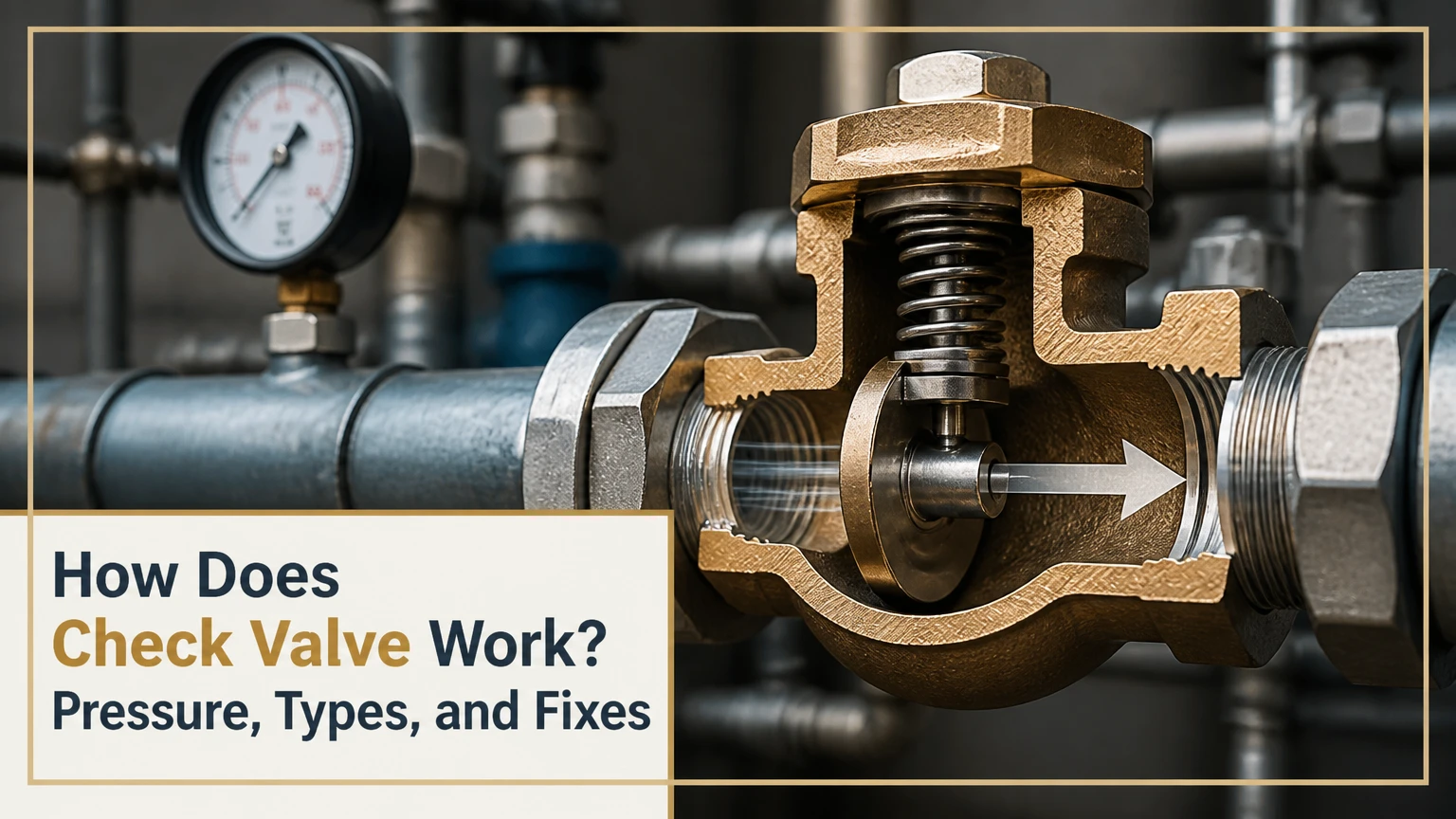
A check valve, also called a non-return valve or one-way valve, allows liquid or gas to move in one permitted direction and automatically blocks reverse flow. The valve opens when upstream pressure overcomes downstream pressure plus the valve’s cracking pressure, then closes through a spring, gravity, hinge action, or backpressure when forward flow falls.
Key Facts at a Glance
- A check valve needs no handle, actuator, electrical power, or control signal during normal operation.
- Forward flow opens the disc, ball, poppet, or plates after the cracking-pressure threshold is reached.
- Reverse pressure normally pushes the closing element onto its seat and tightens the seal.
- Swing check valves usually provide low pressure loss but close more slowly than spring-loaded designs.
- Spring-loaded, dual-plate, and nozzle check valves generally reduce reverse-flow travel and water hammer.
- A valve must be selected for fluid, flow rate, pressure, temperature, orientation, connection size, and seat material.
What Is a Check Valve?
A check valve is an automatic pressure-controlled valve that prevents a pipeline, pump, compressor, or vessel from draining or pressurizing in the wrong direction. Unlike a gate valve or ball valve, a check valve normally has no external handle; fluid pressure moves the internal closure member.
The term covers several mechanisms. A swing valve uses a hinged disc, an inline valve uses a guided poppet, a ball valve uses a spherical closure member, and a dual-plate valve uses two spring-loaded plates. Their shared function is directional flow control, but their pressure drop, closing speed, allowable orientation, and tolerance for solids differ.
A check valve is not a shutoff valve. Most designs are intended to stop reverse flow, not to provide the positive isolation required for maintenance. A leaking check valve can therefore require an upstream isolation valve before service personnel open the line.
Which parts control the flow?
The valve body contains pressure and provides pipe connections. Inside the body, a movable disc, ball, poppet, piston, or pair of plates travels away from a stationary seat when forward pressure is sufficient.
The seat creates the sealing interface. Seats may use metal-to-metal contact or an elastomer such as EPDM, NBR, FKM, or PTFE. A spring supplies closing force in many compact valves, while a hinge, guide, retainer, or cage controls the movement and prevents the closure element from becoming misaligned.
| Component | Typical material | Operating function | Common failure |
|---|---|---|---|
| Body | Brass, PVC, cast iron, 316 stainless steel | Holds pressure and connects to pipe | Corrosion, cracking, thread damage |
| Disc or poppet | Stainless steel, plastic, coated steel | Opens forward passage and blocks reverse flow | Erosion, sticking, deformation |
| Seat | EPDM, NBR, PTFE, bronze, stainless steel | Forms the sealing surface | Cuts, scale, wear, embedded debris |
| Spring | 316 stainless steel, music wire, alloy steel | Returns closure member to the seat | Fatigue, corrosion, loss of force |
| Hinge or guide | Stainless steel, bronze, polymer | Controls disc or piston travel | Wear, binding, broken pin |
How Does Check Valve Work?
A check valve works through a pressure differential across its closure member. During forward flow, inlet pressure pushes the disc or poppet off the seat; during flow reversal, downstream pressure and the closing mechanism move the closure member back against the seat. The valve therefore responds to hydraulic or pneumatic conditions without an operator.
The basic relationship is:
P₁ > P₂ + ΔPcracking
Here, P₁ is inlet pressure, P₂ is outlet pressure, and ΔPcracking is the pressure difference required to move the closure member. Once open, the valve also creates a flow-dependent pressure drop, so the actual operating pressure must cover both cracking pressure and running loss.
What happens during each operating stage?
- Idle condition: The valve is closed because a spring, gravity, or residual backpressure holds the closure member against the seat.
- Pressure rise: A pump, compressor, or upstream source increases inlet pressure.
- Cracking: The pressure differential reaches the manufacturer’s opening threshold, often about 1-5 psi for small standard valves, although some industrial designs require 5-10 psi or more.
- Forward flow: The disc swings, the poppet lifts, the ball moves, or the plates separate. Higher flow generally produces greater opening travel.
- Flow decay: Pump speed falls, a compressor stops, or an upstream valve closes.
- Closure: The spring, gravity, or reverse pressure returns the closure member to the seat.
- Sealing: Backpressure presses the closure member against the seat, limiting reverse leakage.
The exact closure sequence matters. A swing disc may continue moving after the pump stops, allowing a short reverse-flow pulse before sealing. A properly selected spring-assisted or nozzle valve can close earlier and reduce that pulse.
What is cracking pressure?
Cracking pressure is the minimum differential pressure required to begin opening a check valve. It is not the valve’s maximum pressure rating, and it is not the pressure required to produce the valve’s rated flow.
A low cracking-pressure valve may suit gravity drainage or low-pressure suction service, while a stronger spring may be necessary to prevent leakage in a pulsating gas line. The manufacturer’s published value applies to a defined orientation, fluid, temperature, and test method, so a nominal “2 psi” figure should not be treated as universal.
Which Check Valve Type Fits the Application?
Swing, spring-loaded inline, ball, dual-plate, nozzle, and foot valves solve different flow-control problems. Swing valves favor low pressure loss, spring-loaded designs favor rapid closure and flexible orientation, ball valves handle some dirty fluids, and foot valves maintain pump prime at submerged suction inlets.
| Valve type | Typical orientation | Typical strength | Main limitation |
|---|---|---|---|
| Swing check | Horizontal, or approved vertical upward flow | Low pressure drop, high flow capacity | Slow closure and possible water hammer |
| Spring inline | Horizontal or vertical, according to model | Fast closure and broad orientation flexibility | Higher pressure drop and spring wear |
| Ball check | Horizontal or vertical, model dependent | Slurry and viscous-fluid tolerance | Rattle, higher backpressure requirement |
| Dual-plate wafer | Usually horizontal or vertical upward flow | Compact body and quick response | Internal parts are less accessible |
| Nozzle check | Usually engineered pipeline installation | Low-surge closure in pumps and compressors | Higher purchase price and sizing sensitivity |
| Foot valve | Submerged at suction-line intake | Retains pump prime and filters debris | Strainer blockage increases suction loss |
When should you use a swing check valve?
A swing check valve fits clean-water or low-viscosity service where pressure loss must remain low and flow reversal is not abrupt. Its hinged disc can provide a relatively open flow path in a large pipeline, making the design common in water distribution and low-velocity process lines.
Swing valves are poor choices for rapidly cycling pumps, pulsating compressors, or installations where reverse flow must be stopped before a liquid column accelerates backward. Many models also need a specified orientation and sufficient velocity to keep the disc stable.
When is a spring-loaded valve better?
A spring-loaded inline check valve is usually better when the line can be horizontal or vertical, the pump starts and stops frequently, or a short closure distance is valuable. The spring pushes the poppet toward the seat as forward velocity declines, which can reduce reverse travel.
The trade-off is pressure loss. The spring, guide, and poppet occupy part of the flow path, and a valve with an unnecessarily strong spring can prevent the required flow from developing. Check the pressure-drop curve at the real flow rate rather than choosing only by pipe diameter.
What does a foot valve do?
A foot valve is a check valve installed at the bottom of a pump suction pipe, usually below the water surface. Its closure member prevents the suction line from draining when the pump stops, while an attached strainer limits debris entering the pump.
A foot valve cannot compensate for an undersized suction pipe, an air leak, or a blocked screen. Excessive strainer restriction increases net positive suction requirement and can cause cavitation or loss of prime, particularly in shallow wells and long suction runs.
Which Specifications Matter Before Selection?
A correct check-valve specification combines flow conditions, pressure limits, fluid compatibility, installation geometry, and closure behavior. Nominal pipe size alone is insufficient because two valves with the same 2-inch connection can have different cracking pressures, pressure drops, materials, and allowable velocities.
| Specification | Typical residential range | Industrial selection question | Why it matters |
|---|---|---|---|
| Connection size | 1/2-2 in | 2-48 in | Determines fit, not adequate capacity |
| Cracking pressure | 1-5 psi | 2-15+ psi | Affects startup and low-flow operation |
| Pressure class | 125-300 psi | ASME Class 150-2500 | Sets allowable pressure boundary |
| Temperature | 32-180°F for common plastics and elastomers | 180-750°F, material dependent | Changes seal life and body strength |
| Flow coefficient | Published Cv or Kv | Required from flow calculation | Predicts pressure loss |
| Body material | Brass, PVC, cast iron | Carbon steel, alloy steel, 316 stainless | Controls corrosion and pressure capability |
How do you size a check valve?
Size a check valve from actual flow rate, fluid density or specific gravity, pressure drop, and closure behavior, then verify that the connection matches the pipe. A valve should not be oversized merely because its ends fit the line.
Oversizing can leave a swing disc partly open or make a spring poppet flutter. Flutter repeatedly impacts the seat and guide, creating noise, fatigue, and premature wear. Undersizing raises velocity and pressure loss, which may reduce pump output and increase erosion.
For liquids, manufacturers commonly publish Cv, the flow rate in U.S. gallons per minute that produces a 1 psi pressure drop for a specified fluid condition. Metric catalogs may use Kv, usually expressed in cubic metres per hour at a 1 bar pressure drop. Use the manufacturer’s equation and correction factors, especially for gases, steam, viscous liquids, and two-phase flow.
How Should a Check Valve Be Installed?
Install the valve with its body arrow pointing in the intended forward-flow direction, provide the orientation specified by the manufacturer, and keep debris, pipe strain, and unsupported weight away from the valve body. Installation commonly takes 1-3 hours in residential piping when access and isolation are available.
Before installation, verify the fluid, pipe size, pressure and temperature rating, connection type, flow rate, cracking pressure, and vertical or horizontal position. Flush new piping because welding slag, thread sealant, rust, and scale can hold the seat open.
A swing valve installed in a vertical line usually requires upward flow unless its documentation permits another arrangement. Downward flow can prevent gravity-assisted closure. Spring-loaded designs are more tolerant, but the arrow and installation instructions still control.
What should you check after installation?
Open the isolation valve gradually, inspect every connection for leakage, and compare the operating pressure and flow with the design values. A pressure gauge upstream and downstream can reveal abnormal restriction, while a downstream pressure decay test can indicate reverse passing.
You will know the installation is functioning when forward flow reaches the expected rate, differential pressure remains within the published curve, the valve does not chatter, and downstream pressure does not fall rapidly after shutdown. Never use a check valve as the only barrier against hazardous pressure.
Why Do Check Valves Cause Water Hammer?
Check valves cause water hammer when reverse flow begins before the closure member reaches the seat. The moving liquid column then strikes the closed disc, generating a pressure wave that can damage supports, seals, pumps, and pipe joints.
The risk is highest with long liquid lines, high velocity, rapid pump shutdown, and slow-closing swing discs. A spring-assisted, dual-plate, or nozzle check valve may reduce the event by closing before substantial reverse velocity develops, but valve replacement alone does not solve every transient problem.
Water-hammer control may also require a variable-speed drive, controlled pump ramp-down, surge vessel, air chamber, pressure-relief device, or revised pipe layout. Transient analysis is appropriate for large municipal, fire-water, and process systems because closure timing and wave travel depend on pipe length, elasticity, elevation, and fluid velocity.
What Causes Check Valve Failure?
Most check-valve failures come from contamination, incorrect sizing, unsuitable materials, excessive cycling, or water hammer. A check valve that passes reverse flow may have a damaged seat, trapped debris, a weak spring, a bent hinge, or insufficient backpressure for its design.
| Symptom | Likely cause | Diagnostic check | Corrective action |
|---|---|---|---|
| Reverse flow after shutdown | Debris or damaged seat | Isolate and inspect sealing face | Clean, replace seat, or replace valve |
| Loud bang | Slow closure and reverse velocity | Listen during pump stop; inspect supports | Use faster-closing design and assess surge |
| No forward flow | Backward installation or high cracking pressure | Compare arrow and pressure gauges | Reinstall or select a lower-pressure spring |
| Chattering | Oversizing, low velocity, unstable flow | Observe vibration and flow trend | Resize or use a guided, damped design |
| Rising pump discharge pressure | Blocked valve or seized poppet | Measure differential pressure | Remove obstruction or replace internals |
| Loss of pump prime | Leaking foot valve or suction leak | Vacuum or prime-retention test | Repair suction line and replace valve |
A useful practitioner rule is to treat persistent chatter as a sizing problem before treating it as a material problem. Replacing a noisy valve with the same diameter and operating conditions often repeats the failure.
Which Materials and Media Are Compatible?
Brass, PVC, and cast iron commonly suit residential water systems, while 304 or 316 stainless steel supports more corrosive, sanitary, or temperature-demanding service. Seat and seal compatibility matters as much as body material because elastomers may swell, harden, or lose compression in oils, solvents, steam, or disinfectants.
For potable water, confirm local approval requirements such as NSF/ANSI 61 where applicable. Food, beverage, and pharmaceutical systems commonly use 316L stainless steel, sanitary tri-clamp connections, and cleanable elastomers such as EPDM or PTFE, with surface-finish requirements specified by the process.
Dirty water, sewage, abrasive slurry, and viscous liquids need special review. A ball check may tolerate solids better than a small poppet, but large debris can still jam the ball. No check valve is maintenance-free in a contaminated line.
Can a check valve work with gas or vacuum?
A check valve can work with gas, vacuum, or air, but the design must be rated for compressible flow and the required leakage class. Gas flow can produce much larger pressure-drop changes than liquid flow, while a valve suitable for positive pressure may not seal reliably under vacuum.
Select a low-mass closure member, compatible seal, and pressure rating for the gas. Oxygen, hydrogen, natural gas, refrigerants, and medical gases impose additional cleaning, ignition, leakage, and certification requirements. A general plumbing check valve should not be substituted without written compatibility confirmation.
How Much Does a Check Valve Cost?
A residential check valve typically costs $20-$150, with professional installation often adding $100-$400. Industrial valves commonly cost $300-$5,000 or more, while shutdown planning, lifting, welding, testing, and access can exceed the valve purchase price.
| Project context | Valve price | Installation time | Typical labor or project range |
|---|---|---|---|
| 1/2-inch brass household line | $20-$60 | 1-2 hours | $100-$250 |
| 2-inch sump or well line | $45-$150 | 1-3 hours | $150-$400 |
| 4-inch municipal water line | $300-$1,500 | 4-12 hours | $1,000-$6,000 |
| 12-inch process pipeline | $1,000-$5,000+ | 1-3 days | $5,000-$25,000+ |
These are typical planning ranges, not quotations. Regional labor rates, access, isolation requirements, pressure testing, taxes, and material certification can change the total substantially.
How Do You Test and Maintain a Check Valve?
Test a check valve by confirming forward flow, measuring pressure loss, observing shutdown behavior, and checking whether downstream pressure decays during an isolated reverse-flow test. Maintenance intervals depend on cycles, fluid cleanliness, temperature, and the cost of failure rather than on a universal calendar date.
For accessible valves, inspect the seat, disc, spring, hinge pin, and strainer during planned shutdowns. Remove scale and debris without scratching precision sealing surfaces. Replace elastomers when they are cracked, swollen, permanently flattened, or chemically degraded.
A valve that leaks only at low backpressure may be operating within its design limits, because some soft-seat and ball designs need a minimum reverse differential to seal. A valve that suddenly changes from reliable to passing requires inspection, especially after pump work or line cleaning.
FAQ
Can a check valve be installed upside down?
A check valve can be installed upside down only when the manufacturer approves that orientation. Spring-loaded inline valves often tolerate multiple positions, while gravity-dependent swing valves may not close correctly when mounted against their intended flow direction or in a downward vertical line.
Does a check valve reduce water pressure?
A check valve reduces pressure by the amount of flow-dependent loss across its internal passage. The reduction may be small in a correctly sized swing valve but more noticeable in a spring-loaded valve, a dirty strainer, or an undersized fitting.
How long does a check valve last?
A check valve may last several years in clean, moderate-temperature water service, but cycling, abrasive solids, corrosion, and water hammer can shorten life substantially. Industrial service should use cycle counts, inspection findings, leakage limits, and manufacturer recommendations rather than a fixed replacement date.
Do I need a check valve after a water pump?
A pump system often needs a check valve to prevent reverse rotation, drain-back, or loss of prime, but the exact location depends on pump type and system design. A check valve near the pump discharge may protect the pump, while a foot valve protects a flooded suction line.
Is a check valve the same as a backflow preventer?
A check valve and a backflow preventer both limit reverse flow, but they are not automatically equivalent. Backflow-prevention assemblies usually include multiple check elements, test ports, relief features, and certification requirements for protecting potable water from contamination.
Should a check valve be before or after a pump?
A discharge check valve is commonly installed immediately after a pump, subject to the pump manufacturer’s instructions and the hydraulic design. Keeping the valve near the discharge can limit reverse flow through the pump, while suction-side check valves require careful attention to air leaks and inlet losses.
The Bottom Line
A check valve works by converting a pressure difference into automatic mechanical movement: forward pressure opens the closure member, and reverse pressure, spring force, gravity, or hinge action closes it. The right valve depends on more than pipe size. Flow rate, cracking pressure, pressure loss, closure speed, fluid compatibility, orientation, and water-hammer risk determine whether a selected valve will operate reliably.
For a quiet residential pump system, a correctly sized spring-loaded valve is often practical. For low-loss clean-water service, a swing design may be appropriate. For large pumps, compressors, slurry, sanitary processing, or hazardous gas, use an engineered specification and verify the manufacturer’s performance data before installation. Understanding how does check valve work makes those decisions predictable rather than trial and error.