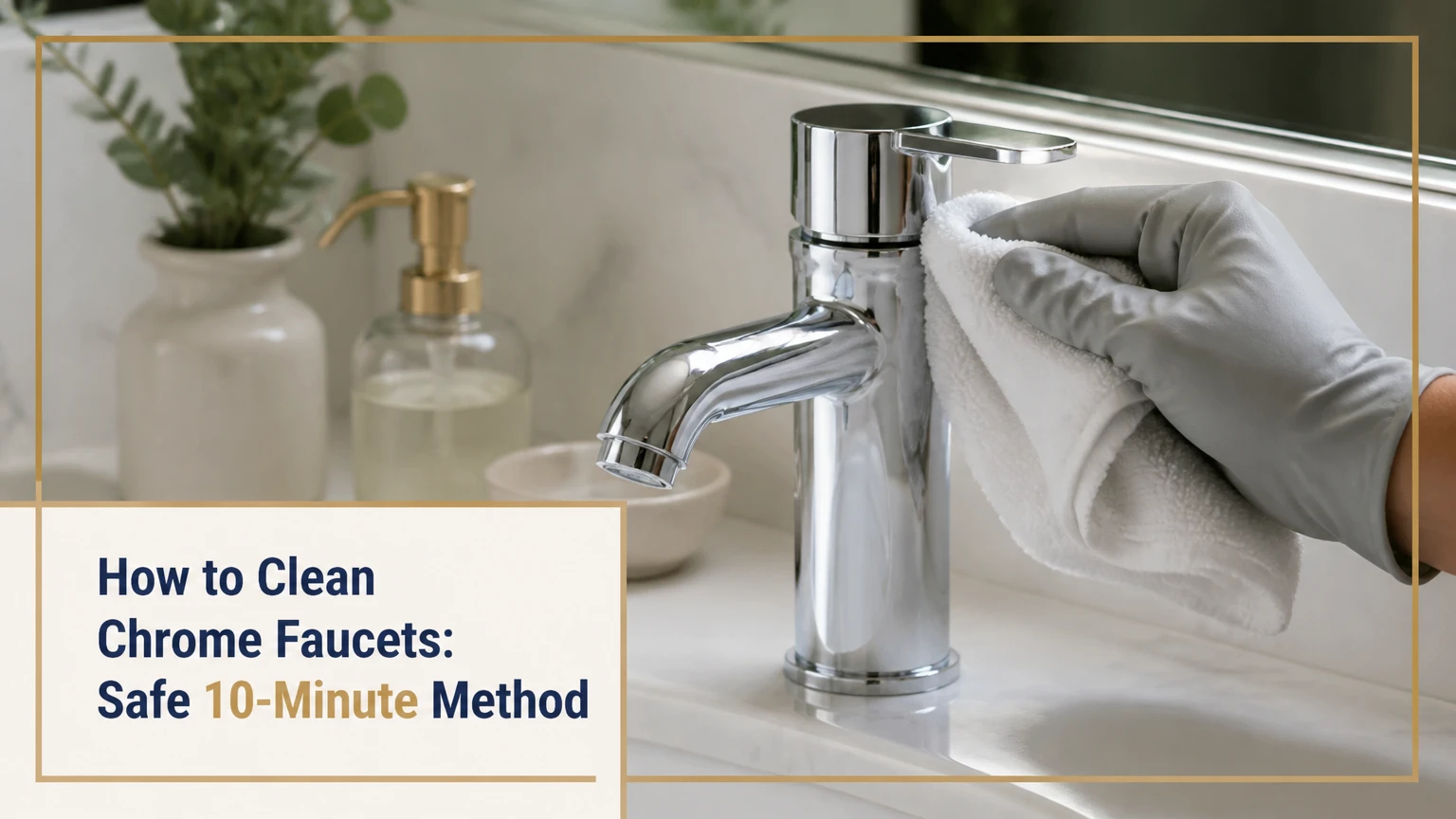
To clean chrome faucets, first wash the surface with diluted dish soap, then rinse and dry it completely with a microfiber cloth. For white mineral scale, apply diluted white vinegar to a cloth for 5-10 minutes, gently brush crevices, rinse thoroughly, and dry immediately. Avoid abrasives, bleach, and prolonged acid exposure.
Key Facts at a Glance
Dish soap and warm water are the safest first-line cleaner for chrome faucets.
A typical diluted vinegar treatment needs only 5-10 minutes for light mineral scale.
Drying after every use prevents water spots from hardening into limescale.
Steel wool, razor blades, abrasive powders, and melamine foam can permanently scratch chrome.
Green corrosion, black pits, and peeling usually indicate damage beneath or within the plating.
Typical household cleaning costs range from $0 to $10, excluding replacement parts.
Before You Start Cleaning Chrome Faucets
Cleaning a chrome faucet usually takes 5-10 minutes for routine soil and 15-30 minutes for hard-water deposits. The safest process costs approximately $2-$10 when you already have dish soap, white vinegar, microfiber cloths, and a soft toothbrush.
| Item | Typical quantity | Purpose | Typical cost |
|---|---|---|---|
| Mild dish soap | 2 drops | Removes grease, oils, and soap film | $0.05 per use |
| Warm water | 2 cups | Dilutes soap and rinses residue | Less than $0.05 |
| Distilled white vinegar | 1 cup | Dissolves calcium carbonate scale | $1-$4 per bottle |
| Microfiber cloth | 2 cloths | Cleans and dries without scratching | $1-$5 each |
| Soft toothbrush | 1 brush | Reaches seams and aerator edges | $1-$4 |
| Spray bottle or bowl | 1 | Holds diluted solution | $1-$5 |
Check the faucet manufacturer’s care instructions before using vinegar. Some brands prohibit acidic cleaners on particular finishes, coated surfaces, seals, or mixed-metal assemblies, and warranty terms may treat chemical damage differently from normal wear.
Protect the drain with a stopper or cloth so a small screw, aerator screen, or rubber gasket cannot disappear down the plumbing. Open a window when using vinegar or any commercial cleaner, and wear gloves if your skin reacts to cleaning products.
What Is Chrome, and Why Does It Scratch?
Chrome on a household faucet is normally a very thin electroplated chromium layer over brass, stainless steel, zinc alloy, or plastic. The chromium surface provides a bright reflective appearance, but the finish is not thick enough to tolerate aggressive polishing or repeated abrasive cleaning.
Chrome resists ordinary corrosion because chromium forms a protective oxide film at the surface. Mineral deposits, however, are not removed by wiping alone once calcium carbonate scale dries and bonds to the fixture. Mild acids dissolve that alkaline scale, while dish soap and surfactants loosen oils, toothpaste, skin residue, and kitchen grease.
The surface can look metallic while remaining vulnerable to abrasion. A new scratch exposes a rougher area that catches more water and residue, so aggressive cleaning can make future spotting worse.
Expert rule of thumb: if a fingernail cannot catch the deposit and a damp microfiber cloth removes it, use soap first. If a white crust remains, use a controlled acid treatment rather than increasing scrubbing pressure.
Step 1: Remove Loose Dirt and Protect Nearby Surfaces
Rinse the faucet with lukewarm water or wipe it with a clean damp microfiber cloth before applying cleaner. Removing grit first prevents loose sand, dried food, and hard mineral particles from being dragged across the chrome during washing.
Do not begin with a dry abrasive motion. A dry cloth can move mineral grains over the surface like fine sandpaper, especially around the faucet base and handle seams.
You’ll know it worked when: loose dust, hair, and visible particles are gone, while the faucet remains wet and free of gritty residue.
Common mistake: spraying cleaner onto a dusty faucet and immediately rubbing. Rinse or lift the particles first.
Step 2: Wash the Faucet With Diluted Dish Soap
Mix approximately 2 drops of mild liquid dish soap into 2 cups of warm water. Dip a microfiber cloth into the solution, wring it until damp rather than dripping, and wipe the spout, handles, base, underside, and escutcheon plate.
Use a soft toothbrush with the same solution around seams, handle collars, the spout outlet, and the perimeter of the drain-side base. Keep the brush pressure light. Chrome does not become cleaner because the bristles are pressed harder.
Dish soap is the best default because it removes organic residue without relying on acid or abrasive particles. It may not dissolve established limescale, but it often removes the cloudy film that people mistake for damaged chrome.
You’ll know it worked when: water spreads more evenly over the surface, greasy fingerprints disappear, and the faucet feels smooth under a clean wet cloth.
Common mistake: using concentrated soap directly on the fixture. Thick soap can leave a film that creates more buffing work.
Step 3: Rinse and Dry the Chrome Completely
Rinse the faucet with clean water until no slippery soap residue remains. Dry every surface with a second microfiber cloth, including the underside of the spout, handle bases, threaded outlet, and seam where the faucet meets the counter or sink.
Drying is a cleaning step, not a cosmetic extra. Evaporation leaves dissolved calcium and magnesium behind, and repeated deposits can form visible water spots even when the faucet was recently washed.
Buff with straight, gentle passes rather than pressing hard in circles. Circular polishing does not repair scratches and can spread remaining grit over a larger area.
You’ll know it worked when: the chrome looks uniformly reflective and no droplets remain around joints or the spout outlet.
Common mistake: allowing the faucet to air-dry. Air-drying is the main cause of recurring spots in hard-water homes.
Step 4: Dissolve White Mineral Deposits With Diluted Vinegar
For white crust or chalky water spots, mix equal parts distilled white vinegar and warm water, such as 1 cup of each. Apply the mixture to a cloth or paper towel rather than flooding the entire faucet, then place the damp material only over the affected deposit for 5 minutes.
Check a hidden area first, particularly if the faucet combines chrome with brushed nickel, painted trim, plastic, rubber, or a special protective coating. Remove the cloth promptly if the finish changes, becomes cloudy, or shows discoloration.
Acetic acid in household vinegar reacts with calcium carbonate scale. A stronger concentration or longer dwell time is not automatically better because the same acidity can attack vulnerable plating defects, seals, surrounding stone, and grout.
After the short treatment, wipe gently with the damp cloth. Use a soft toothbrush for seams, but do not scrape the deposit with metal.
You’ll know it worked when: the scale softens and lifts with light wiping rather than forceful scraping.
Common mistake: soaking the whole faucet overnight. Long exposure can dull vulnerable finishes and may damage seals or adjacent materials. A universal 60-minute maximum is not a manufacturer-approved rule for every faucet, so follow the product instructions instead.
Step 5: Rinse Away Acid and Dry the Surface
Rinse the treated area with plenty of clean water immediately after the vinegar treatment. Remove vinegar from handle gaps, the faucet base, the sink deck, and any nearby natural stone because residual acid can affect materials that are more acid-sensitive than chrome.
Dry the entire fixture with a fresh microfiber cloth. Inspect the finish under bright side lighting, which reveals remaining scale more clearly than overhead light.
Repeat one short treatment if the deposit has softened but not fully disappeared. Do not compensate for poor results by applying stronger acid, using a blade, or increasing scrubbing force.
You’ll know it worked when: no vinegar odor, sticky film, or chalky residue remains and the chrome feels smooth.
Common mistake: rinsing only the visible front of the faucet. Acid trapped behind a handle or at the base can continue working after the surface appears clean.
How Do You Clean a Faucet Aerator?
Remove the aerator when possible, then soak only the removable metal screen and housing in diluted vinegar for 15-30 minutes. Rinse the parts, brush the screen with a soft toothbrush, inspect the rubber washer, and reinstall the aerator without cross-threading it.
The aerator is the small threaded insert at the end of the spout. It mixes air with water and can collect limescale, sediment, and pieces of deteriorated plumbing. A partially blocked aerator may produce a weak, uneven, or spraying stream even when the faucet exterior is clean.
Wrap the aerator with a cloth before using pliers. Turn counterclockwise, keeping the tool on the aerator’s flats rather than gripping the chrome spout. If the aerator will not move, do not twist the entire faucet neck. A plumber may need to remove a seized insert without damaging the spout.
| Aerator condition | Treatment | Time | Replacement decision |
|---|---|---|---|
| Light white scale | Diluted vinegar soak | 15 minutes | Reuse if screen is intact |
| Heavy crust | Vinegar plus soft brushing | 30 minutes | Replace if holes remain blocked |
| Torn screen | No cleaning benefit | 5 minutes to inspect | Install matching aerator |
| Damaged threads | Avoid forced removal | Professional assessment | Replace insert or spout part |
A plastic bag secured around a fixed spout can work for some basic faucets, but it carries greater risk than removing the aerator. The bag can leak onto the counter, the solution can contact seals for too long, and the faucet may have a finish that the manufacturer does not permit to contact acid.
Which Cleaner Is Best for Chrome Faucets?
Mild dish soap is the best routine cleaner, while diluted vinegar is the most practical household option for removable mineral scale. Chrome-specific polish can address light haze after cleaning, but commercial limescale products should be used only when their label explicitly permits chrome and specifies the contact time.
| Cleaner or method | Best use | Contact time | Main risk |
|---|---|---|---|
| Dish soap and warm water | Grease, soap film, fingerprints | 1-3 minutes | Soap residue if not rinsed |
| 1:1 white vinegar and water | Light calcium deposits | About 5 minutes | Dulling with prolonged exposure |
| Citric-acid solution | Controlled mineral removal | Label-dependent | Excess concentration or dwell time |
| Chrome-safe polish | Light haze after washing | Label-dependent | Over-polishing worn plating |
| Baking soda paste | Limited spot treatment away from delicate areas | Under 1 minute | Fine abrasion and residue |
Baking soda is mildly abrasive, so it should not be treated as universally harmless for mirror chrome. If used at all, make a thin paste, test an inconspicuous area, apply almost no pressure, and rinse completely. Dish soap or diluted vinegar is usually safer.
Products such as CLR, Bar Keepers Friend, Flitz, and automotive chrome polishes are not interchangeable. Their formulas, abrasiveness, acidity, and directions differ by product version. Read the current label, confirm chrome compatibility, and never leave a commercial cleaner on the faucet longer than directed.
What Should You Never Use on Chrome?
Never use steel wool, wire brushes, razor blades, pumice, abrasive scouring powder, or melamine foam on a chrome faucet. Avoid bleach, hydrochloric or muriatic acid, drain cleaner, oven cleaner, and mixed cleaning chemicals because they can stain, pit, strip, or discolor the finish.
| Product or tool | Why it causes trouble | Safer replacement |
|---|---|---|
| Steel wool | Leaves scratches and may shed rusting particles | Microfiber cloth |
| Razor blade | Cuts plating and surrounding sealant | Soft toothbrush |
| Melamine foam | Abrades glossy surfaces | Damp microfiber |
| Undiluted vinegar | Increases acid exposure | 1:1 dilution for short contact |
| Chlorine bleach | Can discolor metals and damage seals | Dish soap |
| Drain cleaner | Highly caustic and unnecessary | Manufacturer-approved cleaner |
Never mix vinegar with bleach, ammonia, or other cleaners. Chemical mixtures can release irritating or dangerous vapors, and a faucet does not require blended chemistry to remove ordinary scale.
Practitioner insight: the most damaging tool is often a new kitchen scrub pad. Users recognize steel wool as abrasive but may assume a green or “non-scratch” pad is safe; many pads are designed for cookware, not polished electroplated fixtures.
How Often Should Chrome Faucets Be Cleaned?
Wipe a chrome faucet dry after each use, wash it weekly, and remove mineral deposits when they first appear. Homes with hard water may need a brief scale treatment every 1-2 weeks, while softer-water homes may need deep cleaning only every 1-3 months.
| Routine | Typical frequency | Time | Result |
|---|---|---|---|
| Dry wipe | After each use | 10-30 seconds | Prevents fresh water spots |
| Soap wash | Weekly | 5 minutes | Removes oils and soap film |
| Scale inspection | Weekly | 30 seconds | Finds deposits early |
| Aerator inspection | Every 1-3 months | 5 minutes | Maintains water flow |
| Hard-water treatment | Every 1-2 weeks | 10-20 minutes | Controls recurring limescale |
Water hardness varies by local supply and private well. A household with high calcium or magnesium may see deposits within days, whereas a low-hardness supply can leave the faucet bright for weeks.
A water softener reduces hardness entering the plumbing, but it does not remove existing scale from the faucet. Drying remains useful even after treatment because dissolved minerals and soap residue can still remain on the surface.
Can You Restore Dull or Cloudy Chrome?
A dull chrome faucet can often be restored if the haze is soap film or removable mineral residue; acid-etched, scratched, pitted, or peeling plating cannot be restored through ordinary cleaning. First wash and rinse the faucet, then inspect the surface before choosing polish.
Test the dull area with a damp microfiber cloth. If the haze changes or transfers to the cloth, residue is likely. If the chrome remains cloudy after careful washing and a short compatible descaling treatment, the surface may be etched or worn.
Use a chrome-safe polish only after cleaning, and follow the label. Polish cannot fill deep scratches, rebuild missing plating, or stop corrosion beneath a lifted edge. Repeated polishing can reduce an already thin finish.
What Does Green Residue Mean?
Green residue usually indicates copper compounds from an underlying brass component, often where moisture has entered a damaged or porous area. Clean the surface gently with diluted vinegar, rinse, and dry, but treat recurring green deposits as a possible plumbing or plating problem rather than ordinary dirt.
Green buildup around a handle, base, or seam may be superficial verdigris. It may also signal that the chrome layer has failed and brass is oxidizing underneath. Do not seal active leaks with wax or polish, because trapped moisture can accelerate corrosion.
If the residue returns within days, the faucet may need a cartridge seal, gasket, supply connection, or complete fixture replacement.
What Do Black Spots and Peeling Mean?
Black spots, blisters, bubbling, and peeling usually indicate failed chrome plating or corrosion beneath the finish. Cleaning can remove surface dirt around the defect, but no household cleaner can recreate the missing chromium layer.
A small isolated spot may remain usable if it has no sharp edge or leak. Peeling tends to expand because water enters beneath the plating, so replacement is generally more practical than polishing. Replating is possible for removable specialty parts, but household faucet replacement is often less expensive.
Do not sand the area. Sanding removes more plating and creates a larger exposed region.
Which Situations Need a Different Method?
Kitchen faucets need more degreasing, bathroom faucets commonly need soap-film removal, and shower or utility faucets often need more frequent mineral-scale treatment. The chemistry stays conservative, but the first cleaning stage changes with the residue.
| Situation | Primary residue | Recommended first step | Escalation |
|---|---|---|---|
| Kitchen pull-down faucet | Cooking oil and food film | Dish soap solution | Short diluted-vinegar spot treatment |
| Bathroom sink faucet | Toothpaste, soap, water spots | Warm soapy microfiber wash | Vinegar cloth for scale |
| Shower faucet | Limescale and body oils | Soap wash plus scale inspection | Remove aerator or use approved descaler |
| Well-water faucet | Iron or mineral staining | Identify stain before acid use | Filter or plumbing assessment |
| Rental property | Unknown finish or warranty | Manufacturer-approved soap method | Avoid unapproved acids |
Iron-rich well water may create orange or brown staining that vinegar does not fully remove. A water-treatment professional can identify whether the discoloration comes from iron, manganese, sediment, or corrosion before a stronger product is tried.
Faucets with PVD, matte, brushed, black, gold, or proprietary coatings should not be treated as ordinary polished chrome. Use the care instructions for the actual finish, even when the underlying fixture has a chrome-like appearance.
How Much Time and Money Does Cleaning Take?
Routine chrome-faucet cleaning costs about $0-$10 and takes 5-10 minutes. A deep clean with aerator removal typically takes 15-30 minutes, while a commercial cleaner adds approximately $6-$20 depending on the product and bottle size.
| Task | Typical time | Household cost | Difficulty |
|---|---|---|---|
| Dry after use | 10-30 seconds | $0 | Very low |
| Weekly soap wash | 5-10 minutes | $0.05-$0.25 | Low |
| Localized scale removal | 10-20 minutes | $0.25-$1 | Low |
| Aerator cleaning | 15-30 minutes | $0-$5 | Low to moderate |
| Faucet replacement | 1-3 hours | $50-$500+ | Moderate to high |
A replacement decision should account for leaks, loose handles, cartridge failure, and plating damage, not appearance alone. Spending $15 on several specialty cleaners is poor value if the finish is already peeling or the faucet has an internal leak.
Common Mistakes and How to Fix Them
Leaving Vinegar on Overnight
Problem: prolonged acid exposure can dull vulnerable chrome, attack adjacent stone, and damage seals.
Fix: rinse immediately, wash with diluted dish soap, and stop using acid if the finish looks cloudy.
Scrubbing Harder When Scale Does Not Lift
Problem: pressure removes plating before it removes bonded scale.
Fix: repeat a short diluted-vinegar treatment, then use a soft toothbrush with light pressure.
Using a Blade on the Spout
Problem: a blade can create permanent cuts across the reflective layer.
Fix: soften the deposit with a damp cloth and use a plastic card only if the faucet manufacturer permits it.
Ignoring the Faucet Base
Problem: trapped water and soap at the escutcheon can cause corrosion that spreads beneath the finish.
Fix: clean and dry the seam with a folded microfiber corner or soft toothbrush.
Applying Wax to a Wet or Damaged Faucet
Problem: wax traps moisture and disguises peeling or corrosion.
Fix: use a protective product only on a clean, fully dry, intact finish, and follow the faucet manufacturer’s guidance.
Treating Plating Failure as Dirt
Problem: black pits, bubbling, and peeling are structural finish defects.
Fix: stop abrasive cleaning, check for leaks, and plan repair or replacement.
The Bottom Line
The safest way to clean chrome faucets is to wash them with 2 drops of mild dish soap in 2 cups of warm water, rinse thoroughly, and dry every surface with microfiber. Use a 1:1 vinegar solution only for localized mineral scale, limit contact to about 5 minutes unless the manufacturer says otherwise, and never use abrasives or harsh chemicals.
A dry wipe after each use prevents more buildup than occasional aggressive polishing. If cleaning does not remove cloudiness, or if the faucet has green corrosion, black pits, bubbling, or peeling, the problem is probably damaged plating rather than removable residue. For those conditions, replacement or professional repair is safer than stronger cleaner.
Frequently Asked Questions
Is lemon juice safe for chrome faucets?
Lemon juice can dissolve some mineral deposits because it contains citric acid, but its concentration varies and its pulp or residue can complicate rinsing. Diluted white vinegar is more predictable for a short spot treatment, provided the faucet manufacturer permits acidic cleaners. Always rinse and dry the faucet afterward.
Can I use toothpaste to polish a chrome faucet?
Toothpaste is not a reliable chrome polish because many formulas contain fine abrasive particles intended for teeth. Those particles can create micro-scratches on glossy plating, especially when used with pressure. Clean chrome with dish soap first, then use a product specifically labeled for chrome if polishing is necessary.
Why does my faucet spot again immediately after cleaning?
Immediate spotting usually comes from hard water, incomplete drying, soap residue, or scale remaining around the spout outlet and base. Rinse with clean water, dry with a separate microfiber cloth, and inspect the aerator. A water softener or point-of-use filter can reduce recurring mineral deposits but cannot replace drying.
Can I use WD-40 on chrome faucets?
WD-40 may loosen grime or protect some bare metal surfaces, but it is not a routine faucet cleaner and can leave an oily film around drinking-water outlets. Use dish soap for cleaning and only apply a manufacturer-approved protectant to an intact, fully dry exterior surface away from the water path.
Should I replace a chrome faucet with peeling finish?
Replace a chrome faucet when peeling, bubbling, sharp edges, recurring green corrosion, or leakage affects the fixture. Cleaning cannot restore missing plating, and continued water entry under the finish can enlarge the damaged area. A temporary repair may improve appearance, but it will not recreate a sealed factory finish.
How do I clean chrome without vinegar?
Clean chrome without vinegar by using diluted dish soap and warm water for grease, soap film, and fresh spots. For mineral scale, use a manufacturer-approved citric-acid or chrome-safe descaling product according to its label. Apply the product locally, control dwell time, rinse completely, and dry rather than scraping.