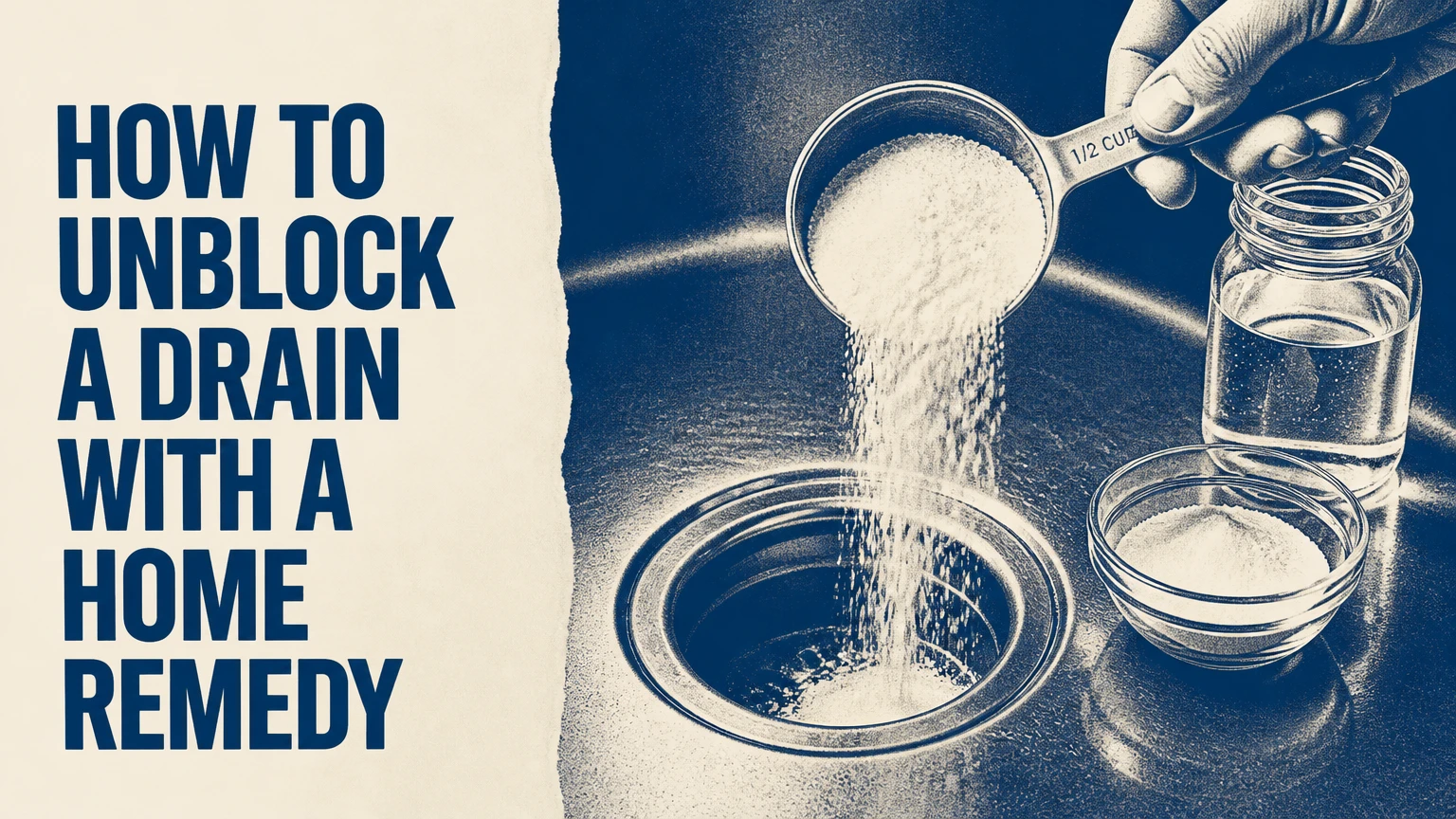
The best way to unblock a drain with a home remedy is to remove standing water, extract visible debris, plunge the drain, and use hot water with dish soap only when grease is suspected. Baking soda and vinegar can loosen light residue or reduce odor, but they rarely clear a dense hair, food, or solid-object blockage.
Key Facts at a Glance
- Mechanical removal works better than fizzing mixtures for most solid drain clogs.
- A plunger needs a water seal and a covered overflow opening to generate useful pressure.
- Hot water and dish soap are most suitable for fresh grease inside a kitchen drain.
- Baking soda and vinegar neutralize each other and cannot dissolve a dense hair mass.
- Never add a home remedy after using a commercial drain opener.
- Multiple blocked fixtures usually indicate a branch-line or main-drain problem.
Before You Start
Most household drain-clearing attempts take 15-45 minutes and cost less than $15 when you already own a plunger. Difficulty ranges from easy for visible hair to moderate when the P-trap must be removed.
| Item | Typical requirement | Purpose |
| Rubber gloves | 1 pair | Protects hands from wastewater and debris |
| Bucket or bowl | 4-8 liter capacity | Removes standing water and catches trap water |
| Cup plunger | 1 | Clears sink, bath, and shower drains |
| Plastic drain tool | 45-60 cm long | Hooks hair near the drain opening |
| Dish soap | 30-60 mL | Helps disperse greasy residue |
| Hot water | 1-2 liters | Flushes loosened residue |
| Baking soda | 120 g, about 1/2 cup | Scours and deodorizes light buildup |
| White vinegar | 120 mL, about 1/2 cup | Reacts with bicarbonate and loosens surface residue |
| Adjustable pliers | 1 pair | Loosens removable P-trap nuts |
| Old towels | 2-3 | Contains splashes and small leaks |
Stop before beginning if corrosive drain opener, bleach, acid cleaner, or an unknown chemical is already in the drain. Liquid drain openers can contain sodium hydroxide, potassium hydroxide, hydrochloric acid, or sulfuric acid, all of which can cause severe burns and dangerous splashback.
Which Home Remedy Should You Use?
The correct remedy depends on the clog material. Hair needs extraction, grease needs controlled heat and surfactant, and a foreign object usually needs physical retrieval.
| Method | Best target | Typical time | Main limitation |
| Remove visible debris | Hair, food, soap deposits | 5-10 minutes | Reaches only material near the opening |
| Cup plunger | Soft trap blockage | 5-15 minutes | Requires a sealed drain and overflow |
| Plastic hair tool | Shower and basin hair | 5-10 minutes | Cannot reach deep branch pipes |
| Dish soap and hot water | Fresh kitchen grease | 15-25 minutes | Does not dissolve hair or hard objects |
| Baking soda and vinegar | Light residue and odor | 20-40 minutes | Weak against complete obstructions |
| Hand-operated drain snake | Deeper hair or soft debris | 15-30 minutes | Can damage a trap if forced |
| P-trap cleaning | Sink trap obstruction | 20-40 minutes | Requires access beneath the sink |
| Professional cable or jetting | Deep, recurring, or main-line clog | 1-3 hours typical | Requires specialist equipment |
The practical order is simple: retrieve, plunge, flush, snake, then inspect the trap. Starting with chemicals can make later manual work more hazardous.
How to Unblock a Drain With a Home Remedy
Step 1: Remove the Standing Water
Scoop out enough standing water to expose the drain opening. Leave approximately 2-5 cm of water only when you are preparing to plunge, because the plunger needs liquid around its rim to transfer pressure.
Use a cup, sponge, wet vacuum, or small container. Empty contaminated water into a working toilet unless the toilet or main drain is also backing up.
Inspect the removed water. Greasy film and food particles point toward a kitchen blockage, while hair and gray soap residue suggest a bathroom clog.
You will know this step worked when: the stopper, strainer, or drain opening is visible and accessible.
Common mistake: Pouring powders into a sink full of water. The powder disperses in the basin instead of reaching the obstruction.
Step 2: Plunge the Drain Correctly
A cup plunger is the best first home tool for a sink, bathtub, or shower blockage. Repeated pressure changes can loosen a soft mass without introducing chemicals into the plumbing.
Remove the stopper or strainer. Seal the sink’s overflow opening with a wet cloth or waterproof tape. For a double kitchen sink, plug the second bowl tightly.
Place the plunger directly over the drain and add enough water to cover the rubber lip. Push gently once to expel trapped air, then perform 15-20 firm strokes while maintaining the seal. Pull upward sharply on the final stroke.
Repeat for no more than three cycles. Endless plunging can compress a hard obstruction or strain weak joints.
You will know it worked when: water forms a visible vortex and drains continuously instead of briefly dropping and rising again.
Common mistake: Using a toilet flange plunger in a flat sink. A simple cup plunger forms a better seal on a level surface.
Step 3: Pull Out Hair and Surface Debris
Hair should be removed, not dissolved. A barbed plastic drain tool or small drain snake can hook a compact hair mass that baking soda, vinegar, or hot water cannot break apart.
Wear gloves and remove the drain cover. Feed the plastic strip 20-45 cm into the drain, rotate it gently, and withdraw it slowly. Place extracted material directly into a bag rather than rinsing it back into the sink.
Repeat until the tool returns with little debris. Flush the drain with hot tap water for one to two minutes.
A straightened coat hanger is a last-choice substitute. Its sharp end can scratch a sink, puncture a flexible connector, or push the obstruction beyond the trap. Bend a small rounded hook and never force it through resistance.
You will know it worked when: the tool stops returning hair and the drain accepts a steady stream of water.
Common mistake: Pushing downward with a smooth wire. This compacts hair deeper into the trap.
Step 4: Flush Grease With Dish Soap and Hot Water
Dish soap and hot water are suitable for a slow kitchen drain affected by fresh oil or soft grease. Dish soap helps disperse oil, while heat reduces the viscosity of fatty residue so flowing water can carry it away.
Pour 30-60 mL of grease-cutting dish soap directly into the drain. Wait 10 minutes. Follow with 1-2 liters of hot water in several controlled pours, pausing to confirm that each portion drains.
Use hot tap water rather than automatically using boiling water. Plastic drain systems, flexible connectors, adhesives, seals, and older joints do not all share the same heat tolerance. An extreme temperature change can also stress cold porcelain.
This method is ineffective against hair, utensils, wipes, coffee grounds, hardened construction material, or a completely sealed obstruction.
You will know it worked when: each water portion drains faster than the previous one and no oily film returns.
Common mistake: Pouring four liters into a fully blocked sink. The basin may overflow before heat reaches the clog.
Step 5: Use Baking Soda and Vinegar for Light Residue
Baking soda and vinegar can loosen light grime and control odor, but they should not be presented as a powerful clog-dissolving treatment. Sodium bicarbonate reacts with acetic acid to produce carbon dioxide, water, and sodium acetate.
Poison Control notes that household drains are not airtight, so the gas usually escapes rather than building enough pressure to dislodge a clog. It also states that the mixture is unlikely to melt a tough oil or grease obstruction.
Remove standing water first. Pour approximately 120 g of baking soda into the opening, followed by 120 mL of white vinegar. Cover the drain loosely to limit splashing, wait 15-30 minutes, then flush with hot tap water.
The visible fizz is not proof that the blockage is dissolving. Most of the reaction occurs where the ingredients meet, often above the actual obstruction.
You will know it worked when: a previously slow drain improves after flushing and the odor decreases.
Common mistake: Using excessive baking soda. Undissolved powder can settle inside a wet trap and create additional sediment.
Step 6: Try Baking Soda and Hot Water Without Vinegar
Baking soda followed by hot water can help scour light soap or fatty residue without immediately neutralizing the bicarbonate with an acid. It remains a maintenance treatment, not a substitute for extraction or snaking.
Pour 60-120 g of baking soda into a drain that still moves slowly. Wait 10 minutes, then add 1 liter of hot tap water in two or three portions.
Do not perform this step after a commercial opener. Iowa State University Extension specifically warns against using a baking soda and vinegar method when commercial drain-opening chemicals have already been used or remain in standing water.
You will know it worked when: the drain continues flowing after a full basin test rather than slowing again within seconds.
Common mistake: Repeating powder-based remedies several times. Residue may accumulate when the underlying obstruction remains intact.
Step 7: Clean the P-Trap or Use a Hand Snake
A sink that remains blocked after plunging and surface cleaning may contain debris in the curved P-trap beneath the basin. The trap intentionally holds water to block sewer gas, but it can also collect food, grease, jewelry, and dense sludge.
Place a bucket beneath the trap. Photograph the assembly so you can restore its orientation. Loosen the slip nuts by hand or with adjustable pliers, support the trap, and lower it into the bucket.
Remove debris manually, wash the trap in another working sink or outdoors, inspect the washers, and reinstall the assembly. Hand-tighten the nuts, then add a small quarter-turn only if leakage appears during testing.
When the trap is clear but the wall pipe remains blocked, insert a hand-operated snake into the exposed drain arm. Advance slowly, rotate through soft resistance, withdraw debris, and avoid forcing the cable around an immovable obstruction.
You will know it worked when: a full basin drains quickly and the reassembled joints remain dry for five minutes.
Common mistake: Overtightening plastic slip nuts. Excessive force can deform washers, crack fittings, and cause leaks.
What Should You Never Mix in a Drain?
Never mix household remedies with bleach, ammonia, toilet cleaner, descaler, hydrogen peroxide, or commercial drain opener. The existing product may contain an acid, alkali, oxidizer, or chlorine compound that reacts dangerously with the next substance.
Poison Control advises consumers never to mix household cleaning products. Vinegar mixed with chlorine bleach can release highly irritating chlorine gas, while ammonia mixed with bleach can release chloramine gases.
Wear gloves and eye protection whenever the drain contains unknown liquid. Do not plunge, snake, or disassemble a trap containing commercial opener because pressure and tool movement can spray corrosive material.
If a corrosive product contacts skin or eyes, rinse with large amounts of water and obtain urgent medical or poison-control guidance. Do not attempt to neutralize a chemical burn with vinegar, lemon juice, baking soda, or another household substance. MedlinePlus warns that adding vinegar or lemon juice after sodium hydroxide exposure may worsen burning.
How Does the Method Change by Drain Type?
Kitchen Sink
A kitchen sink usually blocks because of grease, food waste, coffee grounds, starch, or a jammed garbage disposal. Remove standing water, clear the strainer, plunge both sides as a sealed system, and clean the P-trap if flow does not return.
For a garbage disposal, switch off electrical power before reaching near the opening. Use the manufacturer’s wrench or approved unjamming procedure rather than inserting fingers or metal tools.
Do not rely on hot water alone for a large grease plug. Heat may soften the outer layer and move the grease farther downstream, where it can cool and form a harder branch-line obstruction.
Bathroom Sink
Bathroom sinks usually collect hair, toothpaste, soap residue, cosmetics, and deposits around the pop-up stopper. Remove and clean the stopper before using any liquid remedy.
Hair often wraps around the stopper linkage only a few centimeters below the opening. Cleaning that assembly may restore full flow without plunging or opening the trap.
Cover the overflow hole during plunging. An open overflow prevents the plunger from producing a strong pressure change.
Shower or Bathtub
A shower or bathtub blockage is most often a hair-and-soap mass beneath the grate or crossbar. Remove accessible hair with a plastic barbed tool before plunging.
Some tubs have a trip-lever stopper with internal parts inside the overflow tube. Removing the overflow plate may provide a straighter route for a hand snake than forcing a cable through the drain opening.
Do not pour a large volume of powder through a narrow shower grate. The powder can lodge above the trap.
Toilet
A toilet requires a flange plunger, not a flat cup plunger. Add enough water to cover the plunger head, make 15-20 controlled strokes, and test with a small bucket of water before flushing the tank.
Do not pour boiling water into a toilet. Sudden temperature change can crack porcelain or damage seals. Baking soda and vinegar are also poor choices for wipes, sanitary products, toys, excess paper, or a solid object.
Use a toilet auger if plunging fails. Stop flushing when the bowl level rises, because each additional flush increases the risk of overflow.
Common Mistakes and How to Fix Them
| Problem after treatment | Likely cause | Correct next action |
| Water does not move at all | Complete trap or branch blockage | Stop adding liquid, plunge or snake |
| Water drains, then returns | Obstruction remains downstream | Snake beyond the trap or call a plumber |
| Baking soda remains visible | Insufficient flow carried it away | Remove residue manually and flush only if water moves |
| Sink leaks after trap cleaning | Misaligned washer or loose nut | Re-seat the washer and tighten gradually |
| Several fixtures gurgle | Shared vent, branch, or main-line issue | Stop DIY treatment and arrange inspection |
| Sewage appears in a low drain | Main sewer restriction | Avoid using water and obtain urgent service |
| Drain clears, then blocks again | Pipe-wall buildup, roots, damage, or poor slope | Request camera inspection or professional cleaning |
| Chemical odor or eye irritation occurs | Cleaner reaction or fumes | Leave the area, ventilate safely, and seek poison guidance |
Why Does the Drain Keep Blocking?
A drain that repeatedly blocks is usually experiencing a system problem rather than a one-time plug. Likely causes include accumulated grease, an incorrectly sloped pipe, a damaged joint, scale, a sagging section, inadequate venting, roots, or objects lodged beyond the reach of a household tool.
Frequent treatment may temporarily open a narrow passage without removing the main deposit. The restored flow then carries fresh material onto the remaining obstruction.
A camera inspection is appropriate when the same drain blocks more than twice within several weeks, when multiple fixtures are affected, or when mechanical cleaning encounters the same hard stopping point repeatedly.
When Should You Call a Plumber?
Call a plumber when more than one fixture backs up, sewage appears, a blockage returns quickly, a snake reaches an immovable obstruction, or water leaks inside a wall or cabinet. These signs point beyond a simple surface clog.
Professional help is also appropriate when:
- A corrosive cleaner remains in the pipe.
- The building has fragile, heavily corroded, or unfamiliar plumbing.
- The blockage may involve concrete, grout, roots, or a damaged pipe.
- The trap cannot be removed without disturbing fixed or leaking connections.
- The drain produces persistent sewer odor after the trap is confirmed full.
- Water backs up through a shower when a toilet or washing machine drains.
Mechanical cable cleaning, trap replacement, hydro jetting, vent correction, or camera inspection addresses causes that household ingredients cannot resolve.
How Can You Prevent Another Blocked Drain?
Prevention works by keeping solids and grease out of the plumbing rather than regularly pouring reactive mixtures into it.
Use a hair screen in showers and bathroom sinks. Clean the screen weekly. Scrape plates into a bin, wipe greasy cookware with paper before washing, and collect cooking oil in a container.
Run sufficient water while using a garbage disposal and follow the appliance manufacturer’s instructions. Avoid coffee grounds, fibrous peels, wipes, sanitary products, paint, grout, plaster, and expanding starches.
A monthly visual cleaning of stoppers and strainers usually provides more value than a dramatic homemade reaction. The principle is straightforward. Remove buildup before it enters the trap.
Frequently Asked Questions
What is the strongest natural drain unblocker?
No household ingredient is a reliable universal drain unblocker. A plunger or hand snake is stronger against physical clogs because it applies force directly. Dish soap with hot water may help fresh grease, while baking soda and vinegar are better suited to light residue and odor than a fully blocked drain.
Can salt unblock a drain?
Salt does not reliably dissolve hair, food, plastic, wipes, or a compact grease mass. Coarse salt may provide limited abrasive action when water is already flowing, but adding large amounts to a blocked trap can create more sediment. Mechanical extraction or plunging is a better first response.
How long should a home remedy sit in the drain?
Dish soap can sit for about 10 minutes before a hot-water flush. Baking soda and vinegar can sit for 15-30 minutes, although waiting longer does not turn the neutralized mixture into a stronger cleaner. Stop repeating a remedy when two attempts produce no measurable improvement.
Will Coca-Cola unblock a drain?
Cola is acidic but too weak and too sugary to be a dependable drain opener. It cannot retrieve hair, dislodge a foreign object, or cut through a substantial grease blockage. Pouring a sugary drink into a slow drain may leave additional organic residue if it is not flushed completely.
Can I leave baking soda and vinegar overnight?
Leaving baking soda and vinegar overnight generally provides little added benefit because the acid-base reaction occurs quickly. The mixture becomes mostly water, sodium acetate, and released carbon dioxide. Use modest quantities, flush after 15-30 minutes, and switch to mechanical cleaning when flow does not improve.
Why is my drain blocked when no debris is visible?
The obstruction may sit inside the trap, farther along the branch pipe, or in a shared main drain. Other possibilities include a jammed stopper, disposal fault, venting problem, pipe damage, or poor slope. Gurgling fixtures and simultaneous backups indicate that the problem may extend beyond one drain.
Conclusion
The most dependable answer to how to unblock a drain with a home remedy is to match the method to the blockage. Remove standing water, retrieve visible material, plunge with a complete seal, and use a plastic drain tool or hand snake for hair and soft debris.
Reserve dish soap and hot water for fresh grease. Treat baking soda and vinegar as a light-cleaning or deodorizing option, not as a powerful chemical drain opener. Stop adding substances when the drain remains completely blocked, chemicals may be present, several fixtures are affected, or sewage begins to back up.