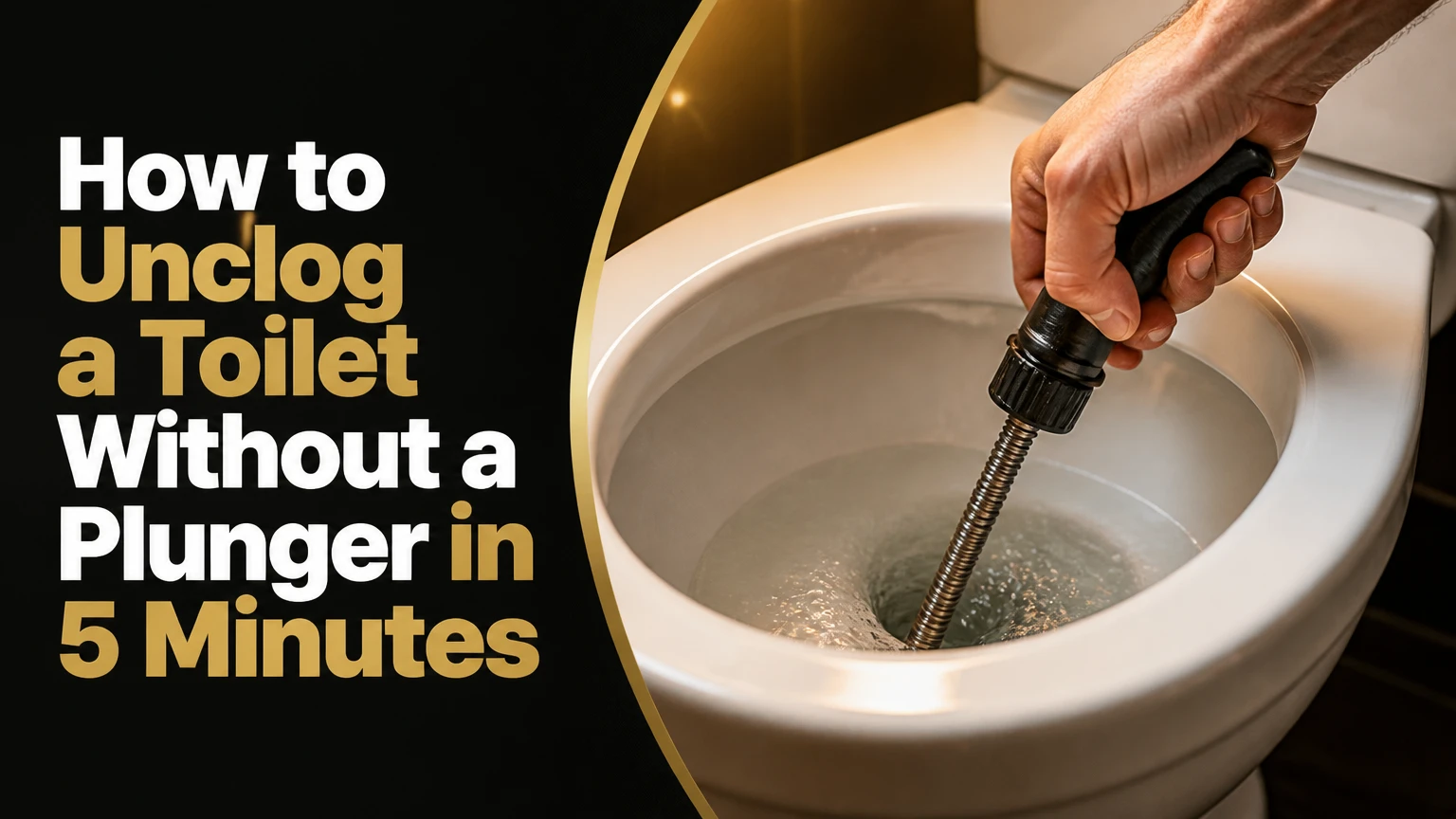
Unclogging a toilet quickly without traditional plumbing tools is entirely achievable using standard household items that break down organic obstructions through lubrication and thermal force. By following a precise seven-step method involving liquid dish soap, controlled hot water, and strategic waiting periods, you can clear standard organic blockages in five minutes with zero mess, provided the obstruction is organic rather than a solid foreign object.
Before You Start
- Time Required: 5 to 8 minutes
- Difficulty Level: Beginner
- Estimated Cost: $0 (using household items)
- Tools and Materials Checklist:
- Liquid dish soap: Exactly $1 \text{ cup}$ (standard dishwashing liquid or hair shampoo)
- Hot tap water: Exactly $1 \text{ gallon}$ ($3.8 \text{ liters}$)
- Container: $1 \text{ bucket}$ or large cooking pot ($2\text{–}3\text{ gallon}$ capacity)
- Digital kitchen thermometer (optional, for precise temperature checking)
- Disposable cup or small container (if bailing is required)
- Rubber cleaning gloves
- Prerequisite Conditions: The toilet bowl must not be filled to the absolute brim, and the clog must consist of organic waste and paper rather than hard plastic, toys, or sanitary products.
Step 1: Assess the Water Level and Prepare the Workspace
Assess the current water level in the toilet bowl to determine whether you can proceed immediately or need to bail water. Put on rubber cleaning gloves to protect your hands from contaminated water. Locate the oval toilet supply shutoff valve on the wall behind the base of the toilet and turn it clockwise until it stops if the water level is dangerously high.
You will know this step worked when you have confirmed that the water level sits at or below the normal baseline level (roughly halfway up the porcelain bowl), or you have successfully isolated the water supply to prevent accidental overflow.
Common Mistake: Proceeding with liquid additives when the bowl is already sitting near the rim. Pouring liquids into a completely full bowl guarantees an immediate floor spill. If the water is at the rim, skip to Step 2 before adding soap.
Step 2: Bail Out Excess Water If Necessary
Scoop out excess water using a disposable cup or small container, pouring the liquid directly into the sink or a separate bucket until the toilet bowl water level drops below the standard halfway line.
You’ll know it worked when the water level in the bowl is reduced by at least half, creating sufficient empty volume to receive the soap and hot water without spilling over the porcelain rim.
Step 3: Add Exactly One Cup of Dish Soap
Pour exactly $1 \text{ cup}$ of liquid dish soap or hair shampoo directly into the toilet bowl, aiming the stream toward the central drain hole. Allow the soap to sit undisturbed for exactly $60 \text{ seconds}$ so it can slide down the porcelain walls and coat the dense organic mass blocking the S-trapway.
You’ll know it worked when you see the viscous soap settle at the bottom of the bowl, coating the perimeter of the drain opening and beginning to penetrate the surface tension of the trapped waste.
Common Mistake: Using powdered laundry detergent or dishwasher powder instead of liquid dish soap. Powders clump together in standing water and create a secondary obstruction within the trapway, worsening the block.
Step 4: Prepare One Gallon of Hot Tap Water
Fill your bucket or large pot with exactly $1 \text{ gallon}$ of hot tap water from your bathroom or kitchen sink, ensuring the water temperature reads between $45^\circ\text{C}$ and $55^\circ\text{C}$ ($110^\circ\text{F}$ to $130^\circ\text{F}$) on a kitchen thermometer, or feels comfortably hot to the back of your bare hand without scalding.
You’ll know it worked when your bucket contains precisely one gallon of steaming, non-boiling water ready for deployment.
Common Mistake: Using boiling water straight from a stove burner. Extreme thermal shock from boiling water ($100^\circ\text{C}$ or $212^\circ\text{F}$) will crack the fragile porcelain of the toilet bowl, causing thousands of dollars in structural damage and a major indoor flood.
Step 5: Pour the Hot Water from Waist Height
Lift the bucket of hot water to waist height and pour the liquid in a fast, steady, and continuous stream directly into the center of the toilet bowl drain opening. Maintain a steady flow rate to maximize the kinetic pressure and thermal energy hitting the soap-lubricated clog.
You’ll know it worked when the water rushes cleanly down into the trapway without splashing dangerously over the outer rim of the bowl, immediately mixing with the dish soap to form an active grease-cutting solution.
Common Mistake: Pouring the water too slowly or holding the bucket too low. A slow pour lacks the hydraulic force required to push the lubricated mass past the apex of the internal S-trap.
Step 6: Wait Three to Five Minutes for Thermal Action
Leave the mixture undisturbed inside the toilet bowl for a duration of $3$ to $5$ minutes, allowing the combination of heat, lubrication, and surfactant breakdown to dissolve the structural integrity of the paper and organic waste.
You’ll know it worked when you observe a gradual, visible drop in the water level inside the bowl as the clog slowly gives way and slips down the drainage pipe.
Step 7: Test Flush and Verify Drainage
Lift the toilet tank lid and press the flush handle down fully, watching the vortex of water enter the bowl to confirm that drainage is completely restored.
You’ll know it worked when the toilet flushes smoothly with normal suction, clearing all contents within $5\text{–}7\text{ seconds}$ and returning the bowl to its normal clean water level.
Common Mistake: Pressing the flush handle before the water level has dropped or before the full 3-minute waiting period has elapsed. Flushing prematurely while the clog is still partially lodged will cause an instant overflow.
Common Mistakes and How to Fix Them
Navigating unexpected setbacks requires knowing how to recover when standard organic clearing methods stall. Below are the most frequent failure modes encountered when executing this technique, paired with professional recovery strategies.
The Water Level Does Not Drop After Five Minutes
- Cause: The obstruction is too dense, fibrous, or composed of compacted personal hygiene products that dish soap cannot break down.
- Recovery: Add $1 \text{ cup}$ of baking soda followed by $2 \text{ cups}$ of white vinegar directly into the standing water. Allow the solution to fizz and bubble for $20$ minutes to chemically dissolve organic matter, then pour another half gallon of warm water into the bowl and test the flush.
The Bowl Fills to the Brim Instantly Upon Pouring Water
- Cause: The vent stack on your roof is blocked, or the main sewer line is partially obstructed, preventing air displacement.
- Recovery: Stop adding liquids immediately. Use a wet/dry shop vacuum designed for plumbing extraction to pull the water out of the bowl, or wait $30$ minutes for the water level to slowly seep past the blockage on its own before attempting a mechanical fix.
The Clog Clears Partially but Keeps Slow-Draining
- Cause: Residual grease or soap scum residue remains plastered along the interior walls of the S-trapway.
- Recovery: Boil a kettle of water, let it cool for $5$ minutes until it is hot but safe ($70^\circ\text{C}$ or $160^\circ\text{F}$), mix in $1$ tablespoon of liquid dish soap, and pour it gently down the drain to flush out the remaining residue.
Variations: Alternative Scenarios and Adjustments
Different bathroom constraints require small adjustments to ensure success without damaging your plumbing system.
Low-Flow and High-Efficiency (HET) Toilets
- Adjustment: Modern water-conserving toilets feature narrow, complex trapways that hold less total volume. Reduce your hot water volume from $1 \text{ gallon}$ to $0.5 \text{ gallons}$ ($2 \text{ liters}$) and reduce the dish soap quantity to $0.5 \text{ cups}$ to prevent overflow within the smaller bowl reservoir.
Hard Water and Mineral Build-Up Clogs
- Adjustment: If hard water scale has narrowed your toilet trapway over time, combine $1 \text{ cup}$ of white vinegar with the dish soap step and let it sit for $15$ minutes to dissolve calcium deposits before applying the hot water pour.
Commercial or Industrial Toilets
- Adjustment: Institutional toilets possess larger trap diameters and commercial flushometers. Increase your hot water volume to $2 \text{ full gallons}$ ($7.5 \text{ liters}$) and use $1.5 \text{ cups}$ of concentrated industrial dish soap to generate enough thermal and surfactant mass to clear the wider pipe.
How Long Does It Take / What Does It Cost
- Time Investment: Total elapsed time ranges from 5 to 12 minutes, depending on whether secondary chemical soaking (baking soda and vinegar) is required to break down stubborn obstructions.
- Financial Cost: $0.00 to $0.50. Since this method relies entirely on standard household supplies already present in your kitchen and bathroom, out-of-pocket expenses are negligible compared to hiring an emergency plumber, which typically costs between $150 and $350.
Frequently Asked Questions
Can I use shampoo instead of dish soap if I am out of dish liquid?
Yes, standard hair shampoo, body wash, or even liquid hand soap serve as effective substitutes. They contain similar surfactant properties that reduce water surface tension and lubricate the porcelain trapway. Avoid using hair conditioner, as its heavy wax and silicone bases can coat the clog and make it stickier.
Why is boiling water strictly forbidden for unclogging toilets?
Porcelain is a ceramic material that expands and cracks when exposed to sudden, extreme thermal differentials. Pouring boiling water ($100^\circ\text{C}$) into a cold or room-temperature toilet bowl creates internal stress fractures that cause the entire bowl to crack, resulting in an immediate and catastrophic structural leak.
What should I do if chemical and soap methods completely fail?
If hot water, dish soap, and baking soda fail to clear the blockage within two consecutive attempts, a solid foreign object—such as a child’s toy, a washcloth, or a plastic cap—is likely lodged mechanically across the trapway bend. You must stop pouring liquids and use a rubber-headed toilet auger (plumbing snake) to hook and retrieve the object.
Can I flush the toilet while waiting for the hot water to work?
Never flush the toilet while waiting for the soap and water mixture to take effect. The bowl is already at or near capacity; adding another full flush cycle of water from the tank will immediately overwhelm the blocked trapway and flood your bathroom floor. Always verify that the water level has naturally dropped before testing the flush.
How often can I safely use the dish soap method on my toilet?
You can use the dish soap and hot water method as frequently as needed for recurring organic clogs without damaging your pipes or wax ring. Unlike harsh chemical drain cleaners that generate intense heat and degrade PVC pipe glue and rubber seals, dish soap and warm water are entirely safe for all standard residential plumbing systems.