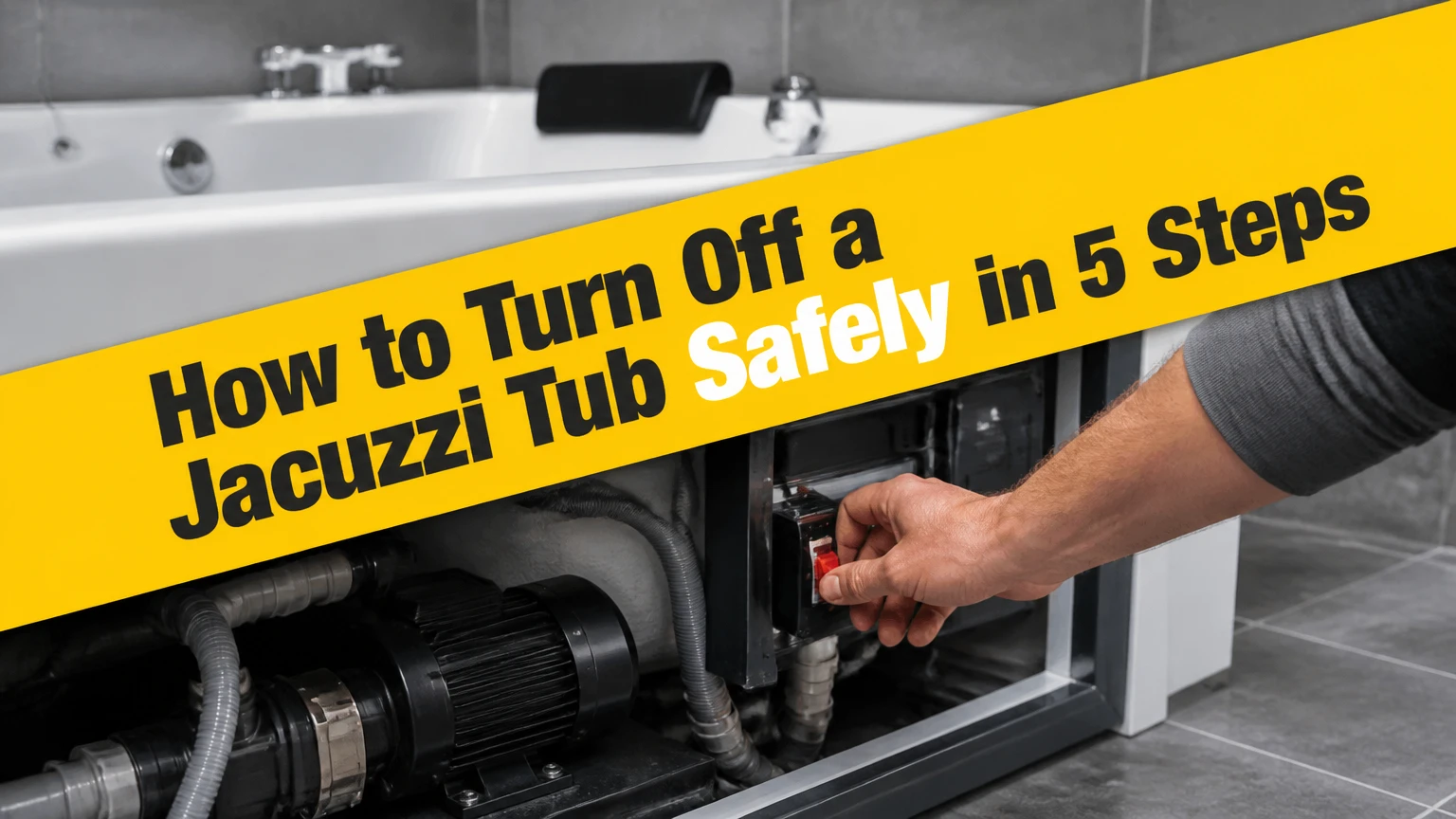
To turn off a Jacuzzi tub, press the jet or pump control until the water movement and motor noise stop, then drain or clean the tub as appropriate. For complete electrical isolation, switch off the dedicated GFCI-protected disconnect only after all controls are off. Never drain an active whirlpool pump, and never leave a filled outdoor spa unprotected in freezing weather.
Key Facts
A control-panel shutdown stops the jets but usually leaves filtration, heating, and freeze protection available.
A breaker or disconnect shutdown removes electrical power and is intended for maintenance, draining, or service.
The correct indoor sequence is controls off, pump stopped, drain opened, then basin cleaned.
Outdoor spas may continue low-speed filtration after the jets stop, even when the display appears quiet.
Jet timers are manufacturer settings, not universal rules; many cycles last about 15 minutes, but some differ.
A filled outdoor spa needs active freeze protection or professional winterization when temperatures may fall below freezing.
What Kind of Jacuzzi Tub Are You Turning Off?
A Jacuzzi tub can mean an indoor jetted bathtub or an outdoor portable spa, and the shutdown method differs because the two systems manage water, heat, and freeze risk differently. An indoor bath is normally emptied after use, while an outdoor spa is usually kept full and powered between sessions.
“Jacuzzi” is a brand name commonly used for whirlpool baths and hot tubs. The controls may be pneumatic, electronic, touchscreen-based, or integrated into a smart-home system. Identify the equipment before switching power because the correct disconnect might be beside an outdoor spa, in a service panel, or behind an indoor access panel.
| Equipment type | Normal water condition | Primary user control | Correct routine shutdown |
|---|---|---|---|
| Indoor whirlpool bathtub | Empty after bathing | Air button or rim panel | Jets off, pump stopped, drain open |
| Indoor air-jet bath | Empty after bathing | Blower button or digital panel | Blower off, water drained, surface dried |
| Portable outdoor hot tub | Filled continuously | Topside digital panel | Jets off, filtration and heat remain available |
| Hardwired outdoor spa | Filled continuously | Topside panel and GFCI disconnect | Panel off for routine use, disconnect for service |
| Swim spa | Filled continuously | Multi-pump control system | Stop each pump, then use operating mode or disconnect |
How can you identify the main controls?
Look for labels such as Jets, Pump, Blower, Heat, Light, Standby, Mode, or Power. An older indoor Jacuzzi bath may have a small round button that activates an air switch; the button does not carry motor voltage through the user’s wet hand.
An outdoor spa usually has a topside panel with a temperature display and several buttons. The main electrical disconnect is often a nearby weather-resistant box containing a GFCI breaker, although local electrical layouts vary. Do not remove service-panel covers to find it.
How Does Turning Off the Tub Work?
The control button sends a command to a relay, air switch, or control board, which removes power from the jet pump or air blower. A separate breaker or GFCI disconnect removes incoming electrical supply, so the tub may remain capable of filtration, heating, lighting, or freeze protection after a normal button shutdown.
An indoor whirlpool pump draws water through an intake and returns it through hydrotherapy jets. An air-jet bath uses a blower to push air through small floor or wall outlets. An outdoor spa can contain several pumps, a heater, circulation plumbing, ozone equipment, and an electronic controller.
The visible jet button may therefore stop only one function. A quiet pump does not prove that every internal component is de-energized. Jacuzzi installation and operating manuals generally distinguish normal control operation from service isolation, and the National Electrical Code Article 680 addresses electrical safety around pools and spas in the United States.
What is the difference between a soft and hard shutdown?
A soft shutdown uses the tub controls and preserves programmed operation. A hard shutdown uses the dedicated disconnect or breaker and is appropriate when a person will access equipment, drain certain systems, or perform electrical or plumbing work.
| Shutdown method | Power status | Best use | Main risk |
|---|---|---|---|
| Jet button off | Jet pump off, controller powered | Daily indoor or outdoor use | Filtration or heater may continue |
| Standby mode | Functions paused temporarily | Filter access or short inspection | Mode duration varies by controller |
| Economy or vacation mode | Heating and filtration reduced | Short energy-saving absence | Water quality may decline if neglected |
| GFCI disconnect off | Spa equipment de-energized | Service, full drain, long shutdown | Freeze damage or lost sanitation |
| Household main breaker off | Multiple circuits de-energized | Electrical emergency only | Unnecessary loss of home services |
The practical rule is simple: use the control panel for ordinary operation, and use the disconnect for electrical isolation. Do not use repeated breaker cycling as a substitute for diagnosing a failed control.
How to Turn Off an Indoor Jacuzzi Tub
Use the following sequence for an indoor jetted bathtub. The process normally takes 2-5 minutes after bathing, excluding the time required for the basin to drain.
Before you start
| Requirement | Typical value |
|---|---|
| Time after controls stop | 2-5 minutes |
| User difficulty | Low |
| Tools | None for routine shutdown |
| Water temperature | Usually 90-104°F, depending on use |
| Required prerequisite | Water must cover pump intake while jets run |
| Service isolation | Dedicated breaker or disconnect, when installed |
Step 1: Turn off the jets and blower
Press the Jets, Pump, or Blower button once. On a pneumatic system, press and release the round air button; on a digital panel, use the button shown in the operating instructions rather than holding the control unless the manual specifies a long press.
The success checkpoint is a complete stop in water movement and motor or blower noise. A low hum may indicate a separate circulation function, but an indoor bathtub should not continue pumping as the water level falls.
The common mistake is pressing the light button or changing the temperature instead of stopping the pump. Confirm the jet streams have stopped before touching the drain.
Step 2: Stop every active function
Turn off the second pump, heater boost, light, and any air control that remains active. Some baths have separate buttons for high-speed and low-speed jets, while others cycle through off, low, and high settings with repeated presses.
The success checkpoint is that no jet produces water or air and no pump sound increases when the control is pressed. If the panel has a lock symbol, unlock it according to the manufacturer’s instructions before assuming the control has failed.
The common mistake is treating a light that remains on as proof that the pump is running. Lights and pumps commonly use separate circuits or relays.
Step 3: Wait for the pump to stop completely
Wait about 30-60 seconds after the final control command. A short delay can occur while a controller completes a programmed cycle, but an indoor bath should not run indefinitely with the drain open.
The success checkpoint is a silent pump and no visible water circulation around the intake. Keep the water level above the intake until the motor stops because a running pump can draw air when the basin level drops.
The common mistake is pulling the plug while the jets operate. Jacuzzi and other whirlpool manufacturers warn against operating a pump without adequate water because air entry can cause loss of prime, noise, or mechanical damage.
Step 4: Open the drain
Pull or turn the drain stopper after the pump has stopped. Let the basin empty naturally, and do not restart the jets to speed draining unless the specific manual expressly permits that procedure.
The success checkpoint is a water level below the jet openings without pump noise. If the drain is slow, remove hair and visible debris from the stopper rather than running the pump.
The common mistake is using a wet vacuum on a built-in pump or opening an access panel while the electrical supply is live. Those actions require equipment-specific instructions and, for electrical work, a qualified person.
Step 5: Rinse and dry the bath
Rinse soap, oils, and bath products from the basin, then wipe the surface with a non-abrasive microfiber cloth. Leave the drain open briefly if the manufacturer permits it, and dry around the control buttons so moisture does not remain in crevices.
The success checkpoint is an empty basin with no standing water around the intake, jets, or drain. Do not use abrasive powders or solvent cleaners unless the tub manufacturer lists them as compatible.
How to Turn Off an Outdoor Jacuzzi Hot Tub
For routine outdoor spa use, press the jet controls off and leave the main electrical supply on so filtration, temperature control, and freeze protection can operate. For maintenance or a complete drain, turn off the topside functions first, then switch off the spa’s dedicated GFCI disconnect.
Outdoor spas differ from indoor baths because the water normally remains in the shell. A full power cut can stop the circulation that protects plumbing from freezing and can allow sanitizer levels and water quality to deteriorate.
Which controls should you turn off first?
Turn off each jet pump, air blower, waterfall, light, and auxiliary feature from the topside panel. The heater may not have a separate off button because many spa controllers activate heating automatically when the water temperature falls below the set point.
Set the temperature lower or select Economy, Away, or Vacation mode only when the owner’s manual supports that mode. These labels are not standardized. Some systems maintain filtration and a reduced temperature, while others pause heating for a specified period.
| Situation | Topside action | Disconnect action | Water treatment action |
|---|---|---|---|
| End of a normal soak | Jets and lights off | Leave on | Check sanitizer on schedule |
| Overnight absence | Jets off, normal mode | Leave on | Cover spa securely |
| Weekend away | Vacation or economy mode | Usually leave on | Test sanitizer and pH |
| Equipment maintenance | All functions off | GFCI disconnect off | Do not use spa |
| Complete drain | All functions off | Disconnect off after shutdown | Follow drain and cleaning procedure |
| Freezing weather | Freeze-protection mode | Leave on unless winterized | Maintain water or hire winterization |
Step 6: Select the correct operating mode
Choose normal, economy, sleep, standby, or vacation mode according to the control panel’s manual. A spa in standby may pause heating for a limited interval, while economy mode may reduce heating but continue scheduled filtration.
The success checkpoint is a mode indicator that matches the intended setting and a temperature schedule that you understand. Write down the original temperature and mode before changing them, especially in a rental or shared property.
The common mistake is assuming economy mode means the spa is electrically off. Economy mode normally reduces operation rather than isolating the circuit.
Step 7: Use the GFCI disconnect for a complete power-down
Locate the dedicated spa disconnect, verify that the control functions are off, and move the breaker to OFF. Do not stand in water, touch a wet disconnect, or open an equipment compartment to reach wiring.
The success checkpoint is a dark control display and no pump, heater, or circulation sound. A GFCI protects against ground-fault current, but it does not make wet electrical work safe while the circuit remains energized.
The common mistake is turning off a random household breaker. Use the circuit identification label and confirm the spa is actually de-energized before service.
How Long Should a Jacuzzi Tub Stay Off?
An indoor jetted bathtub can remain off indefinitely once drained and dry. A filled outdoor spa can usually remain in normal or reduced operation for a short absence, but the required setting depends on ambient temperature, sanitation, cover condition, and the manufacturer’s maintenance schedule.
| Absence period | Indoor jetted bath | Filled outdoor spa | Recommended action |
|---|---|---|---|
| 1 night | Drain and wipe | Leave powered | Cover, verify water level |
| 2-3 days | Drain and dry | Economy or normal mode | Test sanitizer before use |
| 1-2 weeks | Drain and clean | Vacation mode if supported | Arrange water checks |
| 2-4 weeks | Drain and isolate if needed | Professional care preferred | Maintain chemistry and filtration |
| Freezing period | Drain house plumbing as needed | Keep freeze protection active | Winterize professionally if off |
| Long-term storage | Drain, dry, clean | Drain and winterize | Remove water from pumps and lines |
Manufacturers commonly program jet sessions to stop automatically after approximately 15 minutes, but the duration varies by model and controller. Automatic shutoff is an operating convenience, not a guarantee that a defective relay, circulation pump, or heater has stopped.
Can You Turn Off the Breaker With Water Inside?
You can turn off the breaker with water inside, but leaving an outdoor spa filled and unheated is unsafe when freezing temperatures are possible. Water expands as it freezes, and trapped water in pumps, manifolds, filters, and plumbing can split components even when the shell itself remains intact.
A complete winter shutdown requires more than flipping the disconnect. Typical winterization includes draining the shell, removing filter cartridges, opening drain points, blowing or vacuuming water from plumbing lines, and protecting equipment according to the manufacturer’s instructions.
The exact freeze-damage timeframe cannot be guaranteed. Air temperature, wind, insulation, water volume, equipment design, and the length of the freeze all change the outcome. Treat any filled, unpowered spa in freezing weather as a damage risk rather than relying on a fixed 24-hour or 48-hour rule.
An indoor bath presents a different issue. Power can remain off while the basin is empty, but water trapped in concealed plumbing may still require the manufacturer’s cleaning or purge procedure before extended storage.
What If the Jets Will Not Turn Off?
If Jacuzzi jets will not turn off, stop trying the topside button and switch off the dedicated GFCI disconnect if you can reach it safely. If the breaker trips repeatedly, smells hot, shows damage, or will not reset, leave the power off and contact a licensed electrician or spa technician.
| Symptom | Likely cause | Safe user action | Service boundary |
|---|---|---|---|
| Button does nothing | Locked panel or failed switch | Unlock or reset per manual | Replace control if persistent |
| Air button feels loose | Disconnected air tube | Turn power off, inspect only accessible tubing | Repair switch or tube |
| Jets restart after reset | Welded relay contact | Keep disconnect off | Circuit-board diagnosis |
| Pump hums but water stops | Lost prime or blockage | Power off immediately | Pump and suction inspection |
| GFCI trips | Ground fault or wet component | Do not repeatedly reset | Electrical testing |
| Display is dark, pump runs | Separate relay or wiring fault | Isolate at disconnect | Qualified service required |
How do you reset an unresponsive control panel?
Turn the spa off at its dedicated disconnect for the period specified in the manual, commonly 30 seconds to several minutes, then restore power and observe the startup sequence. A reset may clear a temporary software or keypad condition, but it will not repair a mechanically welded relay.
For an indoor pneumatic button, do not blow compressed air into a tube while the pump is energized. A disconnected or water-filled air line can indicate a failed air switch, damaged tubing, or incorrect installation. Replace parts only with model-compatible components after isolating power.
A pump that starts immediately when power returns points toward a stuck relay, shorted control signal, or controller failure. Keep the circuit off until the fault is diagnosed.
What Are the Most Common Shutdown Mistakes?
The most damaging mistakes involve running a pump without sufficient water, cutting power during freezing weather, and opening electrical equipment without verifying isolation. These errors are avoidable when the operator separates normal control shutdown from service power isolation.
- Draining while jets run: Stop every pump before the water level reaches an intake or jet line.
- Using the breaker after every soak: A filled outdoor spa needs filtration and temperature protection between uses.
- Ignoring a tripped GFCI: Repeated resets can conceal a ground fault in a pump, heater, cord, or control box.
- Assuming the display proves isolation: Confirm power at the correct disconnect before maintenance.
- Leaving the cover unsecured: Wind, debris, and heat loss increase when the spa cover is displaced.
- Adding chemicals after shutting down circulation: Chemicals distribute unevenly without circulation; follow the product label and spa manual.
A practitioner rule is to photograph the original control settings before a vacation shutdown. This prevents a common return-home problem, where a changed mode, temperature, or filtration schedule is mistaken for equipment failure.
Another useful rule is to separate “quiet” from “safe.” Quiet means the visible jets stopped. Safe for service means the correct disconnect is off and the circuit has been verified de-energized.
How Much Does a Shutdown-Related Repair Cost?
Routine shutdown costs nothing and normally takes less than five minutes. Typical repair prices vary by region, access, brand, and labor rate, but a replacement air button or tube is usually less expensive than diagnosis and replacement of a spa control board.
| Work item | Typical parts cost | Typical labor time | Typical installed range |
|---|---|---|---|
| Air button or tubing | $15-$50 | 0.5-1 hour | $75-$180 |
| Keypad replacement | $100-$350 | 1-2 hours | $250-$650 |
| Pump capacitor or minor pump repair | $30-$150 | 1-2 hours | $150-$450 |
| Control board replacement | $250-$900 | 1-3 hours | $500-$1,500 |
| GFCI or disconnect repair | $50-$250 | 1-3 hours | $200-$700 |
| Professional winterization | $150-$500 | 1-3 hours | $150-$500 |
These are typical North American planning ranges, not fixed prices. A relay repair can be cheaper than a full board replacement, but board-level work should be performed by a technician familiar with the exact controller.
Which Shutdown Method Fits Your Situation?
The control panel is the correct choice for daily use, while the GFCI disconnect is the correct choice for maintenance and emergency isolation. Vacation and winter conditions require a mode decision rather than a simple on-or-off habit.
| User situation | Best method | Why | Do not do this |
|---|---|---|---|
| Indoor homeowner after bathing | Controls off, then drain | Prevents dry running and residue | Do not drain with jets active |
| Outdoor owner between uses | Jets off, power on | Preserves heat and filtration | Do not cut power in a freeze |
| Short vacation in mild weather | Economy or vacation mode | Reduces heating demand | Do not ignore sanitation |
| Renter or guest | Use topside controls | Avoids altering programmed settings | Do not access the breaker casually |
| Technician servicing equipment | Controls off, disconnect off | Removes electrical supply | Do not rely on a dark display alone |
| Outdoor spa storage | Drain and winterize | Removes freeze-sensitive water | Do not leave plumbing full and unpowered |
Jacuzzi manuals, model labels, and local electrical rules take priority over generic button sequences. The manufacturer may use different names for the same operating state, and some older systems lack a vacation mode entirely.
FAQ
Does turning off the jets turn off the Jacuzzi tub?
Turning off the jets stops the jet pump or blower, but it may not remove power from the controller, heater, circulation pump, or lights. An indoor bath should then be drained. An outdoor spa normally remains powered so it can filter water, maintain temperature, and protect itself from freezing.
Should I turn off the hot tub before draining it?
Yes. Turn off every jet pump, blower, heater function, and auxiliary water feature before draining. After the pumps stop, isolate power at the GFCI disconnect when the drain or service procedure requires it. Running a pump as the water level falls can introduce air and damage the pump.
Does a Jacuzzi tub turn off automatically?
Many whirlpool baths and hot tubs use automatic session timers, often around 15 minutes for high-speed jets, but the programmed duration varies by model. Automatic shutoff may stop one pump while filtration, heating, lighting, or another pump continues. Check the manual rather than treating the timer as full power isolation.
Can I leave my hot tub off for a week?
You can leave a hot tub in reduced or normal operating mode for a week if the cover seals, water chemistry remains controlled, and temperatures are safely above freezing. Arrange a water check for longer absences. Do not leave a filled outdoor spa powered off during freezing weather without complete winterization.
Why does my spa keep running after I press off?
A spa may continue running because a filtration cycle, circulation pump, cooldown period, or programmed cleaning cycle is active. If a high-speed jet pump runs continuously, the control does nothing, or the pump restarts immediately after power returns, isolate the disconnect and arrange service for a keypad, wiring, or relay fault.
Is the GFCI breaker the same as the Jacuzzi power button?
The GFCI breaker or disconnect is not the same as the Jacuzzi power button. The button sends a control command to selected equipment, while the disconnect removes incoming electrical power and provides fault protection. Use the button for normal operation and the disconnect for maintenance or a safely reachable emergency shutdown.
The Bottom Line
To turn off a Jacuzzi tub safely, stop the jets from the control panel, confirm that all pumps have stopped, and drain an indoor bath before cleaning it. Leave a filled outdoor spa powered for filtration and freeze protection unless you are performing maintenance or following a complete drain and winterization procedure. If the jets remain on, isolate the dedicated GFCI disconnect and seek qualified service rather than repeatedly resetting the system.