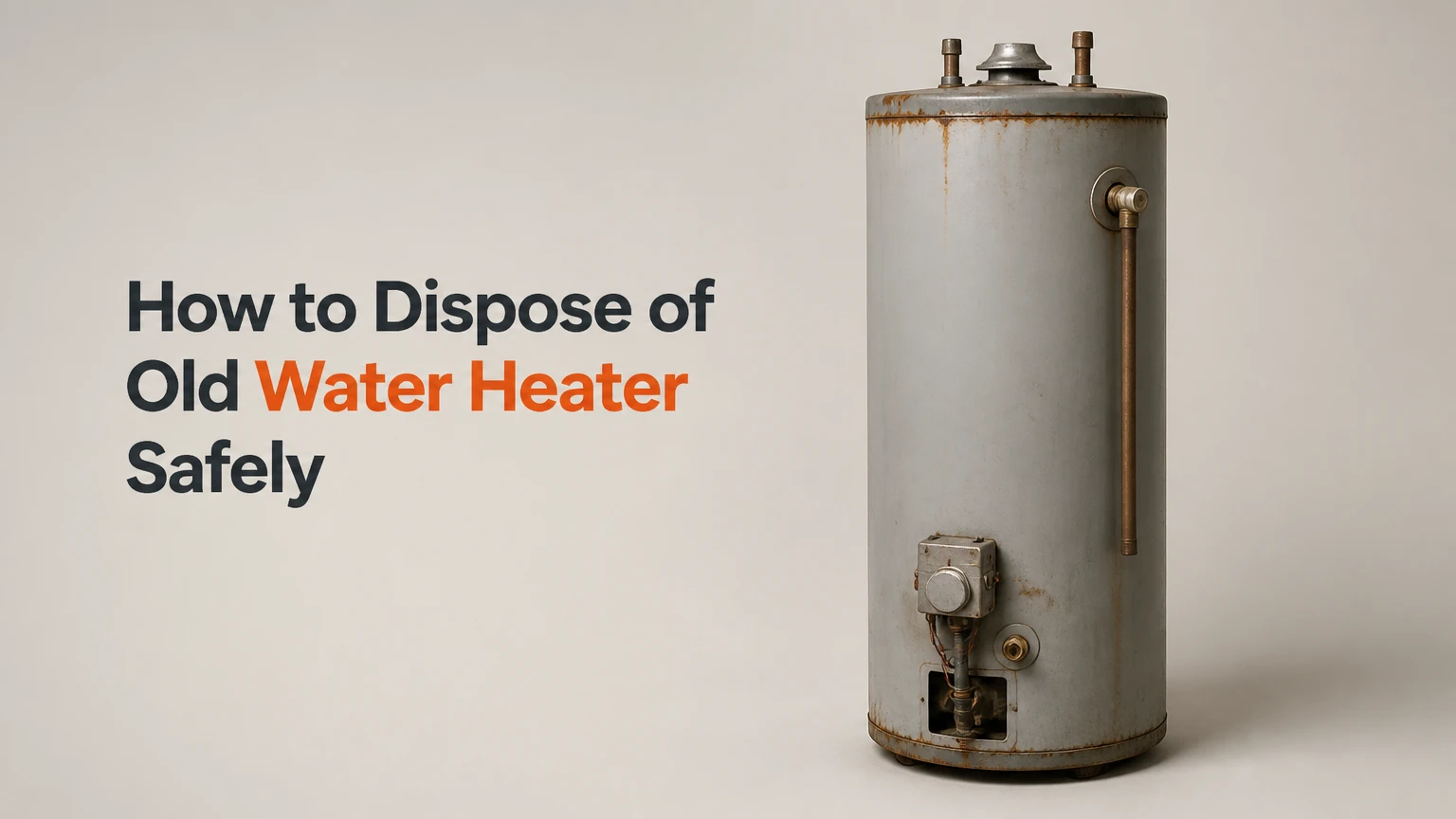
To dispose of an old water heater, shut off its energy source, stop the water supply, drain the tank, and choose a legal disposal route such as scrap-metal recycling, municipal bulk collection, retailer haul-away, or a licensed junk remover. Gas, propane, solar, and heat-pump models require extra precautions before transport.
Key Facts at a Glance
A drained residential tank water heater commonly weighs 90-150 pounds, while a full 50-gallon tank can exceed 500 pounds.
Electric water heaters use dangerous 240-volt circuits, so verify zero voltage before touching wiring.
Gas and propane water heaters must have their fuel supply shut off and disconnected without damaging the gas line or valve.
Steel tanks, copper wiring, brass fittings, and aluminum components are usually accepted by scrap-metal recyclers.
Municipal rules, retailer policies, and recycling fees vary by city, county, state, and country.
Heat-pump and solar water heaters may contain electrical controls, refrigerant, glycol, or rooftop components that need specialized handling.
Before You Dispose of an Old Water Heater
Most removals take 1-3 hours once the replacement is ready, but a corroded basement installation can take much longer. The most important success factor is not the disposal destination; it is making the unit completely safe, empty, disconnected, and stable before anyone moves it.
Before-you-start checklist
| Requirement | Typical specification | Why it matters |
|---|---|---|
| Removal time | 1-3 hours | Includes cooling, draining, and loading |
| Tank capacity | 30-80 gallons | Determines water volume and residual weight |
| Empty tank weight | 90-150 pounds | Varies by steel thickness and sediment |
| Helpers | 1-2 people | Needed for stairs, narrow doors, or awkward turns |
| Appliance dolly | 600-pound rating | Supports the tank and accumulated sediment |
| Garden hose | 25-50 feet | Reaches a drain or safe discharge point |
| Voltage tester | 0 volts confirmed | Protects against 240-volt electrical shock |
| Disposal reservation | 1 appointment or ticket | Prevents rejected curbside placement |
Turn off the heater several hours before draining when possible. Water near the tank may still be hot enough to cause serious burns, even after the burner or heating elements stop operating.
Do not begin gas-line disconnection, electrical disconnection, or cutting of water pipes if you lack the required tools or experience. A licensed plumber or HVAC technician is the safer choice when the unit is in a confined space, connected to rigid gas piping, or installed under a permit-sensitive configuration.
How Do You Identify the Water Heater Type?
Identify the energy source and any special components before disconnecting the old water heater. A standard electric tank has a dedicated breaker and heating-element access panels; a gas tank has a burner assembly and flue; a heat-pump model has a compressor and fan; a solar system may connect to roof collectors and glycol piping.
| Water heater type | Identifying feature | Main shutdown concern | Disposal complication |
|---|---|---|---|
| Electric storage tank | Two element access panels | 240-volt breaker | Wiring must be de-energized |
| Natural-gas tank | Burner and metal flue | Gas supply valve | Gas connection and venting |
| Propane tank | Propane burner and fuel line | Propane service valve | Fuel-line and ignition hazards |
| Heat-pump tank | Fan, compressor, control board | Breaker and disconnect | Refrigerant and electronic components |
| Tankless gas unit | Small wall-mounted heat exchanger | Gas valve and electrical breaker | More electronics and wall connections |
| Solar thermal tank | Solar loop pipes and controls | Solar pump and heat source | Glycol loop and rooftop equipment |
A standard storage tank is usually the simplest appliance to recycle. Heat-pump water heaters are not ordinary scrap until the refrigerant circuit and electrical controls have been handled according to local requirements.
Solar thermal equipment also requires system-specific planning. Closing the domestic-water supply does not necessarily isolate a pressurized solar loop, and rooftop collectors should not be removed by an untrained homeowner.
Step 1: Turn Off Power, Gas, or Other Energy Sources
Shut off the water heater’s energy source before touching pipes, wiring, controls, or the burner compartment. Confirm the shutdown rather than relying only on a switch position, because mislabeled breakers, shared circuits, and defective valves can leave a unit energized.
Electric water heater
- Turn off the dedicated double-pole breaker, usually rated 30 amps.
- Apply a breaker lock or warning label if another person could restore power.
- Test the heater wiring with a properly rated voltage tester.
- Confirm 0 volts between the conductors and between each conductor and ground.
Never remove the junction-box cover before verifying the circuit is dead. An electric water heater can expose a person to lethal voltage even when the tank is empty.
Natural-gas or propane water heater
- Turn the appliance control knob to Off.
- Close the fuel shutoff valve on the supply line.
- Confirm the valve handle is perpendicular to the pipe when the valve design uses that orientation.
- Wait and inspect for fuel odor before proceeding.
Do not use a lighter to test for leaks. If you smell gas or propane, leave the building, avoid electrical switches, and call the fuel utility or emergency service from a safe location.
Heat-pump and solar models
Switch off the dedicated electrical breaker for a heat-pump water heater, then follow the manufacturer’s shutdown instructions for any disconnect. Solar thermal systems may retain heat and pressure in the collector loop, so a qualified solar technician should isolate and drain that circuit.
You will know the energy shutdown worked when: an electric tester reads 0 volts, the burner cannot operate, or the fuel utility confirms the gas or propane supply is isolated.
Common mistake: turning the thermostat to its lowest setting instead of disconnecting the energy source. A low thermostat setting does not make an electric circuit safe.
Step 2: Shut Off the Water and Let the Tank Cool
Close the cold-water inlet valve above the tank, then open a hot-water faucet to relieve pressure and help the tank cool. Water heaters often retain hot water after shutdown, so waiting until the discharge is warm rather than scalding reduces burn risk.
Use the house main shutoff if the tank’s inlet valve is seized or missing. Do not force a corroded valve until you know where the building’s emergency shutoff is located.
Keep a bucket, towels, and a second person nearby when disconnecting old fittings. Corroded nipples can break inside the tank, and residual water can escape from the hot outlet even after the tank appears drained.
You will know the water shutdown worked when: no water enters the tank while a hot faucet remains open, and the faucet flow stops after the supply lines depressurize.
Common mistake: closing only the hot-water outlet. The cold inlet must be closed because it is the line that replenishes the tank.
Step 3: Drain and Flush the Tank
Drain the water heater through its lower drain valve using a hose directed to a suitable drain or outdoor discharge point. Open a nearby hot-water faucet first, then open the drain valve slowly; airflow prevents a vacuum from stopping the discharge.
Drainage procedure
- Attach a 25-50-foot garden hose to the drain valve.
- Place the hose end in a floor drain, sump basin, or outdoor location permitted by local rules.
- Keep the hose end lower than the drain valve whenever possible.
- Open a hot-water faucet at a sink or bathtub.
- Open the tank drain valve slowly.
- Allow the tank to empty completely.
- Close the faucet after drainage finishes.
Discharge water may contain sediment and can stain concrete, grass, or paving. Do not send large amounts of mineral sediment into a small plumbing trap if the drain is likely to clog.
If the drain valve produces only a trickle, sediment may have blocked the opening. Stop and reassess rather than inserting a sharp object deeply into the valve, because breaking the valve can create an uncontrolled leak. A plumber can remove or replace the valve safely, especially when the tank is still connected.
Some practitioners briefly open the temperature-and-pressure relief valve to admit air, but that valve is a safety device and may fail to reseat after years of corrosion. Opening a hot faucet is the lower-risk first method.
You will know drainage worked when: the hose stops discharging, the tank no longer sloshes when gently rocked, and only a small amount of residual water leaves when the fittings are loosened.
Common mistake: assuming an empty-looking tank is weightless. Sediment, trapped water, and a steel shell can leave the unit heavy enough to injure one person.
Step 4: Disconnect Water, Gas, and Electrical Connections
Disconnect each service connection only after the tank is cool, depressurized, and confirmed empty. Photograph the installation before removing fittings, because the pictures help a plumber reproduce the correct hot, cold, drain, vent, and relief-valve arrangement.
Water connections
Use two opposing wrenches when loosening threaded fittings. One wrench turns the union or connector, while the second stabilizes the tank nipple; this reduces the chance of twisting a fitting inside the tank.
Do not cut copper or PEX lines flush with the heater unless the replacement plan accounts for the lost length. A plumber may need the existing shutoff, dielectric fittings, unions, or flexible connectors for the new installation.
Electrical connections
After testing for 0 volts, remove the junction-box cover and separate the conductors according to the manufacturer’s wiring arrangement. Cap or otherwise secure the house wiring in an approved enclosure, and do not leave exposed energized conductors behind the removed appliance.
Gas connections
Gas disconnection is a professional task when the connection uses rigid black iron, a damaged appliance connector, a union that will not turn, or a line without an accessible shutoff. The supply must be capped with a code-compliant fitting if the gas line will remain unused.
Never cap a line that has not been isolated from the fuel source. A gas utility or licensed gas fitter should perform leak testing after any alteration.
Vent and flue connections
Gas units may connect to a metal draft hood and vent pipe. Remove the appliance from the vent only after the fuel is isolated, and avoid damaging the remaining flue because a replacement appliance may require a different venting system.
Step 5: Move the Empty Tank Safely
Move the water heater with an appliance dolly rated for at least 600 pounds, two or more straps, and a helper for stairs or thresholds. Keep the tank upright unless the recycling facility specifically permits another position, because upright movement provides better control and protects fittings.
Clear the route before lifting. Measure doorways, stair turns, and vehicle openings, then remove doors or obstacles that create a pinch point.
Use the dolly’s straps around the tank body, not around fragile valves or pipes. Tilt gradually, keep hands away from the base, and never stand below a tank being moved down stairs.
For vehicle transport, place the tank on its side only if the destination accepts it and the tank can be restrained securely. Use ratchet straps attached to structural anchor points, block the cylinder against rolling, and protect the vehicle from residual water and sharp fittings.
Practitioner rule: a drained tank that still requires two people to control is not a one-person load. Residual sediment can add substantial weight, while a slippery steel shell provides poor handholds.
Which Disposal Method Is Best?
Scrap-metal recycling is usually the best environmental option for a detached standard steel tank, while retailer haul-away is best when a replacement is being installed. Municipal collection costs less in many locations, and private junk removal is the practical choice for basement stairs, limited mobility, or no suitable vehicle.
| Disposal route | Typical cost or return | Typical timing | Physical effort | Best use |
|---|---|---|---|---|
| Retailer or installer haul-away | $25-$150 add-on | Same day | Low | Replacement installation |
| Scrap-metal recycler | $0-$40 transport cost, possible $5-$30 payout | Same day | High | Drained steel tank with vehicle |
| Municipal bulk pickup | $0-$100 | 2-14 days | Medium | Legal curbside collection |
| Private junk removal | $100-$300 per unit | 1-3 days | Low | Basement, stairs, or no truck |
| Landfill appliance drop-off | $20-$100 fee | Same day | High | Areas without recycling |
| Charity donation | Usually unavailable | Varies | Medium | Working newer equipment only |
These are typical US homeowner ranges, not universal prices. Scrap values depend on local metal rates and whether the facility pays a separate rate for copper, brass, or mixed steel; disposal fees depend on municipal funding and appliance rules.
EPA’s waste hierarchy states, “The best way to manage waste is not to create it in the first place.” For a failed water heater, reuse is rarely practical because hidden corrosion and safety components make donation unsuitable, but material recovery is generally preferable to disposal in a landfill.
Retailer or installer haul-away
Ask for old-unit removal when ordering the replacement, not after the installation crew arrives. Confirm whether the price includes disconnection, stairs, removal from the home, recycling, and disposal of a tank that was disconnected by someone else.
Retailer service is convenient but may exclude unusual access conditions. A crew may refuse a unit in a crawlspace, attic, narrow stairwell, or location with unsafe gas or electrical connections.
Scrap-metal recycling
Call the yard before loading the heater. Ask whether the facility accepts whole water heaters, whether the unit must be drained, whether insulation must be removed, and whether proof of ownership or identification is required.
Do not strip insulation or cut the tank apart solely to increase the payout unless the recycler confirms that the extra labor is worthwhile. Water heaters contain steel, copper, brass, plastic, and insulation, but the added value from disassembly is often smaller than the time, tool, and injury risk.
Municipal bulk collection
Municipal pickup requires advance confirmation of the collection date, appliance category, placement location, and preparation rules. Some jurisdictions require the tank to be drained and disconnected; others require residents to remove doors, trim, or specific components.
Place the unit at the curb only during the permitted time window. Leaving it outside early can create a theft, trip, water-leak, or code problem, and some municipalities will reject appliances placed beside an unapproved dumpster.
Private junk removal
A junk company is the safest logistical option when the tank must be carried through a finished home, down stairs, or out of a tight utility closet. Ask whether the provider is insured, whether labor includes inside removal, and whether the final destination is a recycling facility rather than a landfill.
Request a written quote that separates labor, stairs, distance, disposal fees, and same-day charges. A low phone estimate can increase after the crew sees difficult access.
What Should You Do With Heat-Pump, Solar, or Tankless Units?
Specialized water heaters should go to an HVAC, appliance, or electronics recycling route rather than an ordinary scrap pile when they contain refrigerant, compressors, glycol, or substantial controls. Standard electric and gas tanks are simpler because their primary recoverable material is steel, but all models still require utility isolation.
| Unit type | Component requiring attention | Suitable first contact | Do not do |
|---|---|---|---|
| Heat-pump water heater | Refrigerant circuit and compressor | HVAC contractor or appliance recycler | Cut refrigerant tubing |
| Solar thermal heater | Glycol loop and roof collectors | Solar thermal contractor | Open a pressurized hot loop |
| Tankless gas heater | Burner, heat exchanger, electronics | Licensed gas fitter or recycler | Remove gas piping casually |
| Tankless electric heater | High-current wiring and circuit | Electrician or appliance recycler | Assume a small case means low voltage |
| Standard electric tank | Heating elements and wiring | Scrap yard or municipality | Touch wiring before testing |
| Standard gas tank | Burner, flue, gas connector | Plumber or gas fitter | Test leaks with flame |
A heat-pump tank can be heavier and more awkward than a conventional tank because the compressor and top-mounted fan alter its center of gravity. Retain the model number until the recycler confirms the correct handling route.
How Much Does Water Heater Disposal Cost?
Old water heater disposal typically costs $0-$300, depending on whether the tank is recycled personally, collected by a municipality, removed by an installer, or carried out by a private hauler. Access, fuel disconnection, local fees, and transport distance create larger price differences than the tank’s scrap value.
| Cost factor | Typical range | When it applies | How to reduce it |
|---|---|---|---|
| Retailer haul-away | $25-$150 | New unit purchase | Add removal during ordering |
| Municipal ticket | $0-$100 | Bulk or appliance collection | Use scheduled public pickup |
| Junk removal | $100-$300 | Interior labor included | Move unit near an accessible door |
| Scrap transport | $0-$40 | Fuel, rental truck, or trailer | Combine with another recycling trip |
| Plumber disconnection | $150-$500 | Gas, rigid pipe, or difficult access | Bundle with replacement work |
| Scrap payout | $5-$30 typical | Whole mixed-metal tank | Call several yards first |
The table uses typical residential estimates, not guaranteed quotes. A 50-gallon tank in a ground-floor garage can cost very little to recycle, while a 40-gallon tank in a finished basement may cost more because labor and access dominate the job.
What Should You Never Do With an Old Water Heater?
Never place a connected water heater in a dumpster, cut an active gas line, move a full tank, or abandon the appliance on public or private property. Illegal dumping can result in fines, rejected waste, environmental liability, and damage to the next person who handles the unit.
Avoid these failures:
- Moving the tank while full: Water weighs about 8.34 pounds per gallon, so a 50-gallon tank contains roughly 417 pounds of water before adding the tank itself.
- Working on live electrical wiring: A 240-volt circuit can cause fatal shock or an arc flash even when the appliance appears inactive.
- Using a flame to check gas leaks: Use an approved leak-detection method performed by a qualified professional.
- Opening a damaged relief valve: An old temperature-and-pressure valve may not reseal, creating a continuous leak.
- Leaving loose pipes or wires: Secure disconnected utilities in approved caps, boxes, or fittings.
- Putting a tank in ordinary household trash: Waste collectors may reject it, and the tank can damage compaction equipment.
An old tank is also a poor candidate for a commercial dumpster if it still contains water, insulation, sharp metal, or attached gas components. Ask the waste operator for an appliance-specific instruction instead.
How Do You Fix Common Removal Problems?
Removal problems usually result from sediment, seized fittings, inaccessible valves, or unsafe utility connections. Stop the job when a fitting begins twisting the tank nipple, a gas odor appears, or the heater cannot be stabilized during movement.
| Problem | Likely cause | Safe response | Professional trigger |
|---|---|---|---|
| Drain valve will not flow | Sediment blockage or vacuum | Open hot faucet; stop if valve leaks | Replace valve or remove sediment |
| Tank remains very heavy | Residual water or scale | Use dolly and second helper | Stairs or uncontrolled movement |
| Water fitting will not turn | Corrosion or fused metals | Stabilize nipple with second wrench | Nipple begins twisting |
| Gas connector is damaged | Corrosion or seized fitting | Close supply and call gas fitter | Any odor or rigid-pipe work |
| Breaker will not identify circuit | Poor labeling or shared wiring | Turn off main only if qualified | Electrician verifies circuit |
| Tank cannot pass doorway | Oversized route or fixed obstacle | Measure and clear route | Structural alteration required |
Penetrating oil may help with an exterior water fitting, but it should not be sprayed into a gas control, burner, electrical box, or relief-valve opening. Never use a pipe wrench directly on a thin-walled tank shell.
Which Option Fits Your Situation?
The best disposal method depends mainly on access, replacement timing, transport, and utility risk. A ground-floor standard tank favors recycling, while a gas unit in a basement favors professional removal even when municipal collection is cheaper.
Replacing the heater today
Choose installer or retailer haul-away if the replacement is being professionally installed. Confirm the removal charge and access limitations before signing the installation estimate.
Strong enough to load a truck
Choose a scrap-metal yard when the standard tank is drained, disconnected, legally transportable, and easy to move. The financial return is usually modest, so recycling is worthwhile mainly when transport and labor are already convenient.
No truck or physical help
Choose municipal pickup if the schedule works and the city accepts water heaters. Otherwise, hire a junk remover that provides inside labor and documented disposal.
Gas line, rigid piping, or uncertain wiring
Hire a licensed plumber, gas fitter, or electrician for disconnection. Disposal savings are not worth risking a fuel leak, electrical injury, or damage to the building’s service connections.
Multiple units from a renovation
Separate standard steel tanks from heat-pump, solar, and tankless equipment. A contractor or recycler may offer better logistics for a consolidated load, but obtain a receipt for each disposal category.
FAQ
Can I leave an old water heater by the curb?
You can leave an old water heater at the curb only when your municipality specifically accepts it through bulk or appliance collection. Register first, follow the allowed placement window, drain and disconnect the unit, and confirm whether the city requires removal of insulation, valves, or other components.
Is a water heater worth scrapping?
A standard water heater is usually worth recycling for material recovery, but the payout is often modest, commonly around $5-$30 for a whole mixed-metal residential tank. Copper and brass components may increase value, while fuel, truck rental, labor, and yard fees can eliminate the financial return.
Can a plumber dispose of my old water heater?
A plumber can often remove and dispose of an old water heater as part of a replacement job, but disposal is not automatically included in every estimate. Ask whether the quote covers draining, disconnection, stairs, haul-away, recycling, permits, and any gas or electrical work.
Can I transport a water heater in an SUV?
You can transport a drained water heater in a large SUV only when the tank fits securely, does not obstruct safe driving, and is protected from leaks and sharp fittings. An appliance dolly, padding, and rated tie-down straps are safer; never allow the cylinder to roll freely.
How long does it take to drain a water heater?
A residential water heater commonly drains in 20-60 minutes when the valve, hose, and plumbing are clear. Sediment, a clogged drain valve, low hose placement, or failure to admit air can extend drainage substantially or require professional valve replacement.
Do I need a permit to remove a water heater?
A permit is often unnecessary for simply hauling away a disconnected appliance, but replacement, gas-line modification, venting, electrical changes, and new plumbing may require permits or inspections. The building department or licensed installer can confirm the rule for the property’s jurisdiction.
The Bottom Line
To dispose of an old water heater, identify the model, shut off its energy source, close the water supply, drain the tank, disconnect utilities safely, and move it with an appliance dolly and helper. Recycle a standard tank when transport is easy, use municipal pickup when available, and choose installer or professional haul-away for gas units, difficult access, or uncertain connections. Following these steps makes how to dispose of old water heater a controlled removal task rather than a hazardous waste problem.