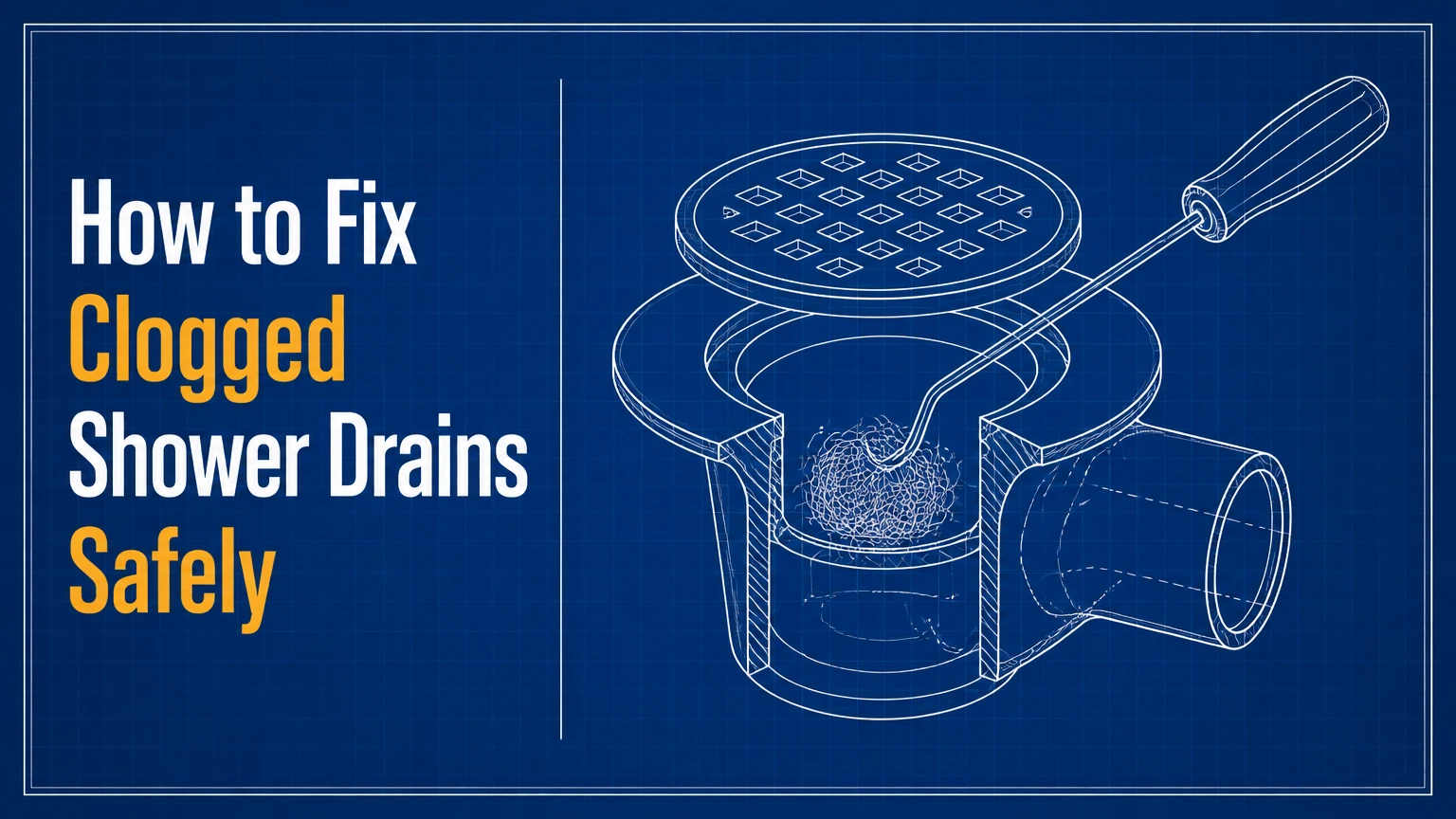
To fix a clogged shower drain, remove the grate, extract visible hair, flush with hot tap water, plunge the drain, and use a hand auger only if the blockage is deeper. Most hair-and-soap clogs clear in 10-30 minutes when treated mechanically first. Stop and call a plumber if other fixtures back up or sewage enters the shower.
Key Facts at a Glance
Hair is the most common material in a localized shower-drain blockage, often binding with soap residue near the drain opening.
Manual extraction is the safest first method because it removes the obstruction instead of pushing it farther into the pipe.
Hot tap water is safer for most plumbing than boiling water, especially around PVC fittings and solvent-welded joints.
A flat-bottomed cup plunger works better on a shower drain than a toilet plunger with an extended flange.
Water rising in the shower when a toilet flushes usually indicates a shared drain or main-line problem, not a surface hair clog.
Chemical drain cleaners should never be mixed with vinegar, bleach, ammonia, or another drain product.
How Shower Drainage Works
A shower drain carries wastewater through a strainer, a trap, and a sloped branch drain. The strainer catches larger debris, the P-trap retains water to block sewer gases, and the drainage line transports used water toward the building sewer through gravity.
The P-trap is an important reason a shower cannot drain freely when its lower curve is packed with hair. The trap also holds standing water by design, so a small amount of water below the grate is normal. Water that remains in the shower pan after several minutes is not normal.
Where does a shower clog form?
A shower clog usually forms at the grate, in the short inlet below the grate, or inside the P-trap. A blockage farther down the branch line is less common when only one shower drains slowly, but it becomes more likely when a nearby sink or tub shows the same symptom.
Use the drainage pattern as a rough location test:
| Drainage symptom | Likely location | First response | Escalation point |
|---|---|---|---|
| Water drains slowly, no backup | Grate or inlet | Remove hair manually | Auger after 2 attempts |
| Shower fills within 2 minutes | P-trap or nearby branch | Extract, then plunge | Plumber if unchanged |
| Shower and tub drain slowly | Shared bathroom branch | Plunge with other openings sealed | Professional diagnosis |
| Shower rises when toilet flushes | Main or shared sewer line | Stop using fixtures | Call plumber promptly |
| Gurgling and sewer odor | Vent or partial line blockage | Check other fixtures | Professional inspection |
What Causes a Shower Drain to Clog?
Hair, soap residue, skin oils, and mineral scale combine into a sticky plug. Hair creates the physical mesh, soap deposits bind strands together, and hard-water minerals roughen the pipe surface so additional residue adheres more easily.
Long hair is especially likely to form a dense mat below the strainer. Shaving cream, bath oils, conditioner, and some solid soap products add organic residue, although shower drains do not usually receive enough grease to justify treating them like kitchen drains.
Hard-water scale can narrow the effective opening without creating one removable hair ball. Calcium carbonate deposits are particularly persistent, and a chemical cleaner may not remove a thick mineral ridge. Repeated scale-related clogs often need mechanical cleaning or replacement of a corroded drain component.
How to Fix Clogged Shower Drains
The safest repair sequence moves from the least invasive method to the most forceful: inspect, extract, flush, plunge, and then auger. The sequence takes about 10-30 minutes for a typical localized clog, and manual removal determines success more often than any liquid treatment.
Before You Start
| Requirement | Typical value | Practical detail |
|---|---|---|
| Working time | 10-30 minutes | Add 15 minutes for cleanup |
| Difficulty | Low to moderate | Moderate when using an auger |
| Basic cost | $5-$20 | Gloves, brush, or plastic extraction tool |
| Expanded cost | $25-$60 | Cup plunger and 15-25 foot hand auger |
| Required protection | 1 pair gloves, 1 eye-protection set | Use chemical-resistant gloves if cleaner is present |
| Water temperature | 120-140°F hot tap water | Do not assume boiling water is safe for every pipe |
You need a screwdriver that fits the grate screws, a flashlight, rubber gloves, a disposable plastic drain tool or needle-nose pliers, a shallow bucket, paper towels, and a flat-bottomed cup plunger. If the drain has already received chemical cleaner, do not plunge or snake it until the product label gives a safe waiting and rinsing procedure.
Step 1: Remove and Inspect the Shower Grate
Turn off the shower and remove the grate using the correct screwdriver or a plastic pry tool. Place screws in a cup, then shine a flashlight into the opening before inserting anything.
Screw-in grates normally have two visible screws. Snap-in covers may lift from a side notch, while some linear drains contain a removable hair-catching basket beneath the top panel. Do not force a decorative tile-insert cover because breaking its seal can create a waterproofing problem.
You will know the step worked when the drain opening, basket, and first few inches of pipe are visible. The common mistake is prying against finished tile with a metal screwdriver, which can chip grout or scratch the drain flange.
Step 2: Extract Hair and Debris by Hand
Insert a plastic drain-cleaning stick 6-12 inches into the opening, rotate it once or twice, and pull it straight upward. If the tool catches a compact mass, withdraw it slowly over a trash bag rather than scraping the material along the pipe wall.
A bent plastic hook, flexible claw tool, or long-nose pliers can retrieve material when a zip tool misses the blockage. Avoid pushing a rigid wire downward because it can snag on the trap, puncture a plastic hair catcher, or push the clog beyond the most accessible point.
Repeat the extraction until the tool comes out mostly clean. Run 1-2 quarts of hot tap water for 30 seconds, then observe whether the water level falls continuously. A successful extraction produces a clear vortex and no rise in the shower pan.
Step 3: Flush With Hot Tap Water
Run the hottest water available from the shower for 2-3 minutes, or pour 1-2 quarts of hot tap water slowly into the drain. Hot tap water softens soap residue and carries loose particles away without exposing ordinary PVC fittings to kettle-level temperatures.
Boiling water is not a universal plumbing treatment. The National Association of Home Builders identifies PVC as a common residential drain material, and PVC manufacturers publish temperature limits that vary by product, pipe size, pressure, and installation; a cautious homeowner should use hot tap water unless the plumbing manufacturer permits higher temperatures.
The common mistake is pouring a full kettle into a cold, partially blocked plastic drain. Rapid thermal change can stress fittings, and hot water cannot dissolve a tightly woven hair plug anyway. If the flow remains poor after extraction and flushing, proceed to controlled plunging.
Step 4: Plunge the Drain
Cover the drain with a flat-bottomed cup plunger and add enough water to submerge the rubber lip by about 1 inch. Press down gently once to remove trapped air, then make 15-20 firm push-pull strokes while keeping the rim sealed.
A shower drain often lacks a nearby overflow opening, unlike a bathtub, but seal any secondary drain or overflow opening connected to the same fixture. Petroleum jelly around the cup can improve the seal on a textured shower floor, although it should be wiped away before anyone walks on the surface.
You will know plunging worked when the water suddenly drops or the drain begins accepting water faster after each stroke. The common mistake is pumping air against a dry drain, which produces little hydraulic force. Do not plunge if the drain contains undiluted chemical cleaner because splashback can injure skin and eyes.
Step 5: Use a Hand Auger for a Deep Blockage
Feed a 1/4-inch hand auger into the drain while turning its handle clockwise. Stop when the cable meets resistance, rotate gently to engage the clog, advance 1-2 inches at a time, and withdraw the cable while continuing to turn it.
A 15-foot auger is adequate for many shower branches, while a 25-foot cable provides more reach when the trap or branch line is distant. Keep the cable centered, avoid sharp side pressure, and never force it through a hard stop that may be a tight elbow or a fixed trap component.
Clean and disinfect the cable after removal, then flush the drain with hot tap water for 2-3 minutes. A successful auger job restores a steady drain with no gurgling. If the cable repeatedly returns clean while water still backs up, the obstruction may be outside the reachable section or the pipe may be damaged.
Which Shower Drain Method Should You Choose?
Manual extraction is the best first choice for hair, plunging is the best second choice for a soft blockage with standing water, and a hand auger is the best DIY option for a deeper obstruction. Chemical cleaners are a last resort because they add handling risks without reliably removing hair or mineral scale.
| Method | Best blockage | Typical cost | Typical time | Main limitation |
|---|---|---|---|---|
| Plastic extraction tool | Hair within 6-12 inches | $3-$12 | 5-10 minutes | Cannot reach distant clogs |
| Flat cup plunger | Soft clog with standing water | $8-$20 | 5-10 minutes | Needs an airtight seal |
| Hot tap water flush | Loose soap residue | $0-$5 | 5 minutes | Does not remove a hair mat |
| Baking soda and vinegar | Light surface odor or residue | $3-$8 | 30-45 minutes | Weak against dense hair |
| Hand auger, 15-25 feet | Deep hair or soft debris | $20-$60 | 15-30 minutes | Can snag or damage old fittings |
| Commercial chemical cleaner | Some dissolvable organic matter | $8-$20 | 15-60 minutes | Toxic splash and pipe incompatibility |
Does baking soda and vinegar unclog a shower drain?
Baking soda and vinegar may loosen light soap residue, but the reaction is not a dependable treatment for a compact hair clog. For a low-risk trial, add 1/2 cup baking soda, followed by 1 cup white vinegar, cover the opening for 15 minutes, and flush with hot tap water.
The fizzing reaction produces carbon dioxide and agitation, not a specialized hair-dissolving enzyme. Vinegar is also an acid, while baking soda is an alkaline compound; combining them quickly neutralizes much of each material. Mechanical extraction remains more effective.
Never use this mixture after a commercial drain cleaner. Chemical residues can react unpredictably, and covering the opening can trap fumes. Natural does not mean harmless when products are already present in the pipe.
Are chemical drain cleaners safe for shower drains?
Chemical drain cleaners are not the preferred first fix for a shower clog. Sodium hydroxide and sulfuric-acid products can generate heat, damage skin, and leave corrosive liquid in a trap when the blockage remains.
The U.S. Consumer Product Safety Commission advises consumers to follow drain-cleaner labels and keep corrosive products away from children. Product labels also commonly prohibit mixing with bleach, ammonia, acids, or other drain products. A drain cleaner cannot be safely assumed to be compatible with every ABS, PVC, copper, galvanized-steel, or older joint configuration.
If a chemical product has already been used, record its name, keep the container available, ventilate the bathroom, and follow the label’s emergency and rinsing instructions. Tell a plumber exactly what was poured into the drain.
What Should You Avoid When Clearing a Shower Drain?
Avoid mixing drain products, forcing a snake, pouring boiling water into unknown plumbing, and using a toilet plunger that cannot seal the shower opening. These errors can cause chemical burns, broken fittings, splashback, or a clog that becomes harder to reach.
Four practitioner rules prevent most avoidable damage:
- Remove before dissolving. A tool that retrieves a hair mass gives better control than a liquid that leaves the mass inside the trap.
- Treat resistance as information. A cable that stops abruptly may have reached an elbow, trap baffle, or pipe defect rather than a clog.
- Do not trust a temporary flow improvement. Water may pass around a partially displaced plug and slow again within days.
- Test other fixtures before escalating force. A shared backup cannot be repaired from the shower grate.
How Do You Know the Problem Is More Than a Shower Clog?
A shower drain needs professional diagnosis when another fixture causes water to rise in the shower, sewage appears, several fixtures drain slowly, or a properly used auger fails repeatedly. These patterns point toward a shared branch, main sewer, vent, collapsed pipe, or root intrusion.
| Symptom | More likely cause | Safe homeowner action | Professional service |
|---|---|---|---|
| Toilet flush raises shower water | Shared branch or main sewer clog | Stop using affected fixtures | Drain machine or camera |
| Sink, tub, and shower slow together | Bathroom branch obstruction | Avoid chemical cleaner | Branch-line cleaning |
| Gurgling with sewer odor | Vent restriction or partial blockage | Check whether fixtures share symptoms | Vent inspection |
| Clog returns within 1-2 weeks | Scale, damaged pipe, or recurring hair entry | Install hair catcher | Camera inspection |
| Sewage-colored water or foul solids | Wastewater backup | Keep people away from water | Emergency plumbing response |
| Water appears below shower base | Drain seal, trap, or pipe leak | Stop using shower | Leak and waterproofing repair |
A blocked plumbing vent can disturb air balance, but gurgling alone does not prove the roof vent is blocked. A plumber may test the branch line, inspect the vent, or use a camera before choosing cable cleaning, hydro-jetting, pipe repair, or replacement.
Tree roots usually affect underground sewer piping rather than the short shower trap. Root intrusion requires equipment from the cleanout or sewer access point; repeatedly treating the shower opening wastes time and can worsen a backup.
How Much Does It Cost to Fix a Clogged Shower Drain?
A homeowner typically spends $3-$60 on tools for a localized clog, while professional drain cleaning commonly costs about $100-$400 depending on region, access, severity, and after-hours service. Camera inspection, hydro-jetting, pipe repair, and excavation cost substantially more.
| Repair level | Typical price range | Typical duration | When it applies |
|---|---|---|---|
| Plastic extraction tool | $3-$12 | 5-10 minutes | Surface hair |
| Plunger and basic supplies | $8-$25 | 10-15 minutes | Soft localized clog |
| Hand auger purchase | $20-$60 | 15-30 minutes | Deeper single-fixture clog |
| Professional cable cleaning | $100-$400 | 30-90 minutes | Stubborn branch blockage |
| Camera inspection | $150-$500 | 30-120 minutes | Recurring or unexplained clog |
| Hydro-jetting | $350-$1,200 | 1-3 hours | Heavy buildup in accessible line |
| Pipe repair or replacement | $500-$5,000+ | 1 day to several days | Collapse, leak, or root damage |
These are typical North American homeowner ranges, not fixed quotes. A renter should photograph the standing water, avoid chemical products, and notify the property manager before using an auger that could damage a building-owned drain.
How Do You Prevent Another Shower Drain Clog?
A mesh hair catcher prevents the largest amount of hair from entering the trap, and weekly cleaning keeps the catcher from becoming a secondary restriction. Remove trapped hair after each heavy-use period, rinse the screen, and wipe soap residue from the drain cover.
Use this maintenance schedule:
- After each shower: Remove visible hair from the grate or catcher.
- Weekly: Wash the catcher and brush the accessible drain opening.
- Monthly: Flush with 1-2 quarts of hot tap water after mechanical cleaning.
- Every three months: Inspect the grate, screws, trap odor, and drainage speed.
- After remodeling: Confirm that mortar, grout, and construction debris did not enter the drain.
Choose a catcher that fits inside or over the drain without reducing the usable opening. A loose screen can move underfoot, while a fine screen that remains dirty can slow drainage even when no pipe clog exists. Do not pour oils, paint, grout, or construction compounds into a shower drain.
Which Fix Is Best for Each Situation?
The best method depends on blockage location, standing water, pipe condition, and whether other fixtures are affected. A renter with one slow shower should begin with a plastic extraction tool, while a homeowner with an older metal branch may prefer gentle extraction and professional cleaning over aggressive snaking.
For a renter with standing water
Wear gloves, remove the grate, and use a plastic extraction tool. Try a cup plunger only after confirming that no chemical cleaner is present, and report recurring backups to the landlord because the branch line may belong to the building.
For an older home with metal plumbing
Use manual extraction and a controlled cup plunger first. Avoid repeated caustic cleaner applications, and use minimal force with an auger because corrosion can thin older galvanized or cast-iron pipe walls.
For a bathroom that backs up at several fixtures
Stop running water and do not keep testing with flushes. A shared-line blockage requires access from a cleanout or professional equipment, not repeated treatment through the shower grate.
Frequently Asked Questions
Can I unclog a shower drain without removing the grate?
Sometimes, but removal improves visibility and lets an extraction tool reach the hair mat. A plastic barbed tool can pass through some grate openings, yet it may only break the clog apart. Removing a screw-in or snap-in cover lets you retrieve debris, inspect the trap inlet, and avoid pushing material deeper.
How long should I wait after using drain cleaner?
Follow the specific product label rather than using a universal waiting time. Do not add another product, plunge, or insert an auger while corrosive liquid may remain in the trap. If the cleaner failed, ventilate the room, retain the packaging, and disclose the product to the plumber.
Why does my shower drain smell after I unclog it?
A shower drain can smell when hair and soap residue remain on the trap walls, when the trap loses its water seal, or when wastewater backs up from a shared line. Clean the grate and accessible opening first. Persistent sewer odor, especially with gurgling, warrants vent and drainage inspection.
Can I use a toilet plunger on a shower drain?
A toilet plunger is usually the wrong shape for a shower drain because its extended flange is designed for a toilet outlet. Use a flat-bottomed cup plunger that covers the shower drain completely. The cup must sit in enough water to seal and generate pressure.
Why does my shower clog again after a few days?
A rapid recurrence usually means hair is still entering the trap, the original plug was only displaced, or scale and pipe damage are restricting the line. Install a correctly sized hair catcher and repeat manual inspection. If the problem returns within 1-2 weeks, arrange branch-line cleaning or camera inspection.
Should I call a plumber immediately for slow shower drainage?
Call a plumber immediately when sewage backs up, multiple fixtures are affected, water rises when a toilet flushes, or a leak appears below the shower. A single slow drain without those warning signs usually permits a careful extraction and plunging attempt before professional service.
The Bottom Line
To fix a clogged shower drain, remove the grate, retrieve hair mechanically, flush with hot tap water, plunge with a sealed cup, and use a hand auger only for a deeper obstruction. Avoid boiling water in unknown plumbing and never mix drain chemicals. If the exact keyword problem involves multiple fixtures, sewage, recurring failure, or a suspected damaged line, professional diagnosis is the safer solution.