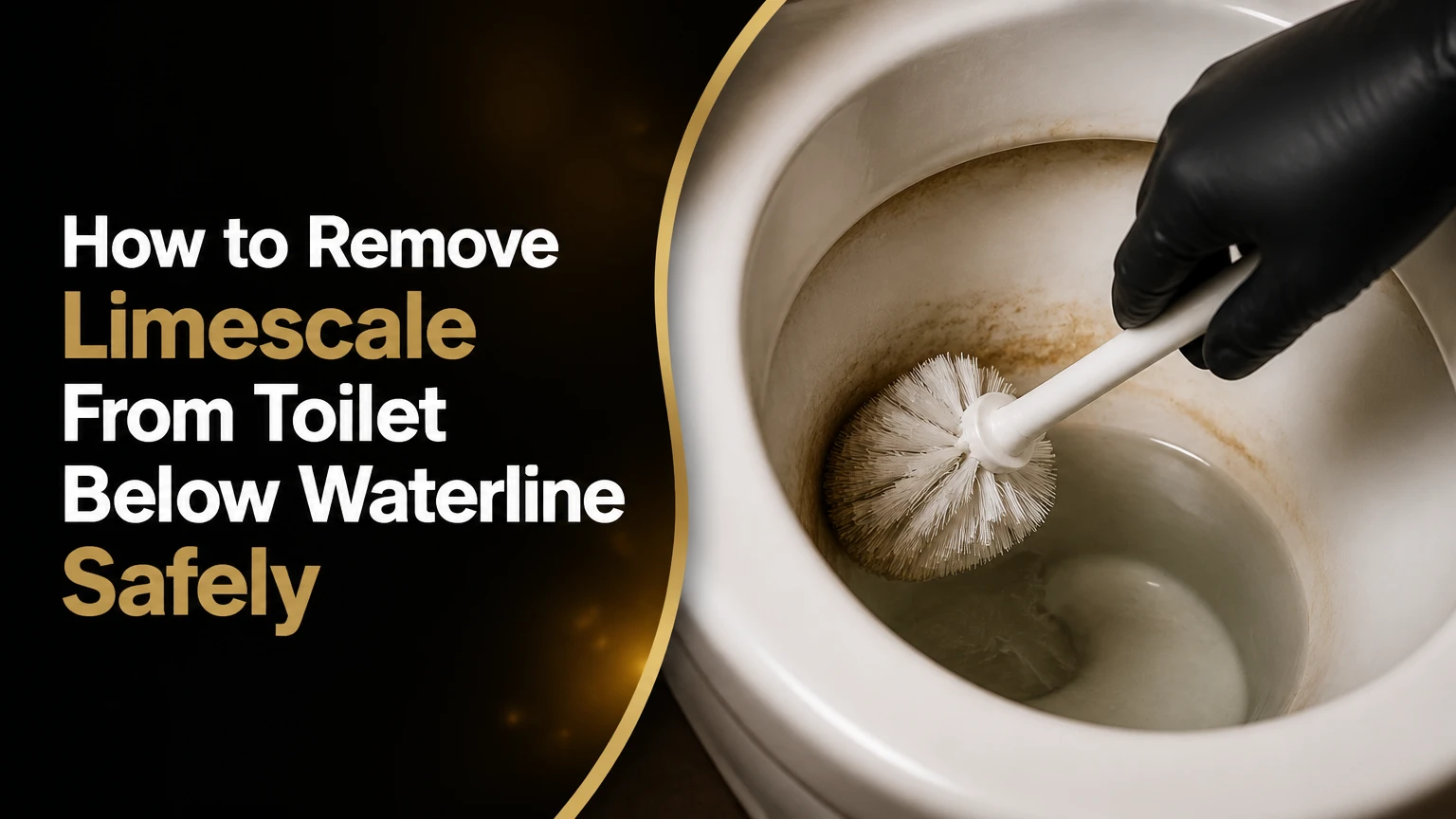
To remove limescale from a toilet below the waterline, shut off the supply, drain and sponge the bowl dry, apply an acidic descaler, wait for the labeled contact time, then scrub with nylon or a fully wet pumice stone. Vinegar handles light deposits; citric acid or a toilet-rated gel works better on thicker scale.
Key Facts at a Glance
- Toilet limescale is primarily calcium carbonate and magnesium carbonate deposited by hard water.
- Draining the bowl prevents toilet water from diluting the descaler at the scaled surface.
- White vinegar usually needs 4-12 hours, while an acidic toilet gel may work in 10-30 minutes.
- A pumice stone must remain saturated and must be used with light pressure to reduce porcelain-scratch risk.
- Bleach does not dissolve carbonate limescale and must never contact vinegar, hydrochloric acid, or another acidic cleaner.
- A scale ring that returns within days often indicates a leaking flapper or fill-valve problem.
What Causes Limescale Below the Waterline?
Limescale forms when hard-water minerals precipitate onto the submerged porcelain surface. Calcium and magnesium bicarbonates remain dissolved in incoming water, but changes in carbon dioxide, temperature, and concentration allow carbonate minerals to form a hard deposit.
The deposit is usually white, cream, grey, or chalky. Brown or orange color can indicate iron, while blue or green color can indicate copper compounds mixed with the mineral layer. Toilet paper fibers, urine salts, and bacteria can adhere to rough scale, making a mineral ring appear darker than its underlying calcium carbonate.
A smooth, intact vitreous-china glaze resists deposits better than a scratched or chemically damaged surface. That is why metal tools can create a long-term problem: a screwdriver may remove one patch while leaving grooves that collect new minerals more readily.
The waterline itself is not the only cause. A slow leak through the flapper can send a thin stream across one side of the bowl continuously. That stream repeatedly delivers hard water to the same area, creating a vertical trail or a ring that returns soon after cleaning.
How Does Acid Remove Toilet Scale?
Acid dissolves carbonate limescale by reacting with calcium carbonate and converting part of the solid deposit into soluble calcium salts, water, and carbon dioxide. The simplified reaction is:
CaCO₃ + 2H⁺ → Ca²⁺ + H₂O + CO₂
Vinegar contains acetic acid, and citric-acid powder supplies citric acid when dissolved in water. Commercial toilet descalers may contain sulfamic, hydrochloric, phosphoric, or other acids, but the active ingredient and concentration vary by product.
Acid does not instantly erase a thick crust. The liquid must contact the deposit long enough to penetrate pores and weakened layers. A brush then removes softened material. For that reason, the most reliable sequence is chemical softening followed by controlled mechanical cleaning.
Acid strength is not the only performance factor. A gel clings to a sloped bowl longer than a thin liquid, while a warm, concentrated solution can improve contact without reaching boiling temperatures. Always follow the product label because toilet-safe formulas differ from drain openers and masonry acids.
Before You Start: Tools, Time, and Cost
A typical light-to-medium treatment takes 20-40 minutes of active work plus 4-12 hours of soaking. Severe buildup may require two treatment cycles or a plumber if the deposit extends into the trapway.
| Item | Typical requirement | Purpose |
|---|---|---|
| White vinegar | 2-4 L at approximately 5% acidity | Light-to-medium mineral deposits |
| Citric acid | 100-150 g mixed with 1 L warm water | More concentrated household descaling |
| Toilet-rated acidic gel | 250-750 mL, label-directed | Thick deposits requiring cling |
| Nylon toilet brush | 1 brush with stiff plastic bristles | Scrubbing softened scale |
| Sponge or absorbent cloth | 1-2 pieces | Removing residual bowl water |
| Gloves and eye protection | 1 pair each | Preventing acid and contaminated-water contact |
| Wet pumice stone | 1 stone, saturated before use | Localized hard patches on glazed porcelain |
Typical US material costs range from $3-$10 for vinegar, $5-$15 for citric acid or a specialty descaler, and $5-$12 for a pumice stone. Prices vary by package size and region. A professional plumbing visit commonly costs substantially more than the materials, so escalation is most sensible when the toilet leaks, will not drain, or has damaged glaze.
Before applying any cleaner, read the toilet manufacturer’s care instructions. Some colored, specialty, or older fixtures have finishes that tolerate less abrasion than standard white vitreous china.
How to Remove Limescale From Toilet Below Waterline
The safest general method has six stages: isolate the water, drain the bowl, identify the deposit, apply a suitable descaler, remove softened scale, and rinse thoroughly. The key success factor is direct contact between the treatment and the mineral surface.
Step 1: Shut Off the Water Supply
Turn the isolation valve behind or beside the toilet clockwise until it stops, then flush once. The tank should empty without refilling.
If the valve is seized, do not force it with excessive leverage. A damaged valve can begin leaking inside the wall or at the compression fitting. Close the home’s main water supply or call a plumber if the local valve cannot be operated safely.
Success checkpoint: The tank remains empty after flushing and no fresh water enters the bowl.
Common mistake: Starting with cleaner while the supply is still open. A continuing trickle dilutes the treatment and may wash it away.
Step 2: Drain and Sponge the Bowl
Push a toilet plunger firmly over the drain opening several times to move bowl water into the trapway. A toilet plunger with an extended flange seals better than a flat sink plunger.
Use a dedicated sponge or absorbent cloth to remove the remaining puddle. The bowl does not need to be laboratory-dry, but the scaled area should be exposed and free of standing water.
Success checkpoint: The mineral ring is visible and a small poured sample of cleaner stays against the deposit instead of immediately disappearing into the bowl water.
Common mistake: Pouring several liters of vinegar into a full bowl. The acid becomes dilute, and the submerged scale receives little effective contact.
Step 3: Identify the Stain Before Choosing a Cleaner
Inspect the color, hardness, and location of the deposit. Scrape a tiny loose edge with a plastic card, never a metal blade. Chalky white material is more likely carbonate scale; orange or blue staining may require a different treatment.
| Appearance | Likely material | First treatment | Important limitation |
|---|---|---|---|
| White, cream, chalky ring | Calcium carbonate | Vinegar or citric acid | Thick layers need repeated contact |
| Grey, brown, orange crust | Scale plus iron or soil | Acid descaler after spot testing | Oxalic-acid products may be needed for iron |
| Blue or green deposit | Copper compounds plus scale | Manufacturer-approved metal-stain remover | Acid alone may not remove the color |
| Black slimy film | Organic residue or mold-like growth | Toilet-safe disinfectant after descaling | Never combine disinfectant with acid |
| Yellow film without crust | Urine salts or general staining | Toilet cleaner and brush | A mineral descaler may add little benefit |
Color alone cannot prove the chemical composition. A layered deposit may contain carbonate, iron, copper, and organic material at the same time.
Step 4: Apply the Least Aggressive Effective Treatment
For light or medium scale, pour 2-4 liters of undiluted white vinegar into the drained bowl. Tilt or spread the liquid so it covers the ring, and press vinegar-soaked toilet paper against higher patches that the liquid cannot reach.
For a stronger household option, dissolve 100-150 grams of citric acid in 1 liter of warm water. Use warm water, not boiling water. Pour the solution onto the deposit and keep the area wet.
Leave vinegar for 4-12 hours, or follow the citric-acid product’s directions. A toilet lid can reduce evaporation, but the toilet must remain clearly marked or unavailable so nobody uses it accidentally.
Success checkpoint: The crust develops a softened, rough edge, and a nylon brush removes powdery residue without heavy force.
Common mistake: Adding baking soda to vinegar. The alkaline powder neutralizes part of the acid, causing fizzing but reducing the acid available to dissolve carbonate.
Step 5: Scrub and Rinse the Bowl
Use a stiff nylon toilet brush after the soak. Work around the ring with short strokes rather than pressing the brush handle against the porcelain.
Turn the water supply on and flush several times after the deposit has loosened. If the bowl remains empty during rinsing, pour a bucket of clean water into the bowl carefully, provided the toilet is not blocked.
Success checkpoint: The surface feels smooth when inspected with a gloved fingertip, and no loose acidic residue remains.
Common mistake: Using a wire brush or steel wool. Metal can cut through the glaze and leave grey marks that permanently increase the surface’s tendency to collect scale.
Step 6: Repeat or Change Methods Only After Inspection
One treatment may not remove a historical deposit. Let the surface dry enough to inspect, then repeat the acid soak or move to a fully wet pumice stone for isolated remaining patches.
Do not escalate immediately to industrial acid because the first cycle left a thin layer. A second controlled cycle is safer than a stronger chemical applied for an excessive time.
Which Removal Method Fits the Deposit?
Vinegar is the lowest-risk starting point, citric acid offers a more concentrated household treatment, commercial gel is faster when labeled for toilet bowls, and wet pumice provides direct abrasion for small hardened areas. None is ideal for every toilet or every stain.
| Method | Best deposit thickness | Typical contact or work time | Typical material cost | Main risk |
|---|---|---|---|---|
| White vinegar, 5% | Light to medium, under 2 mm | 4-12 hours | $3-$10 | Slow results |
| Citric acid solution | Medium, under 3 mm | 2-8 hours | $5-$15 | Eye or skin irritation |
| Toilet-rated acidic gel | Medium to heavy, 2-5 mm | 10-30 minutes | $5-$12 | Corrosion and fumes |
| Wet pumice stone | Localized hard patches | 10-20 minutes | $5-$12 | Scratching if dry or forced |
| Professional removal | Thick crust or trapway deposit | 1-3 hours on site | Often $100+ | Service cost |
Is Citric Acid Better Than Vinegar?
Citric acid is often more practical than vinegar for medium limescale because a measured powder can produce a concentrated solution with less liquid. Vinegar is easier to use and produces fewer measuring errors, but its relatively low acid concentration usually requires a longer soak.
Use either acid on standard glazed porcelain after draining the bowl. Do not assume either treatment is safe for every seat hinge, metal trim, colored finish, or nearby natural stone. Wipe splashes immediately and rinse the surrounding surfaces.
Can You Use a Pumice Stone on Porcelain?
A pumice stone can remove stubborn scale from glazed porcelain when both the stone and bowl remain saturated and pressure stays light. Test a hidden area first, because the stone can scratch worn, damaged, matte, colored, or non-porcelain surfaces.
Soak the stone for at least five minutes. Keep a small amount of water on the bowl, rub only the deposit with short strokes, and wipe away grey slurry frequently. Stop if the surface becomes dull, if the stone catches, or if the deposit does not change after several light passes.
Pumice is poorly suited to the deep U-bend. It cannot follow the trapway safely, and forcing a handle into the outlet can damage the fixture or push debris deeper.
When Is Commercial Acidic Descaler Appropriate?
A commercial descaler is appropriate for thick deposits when the label specifically identifies toilet bowls or ceramic sanitaryware as an approved surface. Use the smallest quantity needed, respect the stated dwell time, ventilate the room, and rinse thoroughly.
Avoid generic muriatic acid, sulfuric-acid drain opener, and pool chemicals in a household toilet. These products may attack metal, elastomers, seals, or downstream components, while their fumes create a greater injury risk than a toilet-rated formula.
Never extend a 15-minute label instruction into an overnight soak. Longer contact does not guarantee better cleaning and can increase damage to fittings and plumbing materials.
What Should You Never Mix With Toilet Descaler?
Never mix vinegar, citric acid, or an acidic toilet cleaner with chlorine bleach, chlorinated disinfectant, ammonia, drain opener, or another cleaning chemical. Acid and hypochlorite bleach can release chlorine gas, while some disinfectant combinations produce irritating or toxic vapors.
Poison Control gives the direct household rule, “Never mix bleach with other cleaning products.” Treat the toilet as contaminated with the previous product until the bowl and nearby surfaces have been thoroughly rinsed.
Use these controls:
- Ventilate with an open window, but avoid placing your face over the bowl.
- Wear chemical-resistant gloves and splash-protective eye protection.
- Keep the product in its original labeled container.
- Rinse the bowl before changing from disinfectant to descaler.
- Follow the label’s first-aid and disposal instructions.
- Leave the room and contact emergency services if breathing difficulty, severe coughing, or eye exposure occurs.
Bleach can disinfect some surfaces, but bleach is not a limescale remover. Applying bleach to carbonate scale wastes product and can create a dangerous reaction when an acid is later used.
Why Does the Scale Keep Coming Back?
A toilet scale ring that returns within a few days usually indicates ongoing water movement, high mineral content, or a damaged surface. Check the flapper first: place a few drops of food coloring in the tank without flushing, and look for colored water entering the bowl after 10-15 minutes.
A leaking flapper is not the only possibility. A fill valve set too high can send water down the overflow tube, and a cracked overflow tube or misadjusted refill tube can create continuous flow. The isolation valve may also fail to close completely.
| Recurrence pattern | Likely cause | Diagnostic check | Corrective action |
|---|---|---|---|
| Thin stream from tank side | Worn flapper | Food-color test after 10-15 minutes | Replace matching flapper |
| Water enters overflow tube | Fill level too high | Mark tank level and inspect tube | Adjust or replace fill valve |
| Ring returns in one week | Hard water plus rough glaze | Inspect porcelain after cleaning | Repair leak and descale periodically |
| One-sided vertical trail | Continuous bowl flow | Observe bowl with supply open | Check flapper, refill tube, and valve |
| Deposit inside trapway | Long-term mineral accumulation | Slow flush or recurring blockage | Have a plumber inspect and clear it |
A whole-house softener can reduce future calcium and magnesium deposits, but it does not repair a leaking toilet. Fix the water loss first; otherwise the toilet will continue delivering hard water to the same surface.
What If the Stain Is Orange, Blue, or Black?
Orange and brown deposits often contain iron, while blue or green stains can involve copper from household plumbing. These compounds may sit within a calcium-carbonate crust, so ordinary vinegar may soften the base without removing the final color.
Use a product specifically labeled for iron or copper stains only after rinsing away acidic toilet cleaner. Oxalic-acid stain removers can be effective on iron, but they require label-directed ventilation, gloves, eye protection, and careful surface testing.
Black material may be organic residue, dark mineral staining, or a shadow under a thick ring. Descale first, rinse completely, then use a compatible toilet disinfectant if organic residue remains. Do not apply bleach while any acid is still present.
A porcelain surface that stays permanently grey after cleaning may have lost its glaze. Cleaning chemicals cannot restore missing glaze; replacement or professional refinishing is the realistic remedy.
How Do Septic Systems and Old Plumbing Change the Choice?
A brief, label-directed use of a household acidic toilet cleaner generally creates less concern than repeated large-volume chemical dumping, but septic owners should follow the septic manufacturer’s guidance. Do not pour concentrated industrial acid into a toilet simply because the property uses a septic tank.
Acidic cleaners can affect metal plumbing, rubber seals, and chrome-plated components. Older toilets may contain aging washers and corroded fittings that tolerate less chemical exposure. Rinse promptly rather than leaving strong acid in the bowl or trapway.
For renters, vinegar, citric acid, nylon brushing, and a wet pumice stone are more conservative choices. Tenants should avoid generic hydrochloric or sulfuric acid unless the landlord or a qualified professional specifically approves the product.
Common Mistakes and How to Fix Them
- The bowl was not drained: Remove the water and repeat with a smaller, concentrated treatment.
- The acid was neutralized with baking soda: Rinse the bowl, then apply a fresh acid solution by itself.
- A dry pumice stone scratched the surface: Stop abrasive work; minor marks cannot be chemically removed.
- The cleaner was left overnight: Rinse repeatedly, inspect fittings for corrosion, and do not repeat the exposure.
- A metal tool made grey streaks: Stop scraping. Further abrasion can enlarge the damaged area.
- The deposit did not change after two cycles: Check whether it is iron, copper, glaze damage, or a trapway obstruction.
A practitioner rule is to increase contact quality before increasing chemical strength. Draining the bowl, keeping a gel on the surface, and repeating a short cycle usually produces a safer result than applying a highly corrosive product once.
When Should You Call a Plumber?
Call a plumber when the toilet will not drain, the water-supply valve will not close, the bowl leaks at its base, the scale is deep inside the trapway, or the deposit returns despite a confirmed leak repair. A plumber can remove the toilet and inspect the outlet without forcing tools through the ceramic trap.
Professional help is also appropriate after accidental chemical mixing, significant acid exposure, or suspected damage to concealed pipework. Do not neutralize an unknown chemical mixture with another product. Ventilate, leave the area, and follow emergency or poison-control instructions.
A toilet with badly scratched glaze may continue collecting scale even after successful cleaning. Replacement can be more economical than repeated abrasive treatments when the bowl surface is visibly dull or scored.
FAQ
Can Coke remove limescale from a toilet?
Coke may loosen minor deposits because it contains acids, but the drink is dilute and contains sugar, so it is less predictable than vinegar or citric acid. Coke is not a sensible treatment for thick toilet scale, and any use would require thorough rinsing to remove sticky residue.
How long should vinegar stay in a toilet bowl?
Leave undiluted white vinegar on light-to-medium limescale for approximately 4-12 hours after draining the bowl. Longer time may help a little, but a second treatment is safer than repeatedly extending the soak. Scrub with nylon afterward and rinse the bowl thoroughly.
Does boiling water remove toilet limescale faster?
Boiling water does not safely accelerate toilet descaling. Sudden heat can create thermal stress in vitreous china and may crack the bowl. Use warm water for dissolving citric acid, keep it comfortably below boiling, and let the acid provide the chemical action.
Can a toilet brush remove hard-water scale by itself?
A toilet brush can remove loose residue but usually cannot dissolve or break a hardened calcium-carbonate crust. Use an acid soak first, then brush with nylon. A fully wet pumice stone can address small remaining patches on tested, glazed porcelain.
Is limescale inside the toilet trapway removable?
A shallow trapway deposit may respond to a toilet-rated descaler, but deep buildup is difficult to reach and can contribute to weak flushing or blockage. Do not force metal rods or large abrasive tools into the trap. A plumber can remove the toilet and clear the passage safely.
How often should a hard-water toilet be descaled?
Inspect a hard-water toilet monthly and descale when a thin ring first appears, rather than waiting for a thick crust. The correct interval depends on water hardness and toilet leakage. Repairing a flapper or fill valve often reduces recurrence more than cleaning more frequently.
The Bottom Line
The most dependable way to remove limescale from toilet below waterline is to shut off the supply, drain the bowl, use vinegar or citric acid for ordinary deposits, and finish with gentle nylon scrubbing. Choose a toilet-rated commercial gel for severe scale only when the label permits it, and use a saturated pumice stone solely on tested glazed porcelain. Never mix acids with bleach, and repair any leaking toilet mechanism that causes the ring to return.