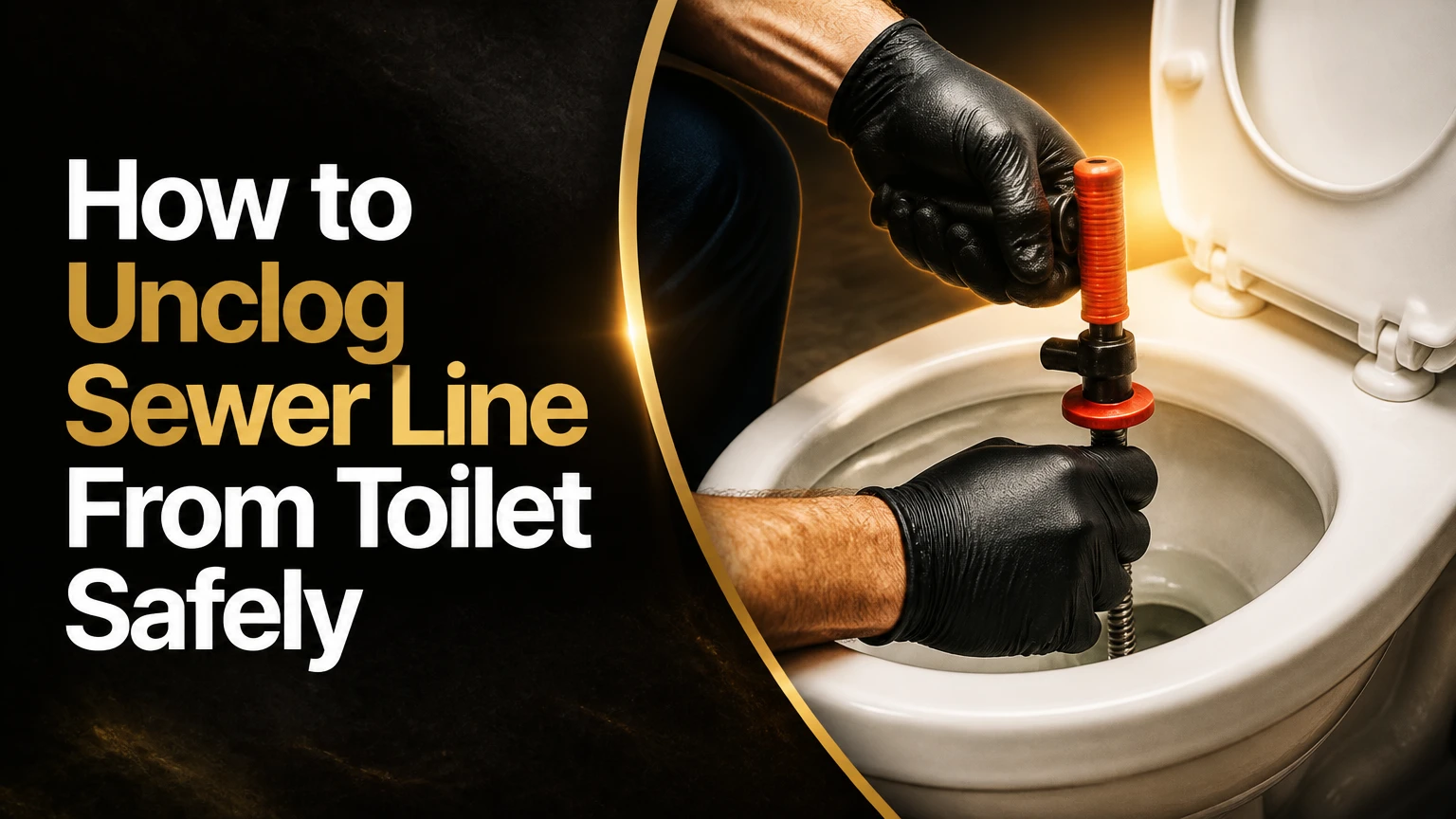
To unclog a sewer line from a toilet, first confirm that the blockage affects multiple fixtures, stop all water use, and access the line through a cleanout whenever possible. If no cleanout exists, a properly sized power auger can sometimes be fed through a removed toilet, but sewage exposure, damaged pipes, and stuck cables make professional service the safer choice in many homes.
Key facts at a glance
A toilet-only blockage usually sits in the toilet trap or nearby branch drain, not the main sewer lateral.
A main sewer blockage commonly makes several fixtures drain slowly, gurgle, or back up at once.
The exterior or basement cleanout is safer and more effective than using a toilet opening.
A typical professional cable-clearing visit costs about $200-$500; hydro-jetting commonly costs $600-$1,400.
Do not pour chemical drain cleaner into a backed-up sewer line because the chemical can remain in standing sewage and injure whoever opens the pipe.
A recurring blockage, root intrusion, collapsed pipe, or uncertain pipe condition warrants a camera inspection after flow returns.
Before You Start: Confirm the Type of Blockage
A main sewer-line clog is likely when toilets, tubs, showers, or floor drains misbehave together, especially when a washing machine or sink discharge makes a toilet gurgle. A single toilet that rises after flushing, while every other fixture drains normally, is more likely blocked in the toilet trap or its short branch line.
Quick diagnostic test
Stop flushing and run a small amount of water in a nearby sink. Watch the lowest drain, shower, or toilet. If water appears there, the obstruction is downstream of the fixtures and may be in the building sewer. If only one toilet responds, try a flange plunger or toilet auger before opening the main line.
Do not continue testing with showers, laundry, dishwashers, or repeated flushes. Every gallon entering a blocked lateral must either remain in the pipe or emerge through a low fixture. The lowest basement drain often becomes the overflow point.
Required equipment and conditions
| Item | Typical specification | Purpose |
|---|---|---|
| Protective gloves | 15-mil nitrile or thick reusable rubber | Reduces skin contact with sewage |
| Eye protection | Wraparound safety goggles | Protects against splashes |
| Rubber footwear | Waterproof boots with nonslip soles | Protects feet and improves footing |
| Sewer auger | 5/8-inch cable, 50-100 feet | Clears many residential laterals |
| Cutting head | Root cutter, spade, or C-cutter | Matches the obstruction |
| Replacement seal | New wax ring or approved rubber gasket | Required when resetting a toilet |
| Disinfectant | EPA-registered product used as labeled | Cleans contaminated surfaces |
Use a battery light rather than an extension cord near standing sewage when possible. If water has reached outlets, appliances, or a furnace, keep away from the area and have electrical power isolated by a qualified person.
How Do You Access a Sewer Line Safely?
Access the sewer line through an accessible cleanout, not through the toilet, whenever possible. A cleanout provides a straighter path, accommodates a longer cable, and avoids removing the fixture and disturbing the toilet flange.
Step 1: Stop water and contain the backup
- Close the home’s main water shutoff.
- Stop the washing machine, dishwasher, water softener regeneration, and automatic ice-maker supply.
- Keep children and pets away from contaminated areas.
- Put on gloves, goggles, boots, and washable clothing.
- Cover the work area with plastic sheeting, then place absorbent towels where you will stand.
If sewage is actively rising, call an emergency plumber or the local sewer utility before opening anything. In a municipal system, the homeowner commonly owns the building sewer from the house to the utility connection, but boundaries vary by location. The utility may be responsible for the public main and sometimes part of the connection.
Step 2: Locate and open the cleanout
Search along the basement wall, near the foundation, in a utility room, or outdoors between the house and street. Residential cleanouts commonly use a 3- or 4-inch threaded cap, although older homes may have unusual fittings or buried access points.
Loosen the cap slowly with a correctly sized wrench while standing to one side. A full lateral can hold a substantial volume of wastewater, and removing the cap quickly can release a sudden surge. If liquid immediately rises behind the cap, stop and let a professional manage the discharge.
Do not force a corroded cap with excessive leverage. Cracking the cleanout fitting or connected pipe can turn a blockage into an excavation or flood-control problem.
Can You Unclog a Sewer Line Through a Toilet?
You can sometimes clear a residential sewer lateral through a removed toilet, but the toilet opening is a backup access method, not the preferred one. A toilet flange usually leads into a branch connection with bends, and a cable fed there may have difficulty reaching the building sewer or may travel into another branch.
Step 3: Remove the toilet only when access justifies it
Use this route when no usable cleanout exists and you understand the risk of resetting the fixture.
- Turn off the toilet’s stop valve.
- Flush once, then sponge water from the tank and bowl into a bucket.
- Disconnect the supply tube.
- Remove the nuts from the floor bolts.
- Rock the toilet gently to break the wax seal.
- Lift it straight up and place it on cardboard or a plastic sheet.
- Cover the exposed flange temporarily to limit odors and splashes.
A toilet does not normally expose a “raw waste stack.” The opening reveals the closet flange and the drain branch below it. The exact path depends on the home’s layout, pipe diameter, fittings, and local plumbing design.
Replace the wax ring or rubber seal during reinstallation. Never reuse a compressed wax ring. Inspect the flange before proceeding; a loose, cracked, or rotten flange needs repair before the toilet can be sealed reliably.
Step 4: Choose and Feed the Right Sewer Auger
Use a commercial power drum machine with a 5/8-inch cable and at least 50 feet of reach for many residential lines. A 3/4-inch cable and 75-100 feet of reach may be appropriate for longer or more difficult laterals, but larger equipment also increases the chance of pipe or operator damage.
| Obstruction | Suitable first tool | Typical attachment | Main limitation |
|---|---|---|---|
| Toilet paper or soft organic waste | Toilet auger or small drain machine | Bulb or auger head | Limited reach through a fixture |
| Grease and sludge | Power sewer auger | Spade or C-cutter | May leave residue on pipe walls |
| Fine tree roots | Professional root-cutting machine | Root cutter | Does not repair the damaged pipe |
| Heavy scale or grease coating | Hydro-jetter | Multi-directional nozzle | Requires sound pipe and trained operation |
| Collapsed or offset pipe | Camera and repair plan | No cutting head is corrective | Clearing may be temporary or impossible |
Read the rental manual before connecting power. Keep the machine stable, use its foot switch, and keep both hands away from the rotating cable. Feed only a short length at a time, maintaining control near the pipe entrance.
The cable should rotate clockwise during forward feeding on most drum machines. Follow the specific machine instructions because drive arrangements differ. Do not wear loose gloves, jewelry, or clothing that can catch the rotating shaft.
Advance until the cable reaches resistance, then reduce forward pressure. A cutter that suddenly stops may be at a hard blockage, a fitting, a root mass, or a damaged section of pipe. Forcing it can kink the cable, bind the cutter, or break a fragile clay or cast-iron line.
You will know the cable has opened a passage when standing water drops noticeably and the machine begins moving forward with less resistance. That result is not proof that the pipe is clean or structurally sound.
Step 5: Retrieve the Cable and Test Flow
Withdraw the cable slowly while keeping the machine controlled and the work area contained. Reverse the motor only according to the manufacturer’s instructions; prolonged reverse operation can unscrew some cable connections or increase the risk of separation.
Wipe and disinfect the cable as it comes out. Keep the cutter head inside the containment area, and place contaminated rags and disposable materials into heavy bags according to local sanitation rules.
After retrieval, restore water gradually. First pour a small bucket into the lowest accessible drain while watching other fixtures. Then run a nearby cold-water faucet for 30-60 seconds. If the level rises, stop immediately.
A garden hose should not be left running for 5-10 minutes into an uncertain or partially blocked line. High-volume flushing can refill a failing lateral faster than it drains and can push sewage into a basement. Controlled testing is safer than indiscriminate flushing.
Reset the toilet with the new seal, reconnect the supply, and check for leaks around the base and supply valve. Flush only after the line accepts controlled water without backup.
Which Sewer-Clearing Method Should You Use?
Mechanical cabling is usually the first professional response for a complete residential blockage, while hydro-jetting is better for pipe-wall buildup after the pipe has been inspected. Drain bladders and chemical products have narrow uses and are poor choices for a backed-up main line with unknown condition.
| Method | Typical specification | Best use | Avoid when |
|---|---|---|---|
| Power auger | 5/8-inch cable, 50-100 feet, roughly 150-250 RPM | Opening paper, roots, and solid obstructions | Pipe is fragile or collapse is suspected |
| Hydro-jetting | About 1,500-4,000 PSI, professional equipment | Removing grease, sludge, and scale from sound pipe | CCTV shows cracks, offsets, or collapse |
| Drain bladder | Domestic hose pressure, often 40-60 PSI | Soft blockage in a short, accessible line | Main line is full, unknown, or backing up indoors |
| Toilet auger | Usually 3-6 feet of reach | Toilet trap obstruction | Blockage affects tubs, sinks, or floor drains |
| Biological treatment | Hours to days, preventive use | Organic maintenance after flow is restored | Immediate complete blockage or root invasion |
| Chemical cleaner | Variable, caustic or oxidizing formula | Limited fixture applications only | Standing sewage, septic concerns, or professional access |
A drain bladder can force water downstream without removing the obstruction. In a full sewer lateral, that pressure may redirect sewage into a branch, dislodge a weak fitting, or leave the operator exposed when the bladder is removed.
Chemical drain openers are especially unsuitable here. Sodium hydroxide, sulfuric acid, and oxidizing products may remain concentrated in stagnant wastewater, causing chemical burns when a toilet, cleanout, or trap is opened. Root-killing products can reduce fine root growth over time, but they cannot restore a collapsed joint or provide immediate flow.
When Is Hydro-Jetting Better Than Snaking?
Hydro-jetting is preferable when a camera or experienced plumber identifies grease, sludge, sand, or scale coating a structurally sound pipe. A cable usually creates a channel through the obstruction, while a jetting nozzle can scour more of the pipe circumference.
Jetting is not a universal upgrade. High pressure can worsen an already cracked, offset, badly scaled, or collapsed line. Responsible service begins with a camera inspection when pipe condition is uncertain, particularly in older homes with clay, Orangeburg, or heavily corroded cast-iron piping.
A root cutter also has a defined limitation: it removes roots temporarily but does not close the joint or replace the damaged pipe. Repeated root blockages should lead to a camera inspection and a repair discussion rather than indefinite annual snaking.
What If the Sewer Snake Passes Through but the Backup Returns?
A cable that passes through without restoring lasting flow often created a narrow channel through a larger obstruction or crossed an open fitting without reaching the actual blockage. Recurring backups after a successful “clear” are evidence that diagnosis is incomplete.
| Symptom after clearing | Likely cause | Next action |
|---|---|---|
| Flow returns for one day | Small hole through grease or wipes | Reclean with suitable cutter or jetter |
| Backup returns during laundry | Partial downstream obstruction | Camera inspection and measured flow test |
| Cable stops at the same distance | Roots, offset, or collapse | Do not force; locate with CCTV |
| Water drains only from cleanout | Downstream public or private restriction | Contact utility or plumber |
| Toilet leaks at base afterward | Damaged or reused seal | Reset with a new seal and inspect flange |
| Multiple fixtures stay slow | Residual debris or second blockage | Professional cleaning and camera review |
Do not jerk a stuck cable with a vehicle, come-along, or improvised winch. If the cable binds, stop the machine, follow the rental manual’s retrieval procedure, and call a plumber if the head cannot be backed out safely.
How Much Does Sewer-Line Clearing Cost and Take?
Typical residential cable clearing costs about $200-$500 professionally and takes roughly 45-90 minutes once access is available. DIY rental may cost $40-$90 per day, but removing and resetting a toilet, cleaning contamination, repairing a damaged flange, or arranging a camera inspection can erase the apparent savings.
| Service or task | Typical cost range | Typical active time | Main price variable |
|---|---|---|---|
| Toilet auger rental or purchase | $25-$100 | 15-45 minutes | Tool quality and blockage depth |
| Power sewer auger rental | $40-$90 per day | 1-3 hours DIY | Cable length and access |
| Professional cable clearing | $200-$500 | 45-90 minutes | Emergency timing and access |
| Toilet pull and reset | $100-$200 additional | 30-60 minutes | Flange condition and labor market |
| Camera inspection | $200-$1,300 | 30-90 minutes | Line length, access, and reporting |
| Hydro-jetting | $600-$1,400 | 1-3 hours | Line diameter, buildup, and access |
| Excavation or repair | Highly variable | One day to several weeks | Depth, surface, and pipe failure |
These are typical United States consumer ranges, not a guaranteed quote. HomeGuide and Angi publish broad national cost ranges, while local labor, emergency surcharges, access, and restoration work can change the final invoice substantially.
Ask whether the quoted service includes access, a camera, cleanup, disposal, and a written finding. A low cable-clearing price may cover only the first opening of the line and not the diagnosis of why the blockage occurred.
When Should You Stop DIY Work?
Call a licensed plumber promptly when sewage reaches living areas, the cable becomes stuck, the cleanout surges continuously, or the line remains blocked after a properly sized machine reaches its expected distance. Professional help is also appropriate when the house has old or unknown piping, a septic system, buried cleanouts, or repeated failures.
Situations that need special handling
Basement or crawl-space backup: Keep people and pets away, avoid electrical contact, and arrange sewage cleanup after the plumbing failure is controlled. Porous materials such as carpet padding, drywall, and insulation may require removal.
Septic property: A full septic tank, failed pump, blocked outlet filter, or saturated drain field can mimic a sewer-line clog. Check the tank service history and call a septic professional rather than repeatedly forcing water into the lateral.
Rental property: Notify the property manager in writing before opening a cleanout or removing a toilet. Lease terms and local law commonly place building-system repairs with the owner, while unauthorized work can complicate liability for pipe damage or contamination.
Municipal sewer suspicion: If the house-side cleanout is clear but wastewater still cannot leave, contact the sewer utility. Ask whether neighboring properties report backups and where the public-main responsibility begins.
Commercial or multifamily building: Shared stacks and laterals require building-specific isolation and access. A homeowner-sized drum machine may be inadequate and can damage common piping.
Common Mistakes and How to Fix Them
- Using a cup plunger on a main-line backup: A standard plunger cannot reach a blockage dozens of feet downstream. Use a flange plunger only when the evidence points to one toilet.
- Opening a cleanout fully at once: Pressure can release sewage suddenly. Loosen gradually from the side and retighten if liquid rises.
- Choosing a cable that is too small: A thin cable may punch through grease and leave the obstruction intact. Match cable and cutter to pipe diameter and material.
- Forcing the machine at resistance: Excessive feed pressure binds cutters and damages cable. Let rotation work gradually, then reassess the obstruction.
- Using chemicals before calling a plumber: Tell the plumber exactly what product and quantity entered the line. Do not add another chemical or mix products.
- Assuming restored flow means restored condition: A temporary opening can hide roots, a belly, an offset joint, or collapse. Request a camera when the problem repeats.
A practical plumber’s rule is to treat the first recurrence as diagnostic evidence, not bad luck. The second backup at the same interval often means the underlying restriction remains.
FAQ
Can I unclog a main sewer line with a toilet plunger?
A toilet plunger can clear a blockage in the bowl trap or the short branch drain, but it rarely reaches a main sewer obstruction. If sinks, showers, and floor drains also back up, stop plunging and locate the cleanout or arrange professional main-line service.
How far is the sewer blockage from my toilet?
The distance varies with the home’s layout, but a building sewer may run 10-100 feet from the foundation to the municipal connection or septic tank. Cable distance alone does not prove location because a machine can travel through fittings, branches, or a damaged pipe.
Do boiling water, baking soda, or vinegar clear sewer roots?
Boiling water, baking soda, and vinegar do not cut established roots or repair a separated sewer joint. These substances may affect minor organic residue in a fixture, but a root-filled lateral requires mechanical removal, hydro-jetting where appropriate, and often a camera-based repair decision.
Will homeowner’s insurance pay for a sewer backup?
Coverage depends on the policy, endorsement, cause, and damage location. Many standard policies exclude sewer backup unless a separate endorsement exists, and policies may treat pipe wear, root intrusion, and sudden interior damage differently. Photograph damage, preserve invoices, and notify the insurer before major disposal when safe.
How can I prevent another sewer-line blockage?
Prevent recurrence by keeping wipes, paper towels, grease, and hygiene products out of the drain system, maintaining an accessible cleanout, and investigating repeated backups with CCTV. Homes with documented root intrusion may need scheduled cleaning, trenchless repair, or replacement rather than routine chemical treatment.
The Bottom Line
To unclog a sewer line from a toilet, first distinguish a single-fixture blockage from a main-line backup, stop every source of water, and use the cleanout when one exists. A controlled power auger can open some residential laterals, but sewage exposure, stuck cables, roots, and damaged pipe make professional diagnosis the safer choice when access or pipe condition is uncertain. A cleared line that backs up again needs a camera inspection, not repeated guesswork.