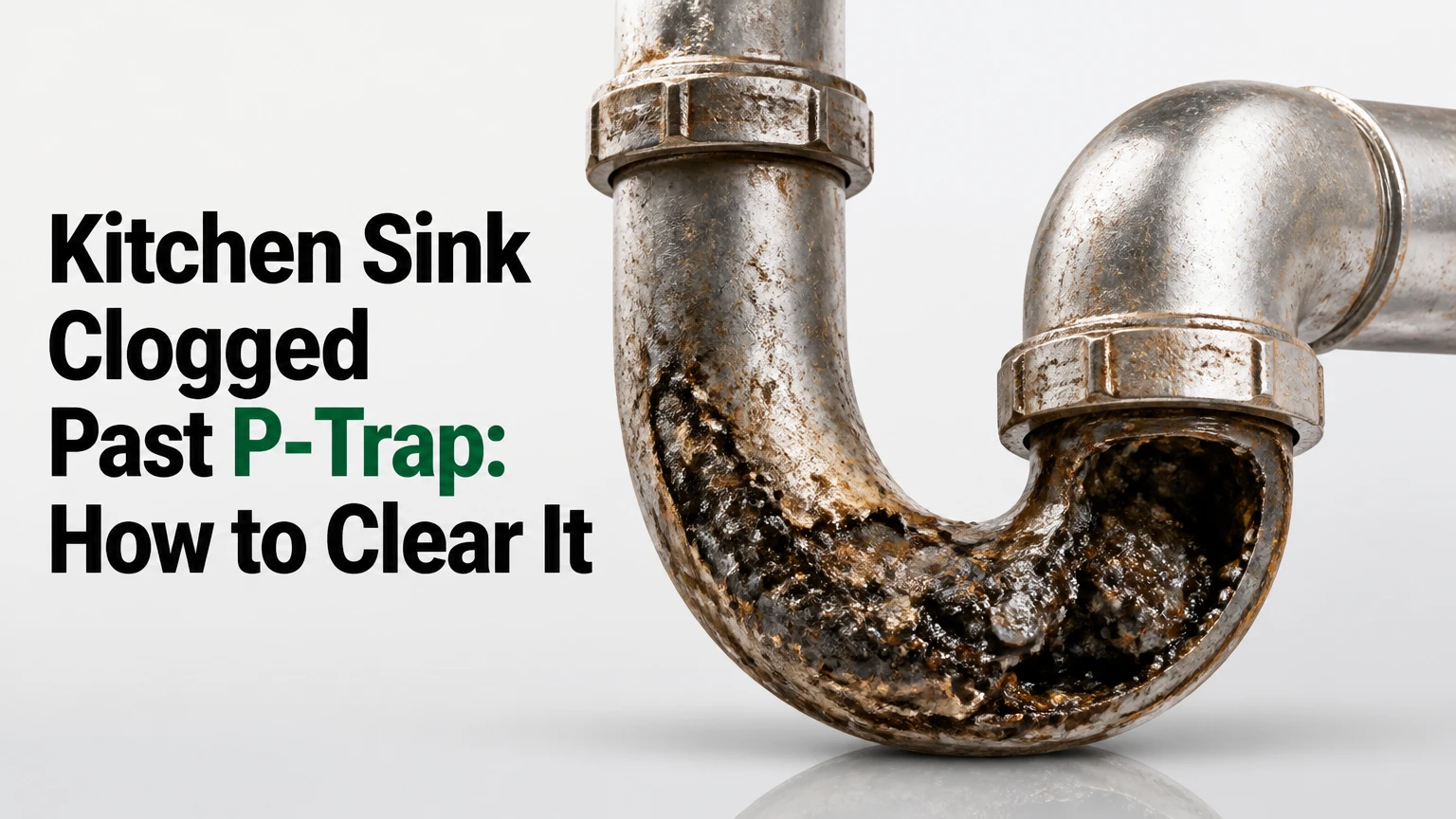
A kitchen sink clogged past the P-trap usually has an obstruction inside the trap arm or horizontal branch drain entering the wall. Remove the trap, test the wall pipe, and use a correctly sized drain auger to break up or retrieve the blockage without forcing the cable through fittings or weakened pipe.
Key Facts at a Glance
- A clear P-trap does not prove the entire kitchen drain is clear.
- Immediate standing water usually indicates a complete or nearly complete branch-line blockage.
- A 1/4-inch manual cable is generally safer for a 1.5-inch kitchen drain than a heavy main-sewer cable.
- Grease clogs often smear and reopen temporarily instead of coming out as one solid plug.
- Multiple backed-up fixtures suggest a larger branch, stack, or building-drain problem.
- Recurring clogs after proper cabling may require camera inspection, pipe correction, or hydro jetting.
What Does a Kitchen Sink Clogged Past the P-Trap Mean?
A kitchen sink clog past the P-trap is located downstream of the curved removable trap, commonly inside the short trap arm, the kitchen branch drain, or a fitting hidden within the wall. The blockage is therefore beyond the reach of ordinary sink stoppers, cup plungers, and short plastic cleaning tools.
The drainage path normally follows this order:
- Sink strainer or garbage disposal
- Tailpiece or continuous-waste assembly
- P-trap
- Trap arm entering the wall
- Horizontal kitchen branch drain
- Drain stack or larger building drain
The P-trap retains water to prevent sewer gas from entering the room. Clearing that trap only removes debris from one short, accessible section. If the trap is clean but water will not enter the wall pipe, the problem is farther downstream.
A kitchen sink trap generally has a minimum nominal size of 1.5 inches under the 2024 International Residential Code. The connected branch may remain 1.5 inches or increase to 2 inches, depending on drainage load and local requirements.
How Can You Confirm the Clog Is Past the P-Trap?
The most reliable DIY confirmation is to remove the P-trap and conduct a cautious wall-pipe test. A clear trap plus water standing at the wall opening confirms that the obstruction is downstream, while an empty wall pipe does not necessarily prove that the full branch is unrestricted.
Diagnostic symptoms
| Observation | Most likely location | Recommended next test |
| One bowl drains, the other does not | Disposal, baffle tee, or continuous waste | Disconnect and inspect sink-side fittings |
| Both bowls hold water | Shared P-trap or downstream branch | Remove and inspect the P-trap |
| P-trap contains packed debris | P-trap itself | Clean, reinstall, and retest |
| P-trap is clear, wall pipe holds water | Trap arm or branch drain | Use a hand auger |
| Sink drains slowly after trap removal | Partial downstream restriction | Cable and perform a volume test |
| Dishwasher causes sink backup | Disposal inlet or kitchen branch restriction | Inspect disposal and cable branch |
| Other nearby fixtures also back up | Shared branch, stack, or building drain | Stop DIY work and locate a cleanout |
| Water emerges from a lower fixture | Larger downstream blockage | Call a drain-cleaning professional |
Do not pour a large bucket of water directly into an untested wall opening. Use approximately 1 cup first, with a bucket and towels positioned below the pipe. If the water immediately rises toward the opening, stop adding water.
Why Do Kitchen Branch Drains Clog Beyond the Trap?
Grease is the dominant mechanism in many deep kitchen clogs, but it rarely acts alone. Cooking oil coats the pipe wall, detergent and food particles adhere to that film, and repeated deposits gradually reduce the usable diameter until ordinary sink discharge cannot pass.
Common contributing conditions include:
- Grease, butter, shortening, and fatty sauces
- Rice, flour, coffee grounds, starch, and fibrous food
- Food-disposal waste sent down with insufficient water
- A long horizontal branch with marginal pitch
- Sagging pipe that retains greasy water
- Corroded cast iron with a rough internal surface
- Misaligned fittings or excessive sharp turns
- A partially blocked vent that worsens drainage symptoms
- Previous chemical cleaner that opened only a narrow channel
Horizontal drainage pipes 2.5 inches or smaller generally require at least 1/4 inch of fall per foot under the 2024 International Plumbing Code. The code states that horizontal drainage piping must have “uniform alignment at uniform slopes.”
The pitch requirement equals a 2 percent slope. A 10-foot branch should therefore fall approximately 2.5 inches from its upstream to downstream end. A belly or back-pitched section retains water and grease, so even successful augering may provide only temporary relief.
Before You Start
| Item | Typical requirement |
| DIY time | 45-120 minutes |
| Difficulty | Moderate |
| Basic cost | $25-$60 |
| Preferred cable | 1/4-inch drum auger |
| Useful cable length | 25 feet minimum, 50 feet for longer branches |
| Pipe access | Open trap arm or dedicated cleanout |
| Protective equipment | Gloves and eye protection |
| Main success factor | Reaching beyond the full clog without damaging the pipe |
Tools and materials
- Bucket with at least 2-gallon capacity
- Absorbent towels
- Chemical-resistant gloves
- Safety glasses
- Tongue-and-groove pliers
- 1/4-inch manual drum auger
- Flashlight
- Small nylon pipe brush
- Trash bag
- Replacement slip-joint washers
- Measuring tape
- Drain stopper for the second sink bowl
Do not begin mechanical drain work when a strong acid, caustic cleaner, or unknown chemical is standing in the pipe. Chemical drain openers can be corrosive, and the EPA identifies some cleaners as household hazardous waste. It recommends mechanical alternatives such as a plunger or plumber’s snake rather than unnecessary chemical use.
Which Drain-Clearing Method Should You Use?
A hand-operated drum auger is usually the best first method for a single kitchen sink clog confirmed beyond the trap. It gives direct access to the branch line, costs less than powered equipment, and creates less risk than inserting an oversized sewer machine into a small pipe.
| Method | Suitable condition | Typical cost | Typical time | Main limitation |
| 25-foot manual auger | Local food or grease clog | $25-$50 purchase | 30-90 minutes | May not reach a distant blockage |
| 50-foot manual auger | Longer kitchen branch | $40-$80 purchase | 45-120 minutes | Harder to control and retrieve |
| Rental power auger | Dense or distant branch clog | $45-$100 per day | 1-3 hours | Can damage fittings or old pipe |
| Professional drain cabling | Stubborn branch restriction | $150-$350 typical | 1-2 hours | May cut a channel without cleaning walls |
| Camera inspection | Recurring or unexplained clog | $150-$500 typical | 1-2 hours | Diagnoses but does not clear |
| Hydro jetting | Heavy grease or internal scale | $300-$800 typical | 1-3 hours | Unsuitable for some damaged pipes |
| Chemical opener | Limited organic residue | $10-$25 | Several hours | Poor control, splash hazard, pipe concerns |
Prices vary by access, market, emergency timing, pipe length, and whether the plumber must remove cabinets or open a wall. Hydro jetting should generally follow an assessment of pipe condition, especially with old cast iron, Orangeburg, or already cracked drainage pipe.
Step 1: Stop Using the Sink and Dishwasher
Stop all water discharge into the kitchen drain before disassembly. Turn off the dishwasher, avoid running the disposal, and tell other household members not to use the sink until the branch is open and leak-tested.
Remove as much standing water as possible with a cup, sponge, or wet vacuum. Less water in the bowls means less wastewater will spill when the trap is disconnected.
Success checkpoint: The sink bowls contain little or no free water.
Common mistake: Running the disposal to force water through. A disposal moves food inside its grinding chamber, but it does not pump water through a blocked branch line.
Step 2: Remove and Inspect the P-Trap
Place the bucket under the P-trap, loosen both slip nuts, and lower the curved section carefully. Hand pressure is often enough on plastic fittings; use pliers gently if the nuts are stuck.
Inspect the trap for grease, food, utensils, glass, and hardened detergent. Clean it mechanically with a nylon brush and warm water. Do not use another household sink if that sink connects to the same obstructed branch.
Success checkpoint: Light passes through the entire trap, and no packed material remains.
Common mistake: Assuming a small amount of slime caused the backup. A thin coating is normal. A complete stoppage requires a substantial obstruction or a downstream restriction.
Step 3: Test the Wall Pipe Carefully
Remove the trap arm if it prevents direct cable access. Shine a flashlight into the wall pipe and check whether water is standing close to the opening.
Add no more than approximately 1 cup of water. If the water remains visible or rises toward the opening, the kitchen sink is clogged past the P-trap. If it disappears, the line may still have a partial restriction farther downstream.
Success checkpoint: You have confirmed whether the wall pipe accepts water.
Common mistake: Pouring an entire bucket into the pipe. A blocked line can overflow inside the cabinet before you can stop the test.
Step 4: Select the Correct Drain Snake
Use a 1/4-inch cable for most 1.5-inch kitchen branch drains. A cable that is too thin may kink without cutting the clog, while a 3/8-inch or 1/2-inch cable may be too aggressive for tight bends, thin fittings, or deteriorated metal.
Start with a 25-foot auger when the kitchen is near the main stack. Choose 50 feet when the branch crosses a substantial portion of the house, but stop if cable control becomes poor.
Success checkpoint: The cable enters the pipe without buckling outside the drain.
Common mistake: Using a large main-sewer auger simply because it has more power. More torque can break a fitting before it clears the obstruction.
Step 5: Feed the Cable Into the Branch Line
Insert 6-12 inches of cable, tighten the drum’s retaining screw, and rotate the drum clockwise while advancing gradually. Release more cable in short increments rather than feeding several feet loosely.
Resistance within the first 1-3 feet may be an elbow or sanitary tee. Maintain rotation and light forward pressure. Do not ram the cable.
Resistance farther down the line may feel soft, springy, hard, or metallic:
| Cable feel | Likely cause | Correct response |
| Soft and greasy | Fat, soap, food sludge | Rotate repeatedly and advance gradually |
| Springy, then releases | Fibrous food or compact debris | Work through and retrieve slowly |
| Hard at a repeatable distance | Fitting, scale, foreign object | Reverse slightly and change cable angle |
| Cable stops while drum twists | Kink forming | Stop, retract, and reset |
| Scraping through entire run | Corroded cast iron or heavy scale | Use caution and consider inspection |
| Cable drops freely after resistance | Clog penetration | Continue several feet beyond the point |
Success checkpoint: The cable progresses steadily without forming loops or sharp bends.
Step 6: Work Through the Blockage
When the cable reaches the clog, tighten the retaining screw and rotate while applying controlled forward pressure. Advance a few inches, retract slightly, and repeat until the cable passes through the resistant area.
Grease clogs often do not attach to the cable. The auger may drill a small channel through the deposit while leaving grease on the pipe walls. Run the cable through the affected area several times, changing the insertion distance slightly on each pass.
Success checkpoint: The cable travels at least 3-5 feet beyond the original resistance with noticeably less effort.
Common mistake: Stopping as soon as the cable punches one hole. That narrow opening may close again after the first dishwasher cycle.
Step 7: Retrieve and Clean the Cable
Withdraw the cable slowly while maintaining light clockwise rotation. Wipe each section with disposable towels before it reenters the drum, and place removed material directly into a trash bag.
Watch for the cable becoming tight during retrieval. Reverse the rotation briefly and push forward an inch or two before attempting to withdraw again.
Success checkpoint: The full cable returns without severe kinks, flattened sections, or missing cutting-head components.
Common mistake: Pulling a stuck cable with maximum force. A cable hooked around a fitting can tighten further or damage the drain.
Step 8: Flush the Open Branch Gradually
After cabling, test the open wall pipe with 1 cup of water. If it drains, increase to 1 quart, then approximately 1 gallon.
Use hot tap water, not boiling water. Water alone will not remove every grease deposit, but a controlled flush confirms that the branch can accept normal discharge before the trap is reinstalled.
Success checkpoint: One gallon enters the wall pipe without rising back toward the opening.
Common mistake: Treating temperature as the main cleaning force. Melted grease can cool and redeposit farther downstream.
Step 9: Reassemble and Leak-Test the Drain
Reinstall the trap arm and P-trap with the tapered side of each slip-joint washer facing the fitting socket. Hand-tighten the nuts, then use pliers only for a small additional adjustment if a joint seeps.
Run cold water first and inspect every joint. Then fill the sink basin several inches and release the stopper to create a high-volume test. Test both bowls, the disposal, and the dishwasher connection where applicable.
Success checkpoint: The sink empties rapidly, no water rises in the second bowl, and all joints remain dry.
Common mistake: Overtightening plastic slip nuts. Excess force can deform washers, split nuts, or pull the trap out of alignment.
What Should You Do if the Snake Gets Stuck?
Stop cranking forward when a drain snake becomes stuck. A trapped cable can kink inside the pipe, wrap around an internal obstruction, or wedge at a fitting, and additional torque may make retrieval harder.
Follow this sequence:
- Release forward pressure.
- Rotate backward one or two turns.
- Push the cable forward approximately 1 inch.
- Rotate clockwise slowly.
- Pull back a few inches.
- Repeat without jerking.
If the cable will not move in either direction, stop using the machine. A professional may need to open a cleanout, remove a fitting, or retrieve the cable with specialized equipment.
Common Mistakes and How to Fix Them
| Mistake | Likely consequence | Recovery |
| Using an oversized cable | Damaged fitting or trapped cable | Stop and switch to a 1/4-inch branch cable |
| Forcing resistance | Punctured old pipe or kinked cable | Retract and approach with rotation |
| Mixing drain chemicals | Toxic reaction or splash injury | Leave the area and follow product safety guidance |
| Snaking through a disposal | Damaged disposal or cable entanglement | Disconnect downstream and enter at the trap arm |
| Flushing with boiling water | Joint stress and hidden leakage risk | Use ordinary hot tap water |
| Reusing damaged washers | Cabinet leak after reassembly | Install new tapered washers |
| Clearing only one narrow channel | Rapid recurrence | Make several cable passes |
| Ignoring multiple fixture backups | Missed main-line problem | Stop using fixtures and call a plumber |
Never mix chemical drain products with bleach, acids, ammonia, or another drain opener. EPA materials identify common drain openers as corrosive household chemicals, and some contain sodium hydroxide, potassium hydroxide, sulfuric acid, or hydrochloric acid.
What Changes With a Double Kitchen Sink?
A double kitchen sink may clog before or after the P-trap. If one bowl backs up into the other, inspect the continuous-waste tee, disposal outlet elbow, and shared trap before assuming the obstruction is inside the wall.
Seal one bowl when plunging the other, because an open second drain releases pressure. If both bowls remain blocked after the P-trap and horizontal waste pieces are cleaned, access the wall branch directly with the auger.
A baffle tee can also trap food. The internal divider directs flow downward, but it creates an edge where grease and fibrous debris collect.
What Changes When the Sink Has a Garbage Disposal?
A garbage disposal adds three possible restriction points: the grinding chamber, the discharge elbow, and the dishwasher inlet. Confirm that the disposal spins freely and that its outlet is clear before cabling the wall pipe.
Disconnect electrical power before placing tools near the grinding chamber. Never insert a drain cable through the disposal opening. Remove the P-trap or discharge elbow and access the downstream branch instead.
Run plenty of cold water during disposal use. Cold water helps keep fats more solid while they travel through the immediate drain assembly, although it cannot prevent accumulation caused by repeatedly sending grease into the plumbing system.
When Is Hydro Jetting Better Than Snaking?
Hydro jetting is often better when repeated cabling restores flow only temporarily and the pipe walls remain coated with grease or mineral scale. A cable opens a path, while properly selected jetting nozzles can scour a larger portion of the pipe circumference.
Hydro jetting is not automatically appropriate for every old drain. Cracked, separated, severely corroded, or poorly supported piping should be inspected first because high-pressure water may expose an existing failure or escape through a damaged joint.
A camera inspection is most valuable after the line has enough flow for the lens to see the pipe. Standing greasy water can obscure the condition and produce an inconclusive recording.
How Much Does It Cost to Clear a Deep Kitchen Clog?
Clearing a kitchen branch clog typically costs $25-$80 for a DIY hand auger or roughly $150-$350 for ordinary professional cabling. Difficult access, emergency service, long branch runs, camera inspection, hydro jetting, or pipe replacement can increase the total substantially.
| Service | Typical range | What usually affects the price |
| Manual auger purchase | $25-$80 | Cable length and drum quality |
| Power-auger rental | $45-$100 per day | Machine size and rental period |
| Professional cabling | $150-$350 | Access, distance, and severity |
| Camera inspection | $150-$500 | Cleanout access and pipe length |
| Hydro jetting | $300-$800 | Grease level and pipe diameter |
| Minor drain repair | $250-$1,000 | Fittings, wall access, and labor |
| Branch-line replacement | $1,000-$5,000+ | Length, material, excavation, and finishes |
These are typical U.S. service ranges rather than fixed quotes. A plumber should identify whether the quoted work covers only opening the line or also includes cleaning, inspection, repair, and a return-service warranty.
Why Does the Kitchen Sink Keep Clogging After Snaking?
A recurring kitchen clog usually means the auger opened a temporary channel or the pipe has an underlying drainage defect. Repeated blockage at the same measured distance is especially useful evidence because it points toward a fixed pipe condition rather than random food debris.
Likely causes include:
- A low or back-pitched branch
- A sagging section that retains water
- Heavy cast-iron scaling
- A sharp or incorrectly installed fitting
- An undersized branch serving several fixtures
- A foreign object lodged in the pipe
- Grease coating that cabling did not remove
- Root entry in an underground kitchen branch
- A damaged, offset, or partially collapsed pipe
The 2024 IRC requires uniform horizontal slope and does not permit drainage piping to become smaller in the direction of flow. Those principles matter because retained water and abrupt restrictions reduce carrying capacity and encourage recurring deposits.
When Should You Call a Plumber?
Call a plumber when the cable cannot pass, the line reclogs within days, multiple fixtures back up, wastewater appears at a lower drain, or the pipe leaks inside the wall. These symptoms suggest a problem beyond routine kitchen-branch maintenance.
Professional service is also appropriate when:
- Chemical cleaner is standing in the pipe
- The home has fragile galvanized or cast-iron drainage
- The cable repeatedly stops at the same location
- A powered auger would be required
- The accessible pipe is cracked or badly corroded
- The kitchen branch runs beneath a slab
- There is no safe access point
- Sewage, rather than kitchen wastewater, enters the sink
Stop using water throughout the affected area when a main building drain may be blocked. Continued fixture use can move wastewater into cabinets, flooring, walls, or lower-level rooms.
How Can You Prevent Another Deep Kitchen Clog?
The most effective prevention is keeping grease and high-volume food waste out of the drain. Routine flushing cannot compensate for repeatedly disposing of fats, flour, coffee grounds, fibrous vegetables, or large quantities of ground food.
Use these practices:
- Wipe greasy cookware into the trash before washing.
- Collect cooking oil in a sealed container.
- Scrape plates thoroughly.
- Use a sink strainer.
- Feed disposal waste in small batches.
- Run water during disposal use and briefly afterward.
- Avoid coffee grounds, flour, eggshell membranes, and fibrous peels.
- Address a slow drain before it becomes fully blocked.
- Have recurring problems camera-inspected rather than repeatedly treated.
Enzyme products may help maintain an already open line, but they are not reliable tools for a complete deep blockage. They work slowly and cannot correct poor slope, pipe damage, or a solid foreign object.
Frequently Asked Questions
Can a plunger clear a clog past the P-trap?
A plunger can sometimes move a shallow downstream clog, especially when the branch still passes a small amount of water. Its effectiveness declines with distance, vent openings, double-sink connections, and dense grease. Seal the second bowl completely, use controlled strokes, and switch to direct wall-pipe cabling if the blockage remains.
How far down is a kitchen sink clog usually located?
A kitchen clog may be only 1-5 feet beyond the trap, but grease restrictions can occur 10-30 feet downstream where the branch turns, loses pitch, or joins a larger drain. Measure the cable length when resistance begins. Repeated resistance at the same distance helps a plumber locate the problem.
Will baking soda and vinegar clear a deep branch clog?
Baking soda and vinegar are unlikely to clear a complete kitchen branch blockage. Their reaction produces agitation but limited mechanical force, and it cannot retrieve food, correct pipe scale, or remove a solid grease plug. Use a properly sized auger after confirming that the trap and sink-side fittings are clear.
Can a clogged vent make the kitchen sink stop draining?
A severe vent problem can slow drainage, cause gurgling, or disturb trap seals, but a completely stationary kitchen sink more often has a waste-line obstruction. If the branch accepts water after cabling but still drains poorly while gurgling, a plumber should evaluate the venting and branch configuration.
Should you use a 25-foot or 50-foot drain snake?
Use a 25-foot cable when the kitchen branch is short and the stack is nearby. A 50-foot cable is useful when the line crosses the house or the first cable does not reach the obstruction. Longer cable is harder to control, so do not advance it without maintaining drum tension.
Can a kitchen clog be part of a main sewer blockage?
Yes. A kitchen backup may be part of a larger blockage when toilets, tubs, floor drains, laundry fixtures, or lower-level drains also behave abnormally. A kitchen-only problem usually points to the kitchen branch. Multiple affected fixtures require broader diagnosis before more water is introduced.
The Bottom Line
A kitchen sink clogged past the P-trap should be approached through the open trap arm with a correctly sized drain auger, gradual testing, and strict limits on force. Clear the P-trap first, cable several feet beyond the obstruction, perform a measured volume test, and call a plumber when the blockage recurs or affects other fixtures.
The key limitation is structural: an auger can restore flow, but it cannot correct a sagging branch, inadequate pitch, severe corrosion, a broken fitting, or a collapsed pipe. When the same deep clog returns, camera inspection and permanent pipe correction are more valuable than another temporary opening.