A poop-clogged toilet may unclog itself when the blockage contains only human waste and ordinary toilet paper. Water can soften those materials enough for the clog to move through the trapway, but wet wipes, paper towels, hygiene products, toys, and tightly compacted obstructions normally require a plunger, toilet auger, or plumber.
Key Facts at a Glance
- A soft organic clog may clear naturally within 2-12 hours.
- A falling bowl-water level means some water is passing the obstruction.
- A water level that does not move suggests a dense clog or foreign object.
- Repeated flushing increases overflow risk without breaking apart the clog.
- Warm tap water is safer than boiling water, which can crack porcelain.
- A flange plunger is the first active tool to use for most toilet clogs.
Will A Poop Clogged Toilet Unclog Itself Every Time?
No. A poop-clogged toilet will unclog itself only when the blockage is soft, water-soluble, and small enough to pass through the toilet’s curved trapway after absorbing water. The toilet is unlikely to clear naturally when the clog includes non-flushable material, excessive compacted paper, or an object lodged inside the trap.
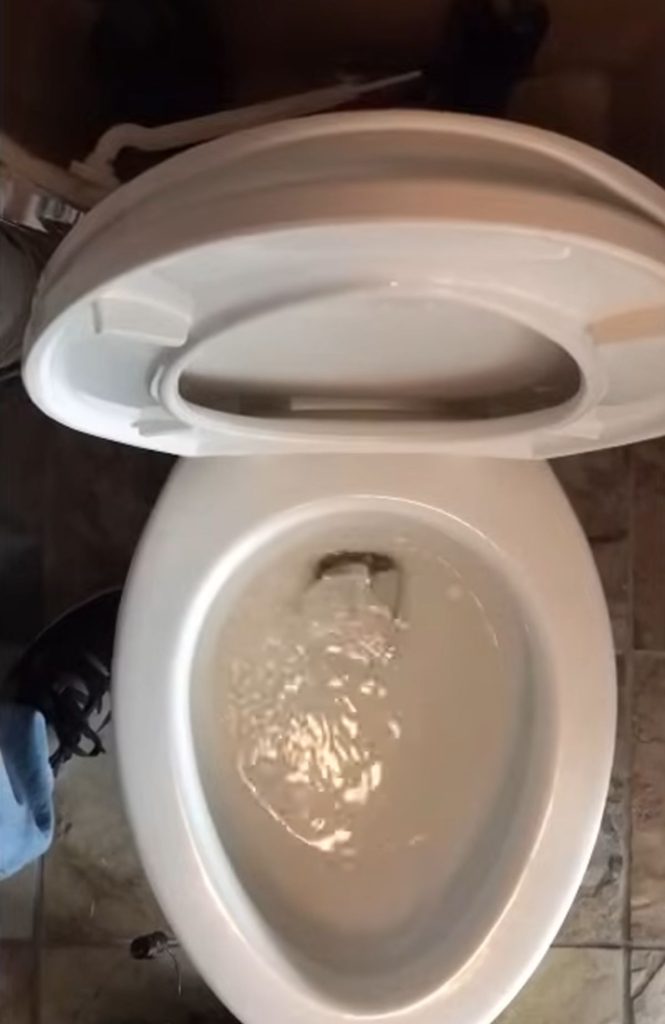
The most useful indicator is water movement. When the bowl level gradually falls, even by a small amount, water is finding a path around the clog. Continued soaking may widen that path until the waste passes.
A completely unchanged water level is less encouraging. It often indicates that the trapway is tightly sealed by compressed material or blocked by something that cannot dissolve.
Waiting is reasonable when:
- The toilet contains only poop and normal toilet paper.
- The bowl is several inches below the rim.
- The water level is slowly declining.
- No one needs to use the toilet immediately.
- No other drain in the house is backing up.
Start active unclogging when the bowl remains full, a non-flushable item may be present, or the bathroom is the home’s only available toilet.
Why Can An Organic Toilet Clog Clear Naturally?
An organic toilet clog can clear naturally because toilet paper loses strength when saturated, fecal matter softens in water, and the standing water in the bowl applies steady pressure against the obstruction. Once the clog loses enough structure, gravity and water pressure may push it through the trapway.
Standard toilet paper is designed to separate into weak fibers after prolonged contact with water. It does not instantly disappear, but a compacted wad can become soft enough to deform and move through a narrow bend.
Human waste also absorbs water and loses firmness. Bacteria may contribute to gradual decomposition, but soaking and physical softening are more important during the first several hours.
The bowl’s water creates hydrostatic pressure against the clog. This pressure is modest, which explains why waiting works for soft blockages but not for plastic, cloth, wipes, toys, or dense paper products.
What Materials Can Break Down?
| Material in the clog | Breaks down in water? | Likelihood of self-clearing | Recommended response |
| Human waste only | Softens over several hours | Moderate to high | Wait and monitor |
| Waste with toilet paper | Paper weakens when saturated | Moderate | Wait 2-8 hours |
| Excess toilet paper | Softens but may remain compacted | Low to moderate | Use a flange plunger |
| Wet wipes | Usually remain structurally intact | Very low | Use a toilet auger |
| Paper towels | Remain stronger than toilet paper | Very low | Plunge or use an auger |
| Hygiene products | Expand and resist breakdown | Almost none | Stop flushing and use an auger |
| Small toy or plastic item | Does not dissolve | None | Retrieve or call a plumber |
How Long Does a Poop Clog Take to Dissolve?
A minor poop and toilet-paper clog may clear in 2-4 hours, while a heavier organic blockage can require 8-12 hours. If the water level has not changed after 12 hours, waiting longer becomes progressively less useful, and a toilet that remains fully blocked after 24 hours normally needs mechanical clearing.
The actual time depends on four variables: the amount of waste, the quantity and type of paper, how tightly the material is packed, and whether water can pass around it.
A visible drop in the bowl level is more informative than the clock. A toilet that drops several inches within an hour is more likely to clear than one that remains completely full for eight hours.
| Waiting period | What the water level may indicate | Recommended action |
| 15-30 minutes | Rapid drop toward normal level | Continue waiting, then test carefully |
| 2-4 hours | Slow but measurable decline | Allow more soaking time |
| 8-12 hours | Partial drainage only | Use a flange plunger |
| 12-24 hours | Little or no movement | Use a toilet auger |
| More than 24 hours | Persistent complete blockage | Call a plumber or inspect the drain line |
Do not leave a toilet unattended when the bowl is close to the rim. Remove some contaminated water first and close the supply valve to prevent an accidental refill.
How Can You Safely Wait for the Toilet to Clear?
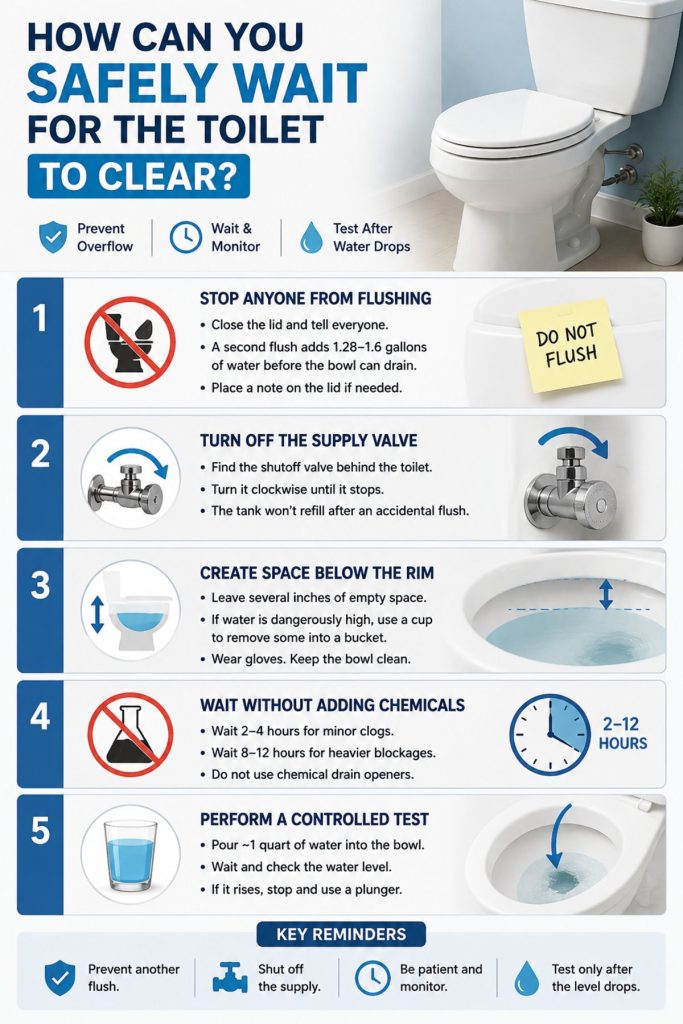
Safe waiting requires preventing another flush, creating overflow space, and monitoring the bowl-water level. Close the toilet’s water-supply valve, remove excess water when necessary, wait several hours, and test the drain only after the water level has noticeably fallen.
Step 1: Stop Anyone From Flushing
Close the lid and tell everyone in the household that the toilet is blocked. A second flush adds another tankful of water, usually 1.28-1.6 gallons in a modern toilet, before the existing bowl water can drain.
Place a note on the lid when children, guests, or multiple household members are present.
Step 2: Turn Off the Supply Valve
Find the shutoff valve on the wall or floor behind the toilet. Turn it clockwise until it stops.
Closing this valve does not remove water already stored in the tank, but it prevents the tank from refilling after an accidental flush. You will know the valve is closed when the tank does not refill after the handle is pressed.
Step 3: Create Space Below the Rim
The bowl should have several inches of empty space below its rim. If the water is dangerously high, use a disposable cup or small container to transfer some water into a bucket.
Wear rubber gloves and disinfect any tool that contacts the bowl. Do not pour contaminated water into a sink or bathtub. Return it to the toilet only after the clog has cleared.
Step 4: Wait Without Adding Chemicals
Allow 2-4 hours for a minor organic clog and up to 8-12 hours for a heavier blockage. Check whether the water level is dropping.
Do not add chemical drain opener. The chemical can remain trapped in the bowl and expose anyone who later plunges or removes the toilet.
Step 5: Perform a Controlled Test
Test the drain only after the bowl level has fallen substantially. Pour approximately 1 quart of water into the bowl instead of immediately using the flush handle.
A clear drain accepts the added water and returns to its normal level. If the bowl begins rising, stop pouring and move to a plunger.
Should You Add Warm Water or Dish Soap?
Warm water and dish soap can help lubricate and soften an organic clog, but they work only when enough empty bowl capacity remains to receive the added liquid. Use hot tap water rather than boiling water, and never add a full bucket to a bowl that is already near the rim.
Add approximately 1/2 cup of liquid dish soap and wait 10-15 minutes. Then pour 1/2 to 1 gallon of hot tap water slowly into the bowl, stopping immediately if the level approaches the rim.
The soap reduces friction along the porcelain trapway. Warm water can accelerate paper saturation and soften the waste.
This method will not dissolve wet wipes, cloth, toys, sanitary products, or other foreign materials. It should be treated as a low-cost attempt for a suspected organic clog, not as a substitute for a toilet auger.
When Should You Use a Flange Plunger?
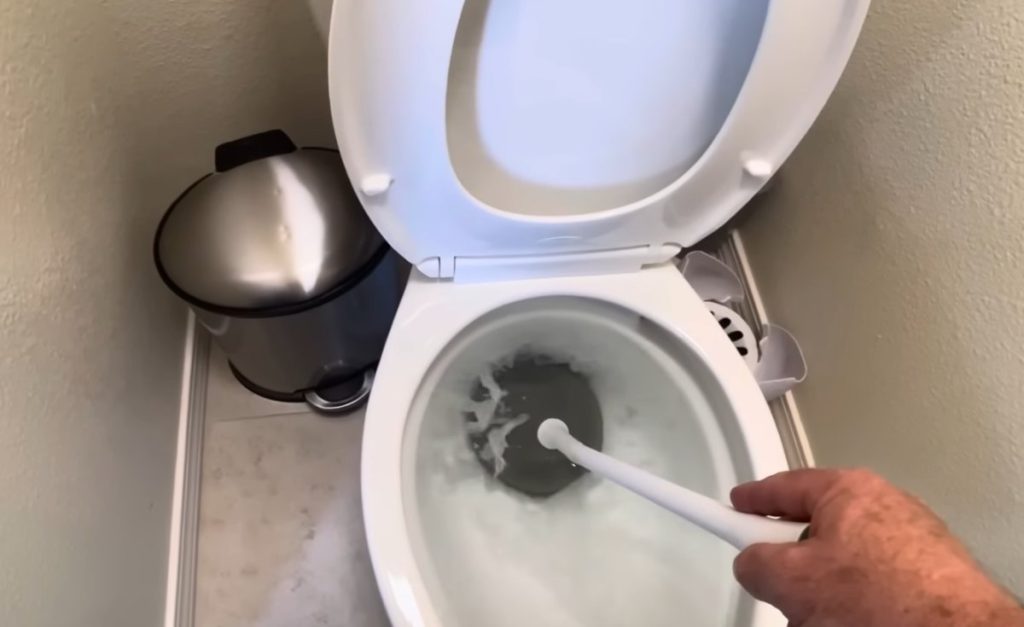
Use a flange plunger when the toilet has not cleared after a short waiting period, the water drains too slowly, or the clog returns during a test. A flange plunger forms a seal inside the toilet outlet and moves water in both directions, which breaks apart or dislodges soft obstructions.
A flat cup plunger is designed primarily for sinks. A toilet plunger has an extended rubber flange that fits into the drain opening.
How to Plunge the Toilet Correctly
- Ensure enough water covers the plunger cup.
- Insert the flange into the toilet outlet.
- Press down slowly to remove trapped air.
- Pull upward firmly without breaking the seal.
- Repeat 10-15 controlled strokes.
- Finish with one strong upward pull.
- Wait and observe whether the water drains.
The first push should be gentle. A hard initial push can force air and dirty water out around the plunger.
Successful plunging usually produces a sudden drop in the bowl level, a gurgling sound, or visible movement through the outlet. Test with a small amount of water before restoring the supply and flushing.
What If the Plunger Does Not Work?
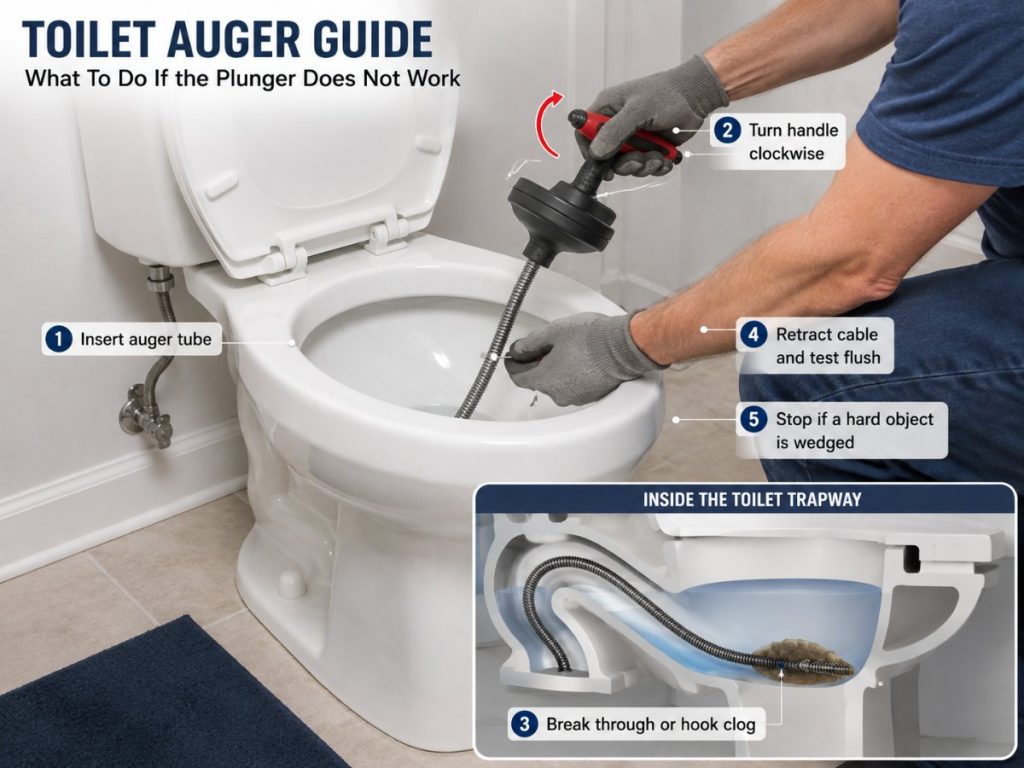
A toilet auger is the next tool to use when correct plunging does not clear the blockage. The auger’s protected cable can break through dense material or hook an object located inside the toilet trap without exposing the porcelain to an unprotected metal wire.
Insert the curved auger tube into the outlet until its protective sleeve rests against the bowl. Turn the handle clockwise while feeding the cable forward.
Resistance may indicate either a trapway bend or the obstruction. Continue turning gently rather than forcing the cable. After contacting the clog, rotate several times, retract the cable, and test the toilet with a small amount of water.
Stop if the cable cannot advance or if you suspect a hard object has become wedged more tightly. Removing the toilet may be safer than pushing the object into the building drain.
Which Toilet-Unclogging Method Works Best?
A flange plunger offers the best balance of price, speed, and success for ordinary poop and toilet-paper clogs. Waiting costs nothing but is unpredictable, while a toilet auger is more suitable for deep clogs, wet wipes, and suspected foreign objects.
| Method | Best use | Typical time | Typical DIY cost | Main limitation |
| Waiting | Soft waste and normal paper | 2-12 hours | $0 | Unpredictable |
| Dish soap and warm water | Lubricating organic material | 20-30 minutes | $1-$3 | Cannot remove objects |
| Flange plunger | Most soft or compacted clogs | 1-5 minutes | $8-$25 | Needs a tight seal |
| Toilet auger | Deep clogs and wipes | 5-20 minutes | $20-$60 | Can damage porcelain if misused |
| Enzyme treatment | Slow organic buildup | 6-12 hours | $10-$25 | Not an emergency solution |
| Licensed plumber | Recurring or multi-drain blockage | 1-3 hours | $150-$500 typical | Highest cost |
Plumber pricing varies widely by location, access, service time, and whether the problem is inside the toilet, in a branch drain, or in the main sewer line. Emergency and after-hours service may cost more.
How Can You Tell Whether Waiting Will Fail?
Waiting is likely to fail when the water level remains completely unchanged, the toilet repeatedly backs up after partial drainage, or a non-flushable item may have entered the bowl. These signs suggest a dense blockage, a trapped object, or a problem farther down the drainage system.
| Symptom | Probable condition | Next action |
| Water level slowly falls | Partial organic blockage | Wait briefly or plunge |
| Water level remains frozen | Dense clog or trapped object | Use a toilet auger |
| Bowl drains, then fills during testing | Partial downstream obstruction | Plunge, then auger |
| Toilet clogs repeatedly | Restricted trap or drain line | Inspect with auger or plumber |
| Sink or shower gurgles | Shared drain or sewer problem | Stop using water and call a plumber |
| Waste appears in another drain | Main sewer backup | Treat as an urgent plumbing issue |
A single clogged toilet usually points to the toilet trap or nearby branch drain. Multiple affected fixtures suggest a larger drainage problem.
What Mistakes Make a Clogged Toilet Worse?
The most damaging mistakes are repeated flushing, adding boiling water, using chemical drain opener, and pushing bare metal objects into the trap. These actions can cause contaminated overflows, cracked porcelain, chemical exposure, pipe damage, or permanent scratches.
Repeated Flushing
A toilet tank can release more water than a blocked bowl can accept. Repeated flushing therefore raises the water level instead of applying useful pressure.
Boiling Water
Toilet porcelain can experience thermal stress when boiling water contacts a cold bowl. Hot tap water provides warmth without the same sudden temperature difference.
Chemical Drain Openers
Chemical drain cleaners may sit inside the toilet trap because the blockage prevents them from flowing away. Anyone who later plunges, snakes, or removes the toilet may be splashed with corrosive liquid.
Bare Wire or Coat Hangers
Unprotected wire can leave dark metal marks or scratch the glazed porcelain surface. It may also push an object deeper without providing enough control to retrieve it.
Testing With a Full Flush
A controlled water-pour test is safer than immediately releasing the full tank. Begin with approximately 1 quart and stop if the bowl rises.
When Is a Clogged Toilet a Plumbing Emergency?
A clogged toilet becomes urgent when contaminated water is overflowing, sewage appears in a shower or floor drain, several fixtures stop draining, or the home has no usable toilet. These symptoms exceed a simple wait-and-see situation and may indicate a branch-line or main-sewer obstruction.
Stop using sinks, showers, washing machines, and dishwashers when several drains are affected. Each additional gallon entering the drainage system can force more wastewater into the lowest fixture.
Call a plumber when:
- A toilet auger cannot reach or clear the blockage.
- A hard object is lodged inside the trap.
- The toilet repeatedly clogs after successful plunging.
- Two or more fixtures gurgle or back up.
- Sewage appears outside the toilet.
- Water leaks from the toilet base.
- The building has only one toilet and it remains unusable.
A recurring clog may result from a restricted drain, poor toilet performance, scale buildup, improper venting, root intrusion, or a damaged sewer pipe. Waiting does not correct those conditions.
How Do You Prevent Another Poop and Paper Clog?
Prevent repeat clogs by limiting each flush to a moderate amount of toilet paper, flushing waste before adding more paper when necessary, and keeping every non-flushable product out of the bowl. Household habits matter more than chemical maintenance products.
Use only toilet paper labeled for toilet or septic use. Even products marketed as flushable wipes generally remain stronger and larger than dispersed toilet-paper fibers.
For large bowel movements or heavy paper use, use a courtesy flush before the bowl becomes overloaded. This divides the material into two smaller loads.
Keep a covered waste bin within reach for wipes, paper towels, sanitary products, cotton swabs, dental floss, and personal-care items. Homes with children may also benefit from a toilet-lid lock.
Expert Rules of Thumb
Water movement is the best diagnostic clue. A steadily falling water level supports short-term waiting. A perfectly static level suggests that soaking alone is unlikely to solve the problem.
Mechanical clearing is safer than chemical clearing. A flange plunger and toilet auger act directly on the obstruction without leaving corrosive liquid inside the trap.
Do not confuse temporary drainage with complete clearing. A partially blocked toilet may empty slowly and still overflow during the next full flush. Always conduct a controlled test before returning the fixture to normal use.
Frequently Asked Questions
Will poop eventually dissolve in a clogged toilet?
Poop softens and breaks apart in standing water, but it does not always dissolve quickly enough to clear a toilet trap. The result depends on the size and density of the waste, the amount of toilet paper, and whether water can pass around the blockage. A tightly packed clog may still require plunging.
Can I leave a clogged toilet overnight?
You can leave an organic toilet clog overnight when the water is several inches below the rim, the supply valve is closed, and no one will accidentally flush it. Do not leave the toilet unattended if the bowl is full, leaking, or connected to other fixtures that are also backing up.
How do I know when it is safe to flush again?
It is safer to test with approximately 1 quart of water before using the flush handle. The toilet should accept the added water and return promptly to its normal bowl level. If the water rises or drains slowly, the obstruction remains and a full flush could cause an overflow.
Does vinegar dissolve poop or toilet paper?
Vinegar is not a reliable toilet-unclogging treatment. It may help remove some mineral deposits, but it does not create enough mechanical force to dislodge compacted waste, wipes, or paper. A flange plunger provides faster and more predictable results for an ordinary toilet blockage.
Can too much toilet paper unclog itself?
A toilet-paper clog may soften and clear naturally, especially when the paper is ordinary single-ply or two-ply toilet tissue. A large compressed wad can remain lodged even after becoming wet, however. Use a flange plunger if the bowl level stops falling or the toilet remains blocked after several hours.
Should I use baking soda in a clogged toilet?
Baking soda is unlikely to clear a dense toilet clog because it cannot mechanically pull or push material through the trapway. It may help control odor, but a plunger, toilet auger, or professional drain service is more appropriate when waiting and warm water do not restore normal drainage.
The Bottom Line
Will a poop clogged toilet unclog itself? It can, provided the blockage consists only of soft organic waste and ordinary toilet paper, and the bowl water is slowly draining. Allow 2-8 hours for a minor clog, but stop waiting when the level does not move, a non-flushable object may be involved, or other household drains begin backing up.
Close the supply valve, prevent additional flushing, and create space below the rim. A flange plunger is the best first active solution, while a toilet auger is more suitable for deep clogs, wipes, and trapped objects. Avoid boiling water and chemical drain openers because they add risk without reliably removing the obstruction.