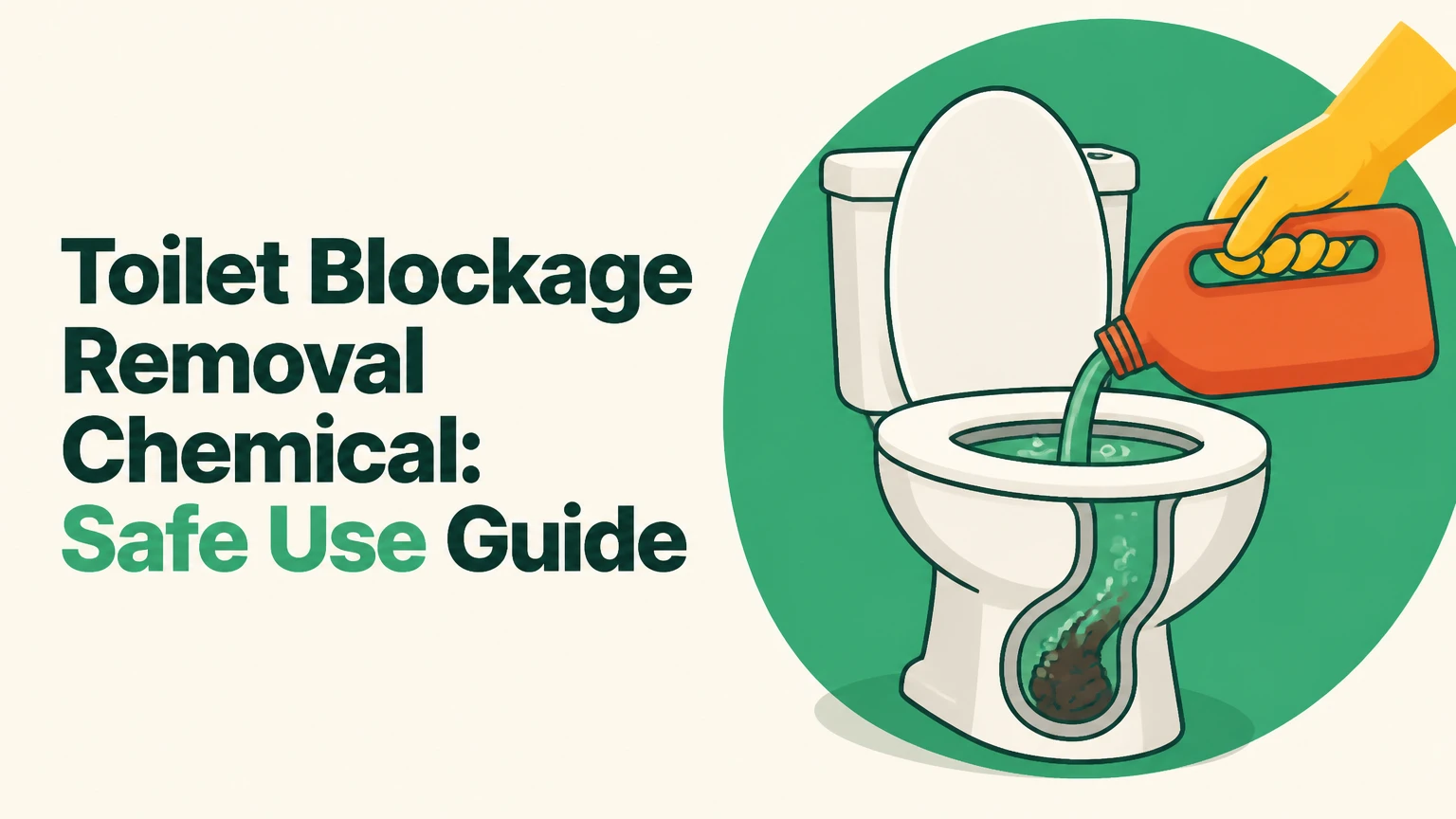
A toilet blockage removal chemical should be used only when its label specifically permits toilet use and the obstruction consists mainly of toilet paper or biodegradable waste. For a fully blocked toilet, a flange plunger or closet auger usually works faster and more reliably because most conventional caustic drain cleaners are not designed for the toilet’s internal trap.
Key Facts at a Glance
- Ordinary sink and shower drain openers should not be poured into a toilet unless the product label explicitly authorizes toilet use.
- Biological enzyme treatments work slowly and are better for organic buildup or preventive maintenance than emergency blockages.
- Chemicals cannot dissolve toys, sanitary products, plastic, cloth, dense wipes, or objects lodged in the toilet trap.
- A flange plunger is normally the first tool for a paper-and-waste blockage.
- Never mix drain opener, bleach, toilet bowl cleaner, vinegar, ammonia, or another household chemical.
- Do not plunge or use an auger after applying a caustic product because contaminated water can splash onto the skin or eyes.
What Is a Toilet Blockage Removal Chemical?
A toilet blockage removal chemical is a liquid, gel, powder, enzyme, or bacterial treatment marketed for breaking down material inside a toilet trap or connected waste pipe. The critical words are marketed for toilet use. A product described only as a sink, bath, shower, or general drain opener should not be assumed safe for porcelain toilets.
Chemical treatments fall into two broad groups. Biological products use enzymes, microorganisms, or both to digest biodegradable residue over several hours or days. Reactive products use alkaline, oxidizing, or acidic ingredients to attack organic material more aggressively.
Many familiar drain-opening gels belong to the second group, but that does not make them toilet products. Drano’s current instructions state that its regular clog removers can be used in sinks, showers, tubs, and kitchen drains, but “DO NOT use them in toilets.” The company recommends only its microorganism-based buildup remover for a slow-running toilet and says that product will not open a completely clogged toilet.
Which Chemical Is Best for a Blocked Toilet?
The best treatment for a slow toilet caused by biodegradable buildup is a toilet-approved enzyme or bacterial product. There is no dependable chemical choice for a toilet containing a solid foreign object, and a completely blocked toilet normally requires a flange plunger or closet auger.
| Option | Best application | Typical working time | Main limitation |
| Toilet-approved enzyme treatment | Slow flow, paper residue, organic buildup | 6-12 hours per treatment | Too slow for an overflowing toilet |
| Bacterial maintenance treatment | Recurring organic accumulation | 1-3 days or repeated doses | Preventive rather than emergency use |
| Toilet-labeled reactive liquid | Organic clog explicitly covered by label | 15-60 minutes | Product-specific compatibility and splash risk |
| Liquid dish soap and warm water | Soft paper blockage needing lubrication | 20-30 minutes | Does not dissolve wipes or solid objects |
| Flange plunger | Paper and waste near the toilet trap | 5-15 minutes | Requires a sound seal around the outlet |
| Closet auger | Wipes or an object lodged in the trap | 10-30 minutes | Incorrect use can scratch porcelain |
The wording on the container controls the decision. Look for an explicit statement such as “safe for toilets,” followed by dosage and dwell-time instructions for toilet bowls. A general phrase such as “pipe-safe” does not prove that the formula is appropriate for a toilet’s glazed porcelain, trap geometry, seals, or standing water.
How Do Toilet-Safe Enzyme Treatments Work?
Toilet-safe enzyme treatments break large biodegradable molecules into smaller compounds that can move through the waste line. Proteases act on proteins, amylases act on starches, lipases act on fats, and cellulase-containing formulas may help weaken cellulose-based paper residue.
Some products also contain microorganisms that continue processing organic material after application. These products require time, suitable temperatures, and direct contact with the material. They do not create the immediate hydraulic force produced by a plunger.
The practical limitation matters. An enzyme product may improve a toilet that drains slowly overnight, but it is unlikely to rescue a bowl already filled near the rim. It also cannot reliably break apart wet wipes, even when the package describes those wipes as flushable. Synthetic reinforcement fibers remain mechanically strong inside the trap.
Are Heavy Drain-Cleaning Gels Safe for Toilets?
Most conventional heavy drain-cleaning gels are not safe to assume suitable for toilets. Density allows a gel to sink through standing water, but viscosity alone says nothing about toilet compatibility.
Current Drano Max Gel instructions explicitly say not to use the product in toilets. The manufacturer also warns users not to plunge during or after application because chemical residue may remain when a drain fails to clear.
This corrects an important weakness in the supplied AI Overview. The Overview presents “heavy gel openers” as a general toilet-safe category and later suggests Drano Max Gel when the bottle label permits it. In practice, the category cannot be recommended safely without checking the individual label, and the current Drano Max Gel label specifically excludes toilets.
The problem is not limited to possible heat. Toilet traps retain chemical solution in a curved internal passage where it may not reach the actual obstruction. A failed treatment then leaves caustic liquid in the bowl, making plunging, augering, toilet removal, and professional service more hazardous.
Before You Start
A chemical treatment is appropriate only when the toilet is stable, not actively overflowing, and the suspected blockage is biodegradable. Shut off the toilet’s water supply first if the bowl is unusually high.
| Requirement | Typical specification |
| Working time | 15 minutes to 12 hours, depending on label |
| Difficulty | Basic, provided the product is toilet-approved |
| Product cost | Typically $8-$25 or local equivalent |
| Protective equipment | Chemical-resistant gloves and safety goggles |
| Water level | Low enough to accept the labeled dose without overflowing |
| Ventilation | Open door, window, or exhaust fan |
| Required label wording | Explicit toilet-use directions |
| Stop condition | Rising water, fumes, heat, leakage, or uncertain chemical history |
Prepare a bucket, disposable scoop, old towels, and a plastic bag before opening the product. Keep children and animals outside the bathroom. Do not begin when another cleaner is already present in the bowl.
How to Use a Toilet Blockage Removal Chemical
Step 1: Stop the Toilet From Refilling
Turn the shutoff valve behind or beside the toilet clockwise until it closes. Remove the tank lid and lift the flapper only when you need to prevent water from entering the bowl after an accidental handle press.
This step limits the amount of contaminated water that can overflow. You will know the supply is closed when operating the handle no longer refills the tank.
Do not repeatedly flush to test the blockage. Each flush can send another tankful of water into a bowl that cannot empty.
Step 2: Identify the Likely Blockage
Determine whether the clog involves toilet paper and waste or a non-dissolvable object. A recent large paper flush may respond to lubrication, plunging, or a biological formula. A blockage following flushed wipes, a sanitary product, a toy, cloth, or packaging requires mechanical retrieval.
Listen to nearby fixtures. A toilet that gurgles when a sink or shower drains may indicate a vent or shared drain problem rather than a blockage confined to the toilet.
Do not add chemicals when several fixtures are backing up. That pattern can indicate a building drain or sewer-line obstruction.
Step 3: Check What Is Already in the Bowl
Ask every household member whether bleach, toilet cleaner, descaler, vinegar, drain opener, or another chemical was recently added. Do not rely on smell because ventilation, fragrance, and dilution can conceal reactive ingredients.
Poison Control warns that bleach mixed with acid can release chlorine gas, while bleach mixed with ammonia can release chloramine gas. Possible exposure symptoms include eye or throat irritation, coughing, headache, dizziness, and difficulty breathing.
When the chemical history is unknown, stop. Do not create a mixture based on the assumption that the previous product has been diluted.
Step 4: Lower Excess Water Safely
Bail excess water into a chemical-resistant bucket until the bowl is below its normal waterline. Leave enough water to cover the trap opening unless the product label requires another level.
Move slowly to prevent contaminated droplets from reaching the floor or clothing. Dispose of the removed water only after confirming it does not contain a hazardous cleaner.
The bowl is ready when the full labeled dose can be added without raising the water close to the rim.
Step 5: Read the Toilet-Specific Label
Confirm the label names toilets as an approved application. Check the exact dose, required water level, dwell time, temperature limits, septic compatibility, first-aid instructions, and prohibited combinations.
Never transfer a cleaner into an unmarked container. Product identity and first-aid information must remain available throughout the job.
A label that says “safe for pipes” or “septic safe” is insufficient. Neither phrase automatically means the formula is intended for toilet bowls.
Step 6: Add Only the Specified Dose
Pour the measured dose slowly into the center of the bowl while keeping your face away from the opening. Avoid squeezing a flexible bottle because trapped air can force liquid out suddenly.
More product does not guarantee faster clearance. An excessive dose raises the chemical concentration, increases splash exposure, complicates disposal, and may leave more reactive liquid trapped behind the blockage.
You will know the application is controlled when the water remains well below the rim and no liquid has splashed onto surrounding surfaces.
Step 7: Wait for the Full Dwell Time
Leave the bathroom undisturbed for the period printed on the label. A reactive toilet-approved formula may require 15-60 minutes, while an enzyme or microorganism treatment may require 6-12 hours and sometimes repeated applications.
Do not flush early. Do not add boiling water, another chemical, or a second dose unless the manufacturer specifically directs it.
Drano’s biological buildup-remover guidance, for example, specifies a 6-8-hour waiting period and repeated treatment for three consecutive days when addressing slow toilet flow. The same manufacturer states that this product is not intended to open a completely clogged toilet.
Step 8: Test Without Causing an Overflow
Check whether the water level has fallen. When it has, pour approximately 2-4 liters of ordinary tap water into the bowl gradually before restoring the toilet supply.
Stop immediately if the level rises and remains high. Do not perform a full flush until the test water drains at a normal rate.
The treatment has worked when added water passes through promptly, the bowl returns to its normal level, and no gurgling occurs in nearby fixtures.
Step 9: Restore the Water Supply
Turn the shutoff valve counterclockwise, allow the tank to fill, and perform one supervised flush. Keep one hand near the shutoff valve during the test.
Close the valve immediately if the bowl rises toward the rim. A partial improvement does not mean the obstruction has cleared completely.
After successful flow returns, clean exterior surfaces according to the product label and wash gloved hands before removing the gloves.
Chemical, Plunger, or Auger: Which Should You Use?
A flange plunger is the best first response to a normal toilet paper blockage because it applies hydraulic pressure without leaving corrosive residue. A closet auger is better when wipes or an object may be lodged in the toilet trap.
| Situation | First choice | Expected time | Why |
| Recent paper-and-waste clog | Flange plunger | 5-15 minutes | Moves the soft obstruction mechanically |
| Slow toilet with organic buildup | Toilet-approved biological treatment | 6-24 hours | Digests residue gradually |
| Suspected wipes in trap | Closet auger | 10-30 minutes | Breaks, hooks, or retrieves fibrous material |
| Toy or solid object | Closet auger or toilet removal | 20-90 minutes | Chemicals cannot dissolve rigid objects |
| Several fixtures backing up | Drain professional | Same day | Likely shared-line or sewer obstruction |
| Chemical already applied | Stop mechanical work | Until professionally assessed | Plunging can splash caustic liquid |
The strongest practical rule is simple: use chemistry for biodegradable residue and mechanical force for physical obstructions. A toilet clog is often a geometry problem, not a chemistry problem.
Does Baking Soda and Vinegar Unclog a Toilet?
Baking soda and vinegar may agitate or loosen a very minor soft blockage, but the reaction does not provide strong dissolving power. The visible fizz mainly results from acid-base neutralization that produces carbon dioxide, water, and sodium acetate.
The reaction can create movement and may help distribute warm water or soap. It cannot be expected to digest dense paper, wipes, hair bundles, sanitary products, or foreign objects. Calling the method “zero risk” is also too broad. A full bowl can overflow during foaming, and vinegar must never be combined with a bleach-containing cleaner.
Use baking soda and vinegar only when no commercial chemical is present and the water level leaves ample space for foaming. A flange plunger remains more dependable for an actual blockage.
Can Dish Soap and Warm Water Clear the Toilet?
Dish soap and warm water can help a soft toilet-paper clog by lubricating the trap and reducing friction. Add approximately 120-240 milliliters of liquid dish soap, wait 10-15 minutes, and then add 2-4 liters of warm tap water gradually.
Use warm water rather than boiling water. Very hot water adds unnecessary thermal stress to cold porcelain and can soften some sealing materials. More importantly, pouring a large volume quickly can overflow the bowl.
Dish soap does not chemically dissolve wipes, plastic, cloth, or hygiene products. Treat it as a lubrication method, not a universal drain opener.
Common Mistakes and How to Fix Them
Mixing Two Cleaning Products
Do not neutralize one product with another. Leave the room if strong fumes develop, move to fresh air, and seek local poison-control or emergency guidance when coughing, breathing difficulty, chest discomfort, or severe eye irritation occurs.
Plunging After Adding Drain Opener
Stop plunging immediately. Conventional drain-opener manufacturers warn that chemical residue may splash back when the clog remains. Drano also warns that mixing its gel with other products may produce hazardous fumes or a violent reaction.
Tell the plumber exactly which product, concentration, and amount entered the toilet.
Using a Sink Cleaner in the Toilet
Do not flush repeatedly in an attempt to wash it away. Close the bathroom, restrict access, retain the product container, and contact the manufacturer or an appropriate poison-information service for handling instructions.
Adding Boiling Water
Stop adding water and inspect the bowl for cracking or leakage around the base. Shut off the supply when water appears on the floor because the bowl, connection, or wax seal may be compromised.
Repeating Chemical Doses
Do not add more because the first dose failed. Failure usually indicates that the material is non-biodegradable, the chemical cannot reach it, or the obstruction lies farther down the line.
Assuming Every Slow Flush Is a Clog
Check the tank water level, flapper operation, rim jets, siphon jet, and venting. A weak flush can result from insufficient tank water or mineral deposits even when the waste line is open.
When Should You Call a Plumber?
Call a plumber when the bowl remains blocked after one proper plunging or augering attempt, when chemicals are trapped in the toilet, or when multiple fixtures back up together. Recurring blockages also warrant investigation because the underlying cause may be a damaged line, root intrusion, poor venting, scale, or an incorrectly installed drain.
| Warning sign | Possible cause | Appropriate response |
| Toilet and shower back up together | Shared waste-line blockage | Stop water use and arrange drain service |
| Gurgling in several fixtures | Vent or main-line restriction | Professional diagnosis |
| Object visible but unreachable | Foreign body in trap | Closet auger or toilet removal |
| Water leaks around toilet base | Seal failure or cracked fixture | Shut off supply and repair |
| Clog returns every few days | Partial line obstruction | Camera inspection or drain cleaning |
| Chemical fumes or skin exposure | Reactive or caustic product | Fresh air, rinsing, and urgent safety guidance |
Professional costs vary by region and access. A straightforward toilet augering visit commonly costs less than toilet removal, camera inspection, or main-line cleaning. The lowest-cost decision is often calling before repeated chemicals turn a simple obstruction into a hazardous service job.
Expert Rules of Thumb
Use the toilet trap as the diagnostic boundary. When only one toilet is affected, the obstruction may be inside the fixture or its immediate branch. When several fixtures react, stop treating the toilet as an isolated problem.
“Flushable” does not mean rapidly dispersible. A wipe can pass through the bowl opening yet remain intact long enough to catch on rough pipe surfaces or combine with other debris.
A falling bowl level is not proof of full clearance. A partial clog can pass a small quantity of water and fail during the next full flush. Always perform a controlled water test before restoring normal use.
Frequently Asked Questions
Will a toilet blockage chemical dissolve toilet paper?
A toilet-approved enzyme or biological treatment may weaken accumulated toilet paper over several hours. A normal paper clog usually clears faster with a flange plunger because plunging separates and moves the wet paper mechanically. Thick paper towels, tissues, and reinforced wipes are less likely to disperse.
Can I leave an enzyme cleaner in the toilet overnight?
Yes, when the label specifies an overnight dwell period. Biological products commonly need 6-12 hours of contact time. Keep the bathroom ventilated and inaccessible to children or animals, and do not add bleach or toilet disinfectant because those substances may deactivate microorganisms or create an unsafe mixture.
Is a toilet chemical safe for septic tanks?
Only when the product label states that it is septic-compatible at the specified dose. Biological products are often marketed for septic systems, but “septic safe” does not mean the product can clear a solid object or repair an overloaded, poorly maintained, or failing septic system.
What chemical dissolves flushable wipes?
No ordinary household chemical can be trusted to dissolve a wipe quickly and safely inside a toilet. Wipes often contain fibers that remain structurally intact in plumbing. Use a closet auger to break or retrieve the material, and arrange professional removal when the wipe has moved farther into the drain line.
How long should I wait before flushing?
Follow the product label exactly. Toilet-approved reactive products may specify 15-60 minutes, while enzyme or bacterial treatments may require 6-12 hours or repeated overnight doses. Test first with a moderate amount of water instead of immediately releasing the entire tank.
Why does the toilet keep blocking after treatment?
Recurring blockage suggests that the chemical treated only part of the problem. Possible causes include wipes, a trapped object, insufficient flush volume, mineral-restricted jets, drain-line scale, poor venting, roots, pipe damage, or a partial main-line obstruction. Repeated chemical dosing will not correct those defects.
Conclusion
A toilet blockage removal chemical is suitable only when the product is explicitly labeled for toilet use and the obstruction consists of biodegradable paper or organic residue. Enzyme and bacterial formulas are the safest chemical category for slow organic buildup, but they work gradually and cannot clear rigid objects or dense wipes.
For an ordinary blocked toilet, close the water supply and use a flange plunger first. Use a closet auger when an object or fibrous material is suspected. Never pour ordinary sink drain opener into the toilet, never mix cleaners, and never plunge after adding a caustic chemical.