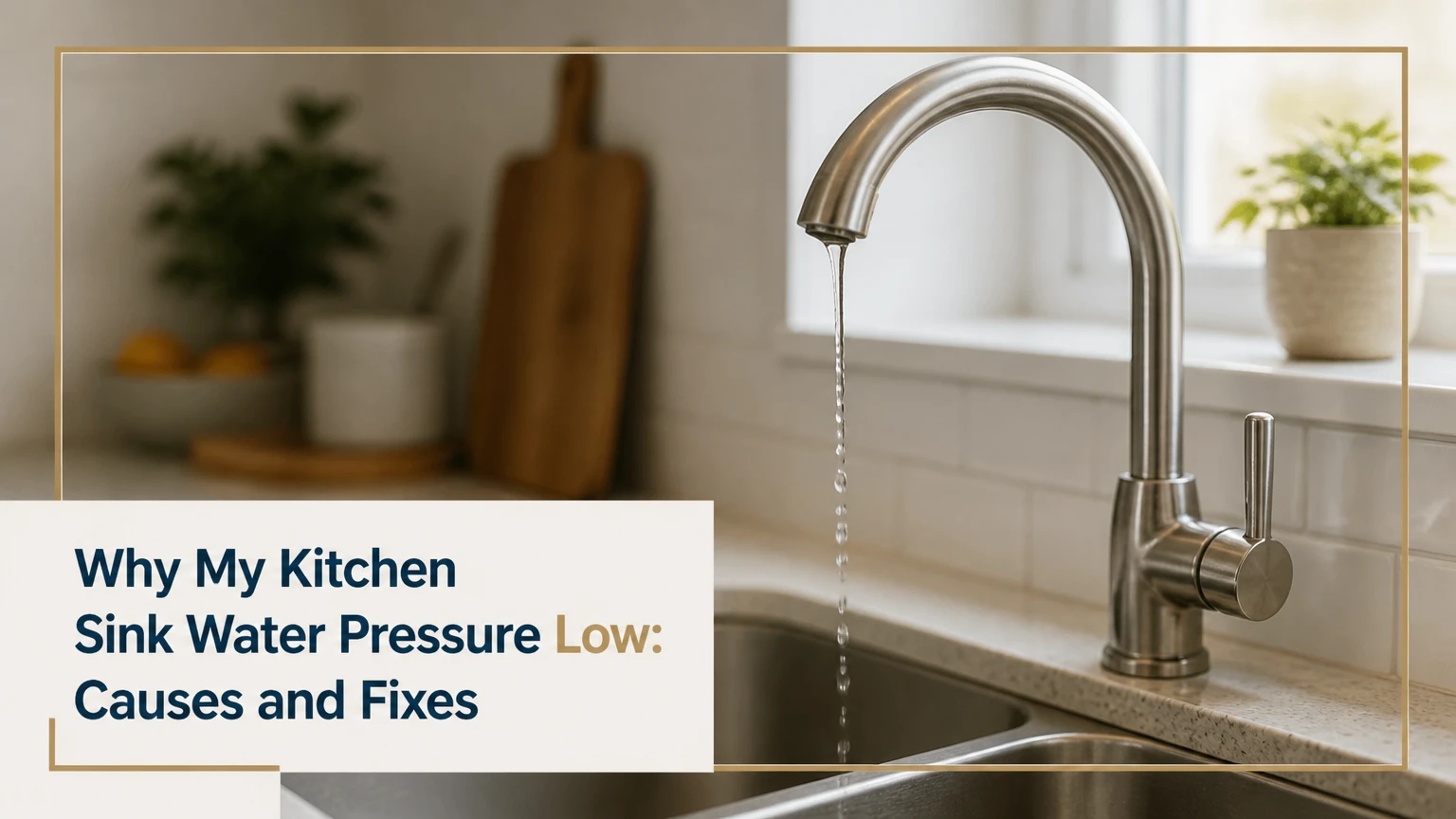
If you are asking, “why my kitchen sink water pressure low,” the most likely cause is a clogged aerator, blocked sprayhead, partially closed valve, kinked hose, or sediment inside the faucet cartridge. Test other fixtures and compare hot with cold water before replacing parts, because those two checks reveal whether the restriction is inside the faucet or elsewhere in the plumbing system.
Key Facts: At a Glance
- Low flow at one kitchen faucet usually indicates a localized restriction rather than a whole-house pressure problem.
- Strong flow after removing the aerator confirms that the aerator or its flow restrictor is blocked.
- Weak hot and cold flow together points toward the faucet outlet, cartridge, hose, or diverter.
- Weak flow on only one temperature points toward that side’s valve, supply hose, cartridge inlet, or branch pipe.
- A kitchen sink faucet may be rated from approximately 1.5 to 2.2 gallons per minute, depending on the model and local efficiency rules.
- Chemical drain cleaner cannot improve faucet pressure because the drain and pressurized water-supply system are separate.
Why Is My Kitchen Sink Water Pressure Low?
Kitchen sink flow becomes weak when water cannot move freely through the supply valves, hoses, faucet cartridge, diverter, spray hose, sprayhead, aerator, or upstream plumbing. The restriction may reduce actual pressure, but homeowners commonly describe any weak stream as “low pressure,” even when normal pressure exists behind a clogged faucet component.
Pressure and flow are related but different:
- Water pressure, measured in pounds per square inch, is the force pushing water through the plumbing.
- Flow rate, measured in gallons per minute, is the quantity leaving the faucet.
- A small blockage can reduce flow while pressure elsewhere in the home remains normal.
The 2024 International Residential Code lists 2.2 GPM at 60 PSI as the maximum flow rate for a sink faucet under its general fixture table. EPA technical guidance also notes that kitchen faucets are commonly available in approximately 1.5 to 1.8 GPM efficiency ranges.
Is the Problem Pressure or Restricted Flow?
A kitchen faucet with a narrow, weak stream usually has restricted flow. A whole-house pressure problem becomes more likely when showers, toilets, outdoor faucets, and bathroom sinks also perform poorly, especially when several fixtures operate at once.
Use this diagnostic table before disassembling anything:
| Test result | Most likely problem area | First action |
| Only kitchen faucet is weak | Aerator, sprayhead, cartridge, hose | Remove outlet component |
| Kitchen hot and cold are weak | Common faucet component | Check aerator and cartridge |
| Only kitchen hot is weak | Hot valve, hose, cartridge inlet | Inspect hot supply path |
| Only kitchen cold is weak | Cold valve, hose, cartridge inlet | Inspect cold supply path |
| Every fixture is weak | Main valve, PRV, well, municipal supply | Test house pressure |
| Flow drops when two fixtures run | Supply capacity or dynamic pressure | Measure pressure under demand |
| Faucet became weak after plumbing work | Construction debris | Flush outlet and cartridge |
| Spray mode is weak but stream is normal | Sprayhead ports or selector | Clean or replace sprayhead |
How Do You Measure Faucet Flow?
Measure kitchen faucet flow by timing how long it takes to fill a container of known volume. This simple test gives a repeatable result and helps confirm whether cleaning or replacing a component produced a real improvement.
Use this formula:
GPM = container volume in gallons ÷ filling time in seconds × 60
For example, if a one-gallon container fills in 40 seconds:
1 ÷ 40 × 60 = 1.5 GPM
Test the faucet at full cold, full hot, and a mixed position. Repeat the test after removing the aerator or sprayhead.
| One-gallon fill time | Approximate flow | Practical interpretation |
| 27 seconds | 2.2 GPM | High-flow standard faucet |
| 33 seconds | 1.8 GPM | Common efficient kitchen flow |
| 40 seconds | 1.5 GPM | Efficient but generally usable |
| 60 seconds | 1.0 GPM | Noticeably slow for pot filling |
| 90 seconds | 0.67 GPM | Significant restriction likely |
| 120 seconds | 0.5 GPM | Severe restriction or supply issue |
A low GPM result does not prove that house pressure is low. The outlet may simply be designed for a lower flow rate, so compare the result with the faucet manufacturer’s specification whenever possible.
What Causes Low Pressure at Only the Kitchen Sink?
Low pressure at only the kitchen sink usually originates between the under-sink shut-off valves and the faucet outlet. The aerator and sprayhead are the most accessible suspects, followed by the cartridge, supply hoses, diverter, check valve, and faucet body.
1. Clogged Faucet Aerator
A clogged aerator is the most common and easiest restriction to test on a fixed-spout faucet. Sand, pipe scale, rust fragments, and calcium deposits collect inside its mesh screens and narrow water passages.
Moen’s official troubleshooting guidance recommends removing the spout aerator, clearing debris, reinstalling it, and replacing it if low flow persists.
To test it:
- Close the drain or cover it with a cloth.
- Unscrew the aerator by hand.
- Use a cloth and adjustable pliers only if hand pressure fails.
- Turn the faucet on slowly without the aerator.
- Compare the new stream with the previous flow.
Strong flow without the aerator confirms an outlet restriction.
Disassemble the aerator over a towel so the screen, washer, and flow regulator remain in order. Soak mineral-covered metal and plastic parts in white vinegar for 30-60 minutes, brush them with a soft toothbrush, rinse, and reinstall.
Replace the aerator when its screen is torn, its plastic insert is cracked, or cleaning does not restore flow. Match the thread type and rated GPM.
2. Blocked Pull-Down or Pull-Out Sprayhead
A pull-down sprayhead can contain screens, spray plates, selectors, backflow components, and flow restrictors that trap sediment. Removing only the visible nozzle deposits may not clear an internal blockage.
Unscrew the sprayhead from the hose and point the bare hose into the sink. Hold it securely before opening the faucet.
- Strong hose flow means the sprayhead is restricted.
- Weak hose flow means the restriction is farther upstream.
- Normal stream mode but weak spray mode indicates clogged spray ports or a faulty mode selector.
Moen advises inspecting the screen between the hose and wand. If flow from the disconnected hose is strong, the wand or its screen is the likely cause.
Use vinegar on removable mineral-covered parts. Avoid drilling the flow restrictor or permanently removing safety components because the modification can create splashing, excessive consumption, or code and warranty issues.
3. Partially Closed Shut-Off Valve
A partially closed shut-off valve limits the amount of water entering one side of the faucet. This often happens after appliance installation, filter replacement, leak repair, or cleaning under the sink.
Turn a multi-turn valve counterclockwise until fully open, but do not force a corroded or seized stem. A quarter-turn valve is normally open when its handle aligns with the tubing.
A valve can appear open while its internal rubber washer has detached or deteriorated. Suspect internal valve failure when:
- One temperature has very weak flow.
- The supply hose is clear.
- Turning the valve changes little.
- The valve leaks around the stem.
- Flow remains weak during a direct bucket test.
A heavily corroded valve should be replaced by someone prepared to shut off the home’s main water supply.
4. Kinked or Crushed Supply Hose
Flexible supply hoses can fold behind stored items, twist during faucet installation, or become pinched against the cabinet wall. A sharp bend reduces the hose’s internal area and may affect one temperature only.
Inspect each hose from the shut-off valve to the faucet connection. Correct gentle bends without pulling on the fittings. Replace a hose that is flattened, frayed, rusted, swollen, or sharply creased.
Never straighten a deteriorated braided hose repeatedly. Internal damage can cause a delayed leak.
5. Clogged or Worn Faucet Cartridge
The faucet cartridge controls volume and temperature. Sediment can block its inlet ports, while worn seals or damaged internal components can prevent it from opening fully.
A cartridge becomes likely when:
- Both hot and cold supplies reach the faucet normally.
- The aerator and sprayhead are clear.
- The handle feels stiff or has limited movement.
- Temperature control has changed.
- Flow became weak after the water supply was shut off and restored.
Moen lists cartridge debris among the typical causes when both hot and cold flow are low at a sink faucet.
Turn off both shut-off valves before removing a cartridge. Photograph the handle and retaining components, identify the exact faucet model, and buy the correct replacement. Similar-looking cartridges are not automatically interchangeable.
6. Blocked Diverter or Check Valve
Kitchen faucets with side sprayers or pull-down assemblies may contain a diverter that directs water between outlets. Sediment or worn seals can leave the diverter partly engaged, restricting the main spout, sprayer, or both.
A stuck diverter is more likely when:
- Flow changes when the sprayer trigger is pressed.
- Water comes from both outlets simultaneously.
- The spout pulses or chatters.
- The problem started after debris entered the lines.
Some faucets also contain check valves in the hose connection. Clean only serviceable components identified in the manufacturer’s parts diagram.
Why Is Only the Hot Water Pressure Low?
Low hot-water flow at the kitchen sink usually indicates a restriction in the hot shut-off valve, hot supply hose, hot cartridge inlet, or hot-water branch line. A water-heater problem becomes more likely only when other hot-water fixtures are also weak.
Compare kitchen hot flow with a nearby bathroom faucet.
| Pattern | Likely cause | Next test |
| Kitchen hot weak, bathroom hot normal | Kitchen valve, hose, cartridge | Test hot supply into bucket |
| All hot fixtures weak | Heater outlet or hot main | Inspect heater-side plumbing |
| Hot starts strong, then fades | Valve debris or flexible connector | Check dynamic flow |
| Hot and cold both weak | Common faucet restriction | Inspect outlet and cartridge |
| Hot flow weak after heater service | Sediment introduced into line | Flush faucet components |
Water-heater sediment does not normally reduce only one faucet unless debris has traveled into that fixture or a local branch has become restricted.
Why Did the Pressure Drop Suddenly?
A sudden pressure drop often follows utility work, water-heater service, main-valve operation, filter replacement, or faucet repair. Restoring water can dislodge mineral scale and rust, which then collects in the faucet’s smallest passages.
Check the timeline:
- After municipal work: Clean the aerator, sprayhead screen, and cartridge inlet.
- After replacing a filter: Confirm the filter direction, cartridge seating, bypass position, and valve position.
- After faucet installation: Check kinked hoses, shipping plugs, connector screens, and crossed tubing.
- After moving items under the sink: Inspect hoses and valve handles.
- During freezing weather: Consider a frozen or damaged branch line.
- Without an obvious event: Compare other fixtures and check for leaks.
The counterintuitive rule is simple: sudden low faucet flow after plumbing work usually indicates debris at the fixture, not an immediate failure of the entire pressure system.
How Do You Troubleshoot Low Kitchen Faucet Pressure?
Troubleshoot from the outlet backward toward the main supply. This sequence minimizes disassembly, prevents unnecessary part purchases, and usually identifies the restriction within 30-90 minutes.
Before You Start
| Requirement | Typical amount |
| Time | 30-90 minutes |
| Difficulty | Beginner to intermediate |
| DIY cost | $0-$60 |
| Tools | Towel, bucket, pliers, screwdriver, hex key |
| Cleaning material | 1-2 cups white vinegar |
| Replacement parts | Aerator, hose, cartridge, or valve as diagnosed |
Step 1: Test Other Fixtures
Run a bathroom faucet and shower. Test both while the kitchen faucet remains open.
Success checkpoint: Other fixtures remain strong, confirming a localized kitchen problem.
Common mistake: Assuming one weak fixture proves the home’s pressure regulator has failed.
Step 2: Compare Hot and Cold
Run full cold, then full hot. Measure each flow rate when the difference is not obvious.
Success checkpoint: You know whether one supply path or a shared faucet component is affected.
Common mistake: Testing only the mixed handle position, which hides a one-sided restriction.
Step 3: Remove the Aerator or Sprayhead
Test flow from the open spout or bare hose.
Success checkpoint: Strong flow identifies the removed component as the restriction.
Common mistake: Opening the faucet fully while holding a loose pull-down hose, which can spray the cabinet and floor.
Step 4: Inspect Valves and Hoses
Open both shut-off valves fully and straighten the supply hoses. Look for corrosion, moisture, or deformation.
Success checkpoint: Both hoses have smooth curves and both valves are fully open.
Common mistake: Forcing an old valve that is already seized or leaking.
Step 5: Test the Supply Directly
Turn off one valve, disconnect its hose, place the hose or valve outlet into a bucket, and briefly open the valve. Repeat only when you understand the connection and can control the water.
Success checkpoint: Strong bucket flow proves the home supply reaches that point.
Common mistake: Disconnecting plumbing without confirming that the valve closes completely.
Step 6: Flush or Replace the Cartridge
Shut off both supplies, remove the handle and cartridge, clear visible debris, and flush according to the faucet manufacturer’s procedure.
Success checkpoint: The faucet reaches its expected flow without leaking around the handle.
Common mistake: Reinstalling a new cartridge before clearing sediment from the valve body.
Could the Whole-House Pressure Regulator Be Failing?
A pressure-reducing valve becomes a likely suspect when flow is weak at several fixtures, pressure changes unpredictably, or performance collapses whenever more than one fixture operates. A kitchen-only problem rarely justifies replacing the PRV.
Attach a pressure gauge to a compatible hose bib or laundry connection. Measure:
- Static pressure: No fixtures running.
- Dynamic pressure: One or more fixtures running.
- Overnight maximum: With a recording gauge, when relevant.
The 2024 International Residential Code limits static water pressure to 80 PSI and requires pressure reduction when the supply exceeds that level. The code also calls for a booster solution when available pressure cannot provide the required fixture flow.
Do not adjust a regulator solely to compensate for one clogged faucet. Excessive pressure can damage hoses, valves, water heaters, and appliances.
Could a Leak Cause Weak Kitchen Flow?
A substantial supply leak can reduce available pressure, especially when the leak is between the meter and the home or when pipe damage affects the kitchen branch. Small dripping faucet leaks usually do not cause a major pressure loss.
Look for:
- An unexplained increase in water use
- A meter that moves when every fixture is off
- Damp cabinets, walls, ceilings, or flooring
- Hissing behind walls
- Mold or persistent musty odors
- Warm flooring near a hot-water leak
- A sudden pressure decrease throughout the home
Close every fixture and water-using appliance, then observe the meter. Continued movement warrants professional leak investigation.
Shut off the main water supply promptly when water is actively damaging the building.
What If the Home Has Galvanized Pipes?
Old galvanized steel pipes can lose internal diameter as rust and mineral scale accumulate. The pipe may look normal from outside while its internal passage has narrowed severely.
Galvanized pipe restriction is more likely when:
- The home has consistently weak flow.
- Rust particles repeatedly clog aerators.
- Several fixtures on one branch are affected.
- Flow remains low despite normal static pressure.
- The pipe is decades old.
Do not aggressively hammer, twist, or chemically treat corroded supply pipes. Disturbing advanced corrosion can open a leak. Localized repair may help one branch, but widespread restriction often requires planned repiping.
Should You Repair or Replace the Faucet?
Repair the faucet when the body is sound, replacement parts are available, and the restriction can be traced to an aerator, sprayhead, hose, diverter, or cartridge. Replace it when several components are failing, the body is corroded, or model-specific parts are unavailable.
| Solution | Typical DIY cost | Typical professional cost | Typical time |
| Clean aerator or sprayhead | $0-$10 | $75-$175 | 10-30 minutes |
| Replace aerator | $5-$25 | $90-$175 | 10-20 minutes |
| Replace cartridge | $15-$70 | $150-$350 | 30-90 minutes |
| Replace supply hose | $10-$30 each | $125-$300 | 30-60 minutes |
| Replace shut-off valve | $10-$40 | $175-$400 | 45-120 minutes |
| Replace kitchen faucet | $70-$500+ | $250-$750+ | 1-3 hours |
| Replace pressure regulator | $75-$250 | $350-$900 | 2-4 hours |
| Repair concealed pipe | Varies | $300-$2,000+ | Several hours |
These are typical planning ranges, not fixed prices. Faucet design, access, corrosion, local labor rates, finish quality, and required wall repair can change the final cost substantially.
What Common Mistakes Make the Problem Worse?
The most damaging mistakes involve replacing parts before isolating the restriction, forcing corroded valves, and opening connections without controlling the water supply.
Avoid these errors:
- Pouring drain cleaner into the sink: Drain chemicals affect wastewater piping, not faucet supply pressure.
- Removing random flow components: A restrictor may be part of the faucet’s intended design.
- Overtightening plastic parts: Aerators, sprayheads, and connectors can crack.
- Scratching the faucet finish: Wrap decorative parts before using pliers.
- Ignoring manufacturer diagrams: Cartridges and internal assemblies vary by model.
- Replacing the PRV first: A kitchen-only restriction usually occurs at the fixture.
- Skipping a post-repair leak test: Dry every connection, run hot and cold water, and inspect again after several minutes.
When Should You Call a Plumber?
Call a plumber when low flow affects multiple fixtures, shut-off valves do not close, concealed leakage is suspected, pipes are heavily corroded, or direct supply tests show poor flow before water reaches the faucet.
Professional diagnosis is also appropriate when:
- Pressure exceeds 80 PSI.
- Static pressure seems normal but dynamic pressure collapses.
- A well pump cycles abnormally.
- The main valve or meter valve appears damaged.
- Hot-water flow is weak throughout the home.
- The faucet connection uses inaccessible proprietary parts.
- Repair attempts create a leak.
A plumber can test pressure under demand, isolate branch restrictions, service the regulator, evaluate well equipment, and replace valves without relying on guesswork.
Frequently Asked Questions
Can a clogged kitchen drain cause low faucet pressure?
A clogged kitchen drain does not reduce water pressure from the faucet because the drainpipe and pressurized supply pipes perform separate functions. A severe drain blockage may cause standing water or slow drainage, but weak faucet flow must be diagnosed through the aerator, sprayhead, faucet components, supply valves, hoses, or upstream water system.
Why is my new kitchen faucet pressure low?
A new kitchen faucet may have a lower rated GPM than the previous model, but severe weakness often results from installation debris, a kinked hose, partially opened valves, a clogged inlet screen, an incorrectly seated connector, or a blocked sprayhead. Test flow with the sprayhead removed before assuming the new faucet is defective.
Can vinegar damage a faucet aerator?
Short vinegar soaking is generally suitable for many removable aerator components, but prolonged exposure may affect some decorative finishes, rubber parts, or manufacturer-specific coatings. Remove the aerator before soaking whenever possible, limit treatment to the mineral-covered internal pieces, rinse thoroughly, and follow the faucet manufacturer’s cleaning instructions.
Why does kitchen pressure drop when another faucet runs?
Kitchen flow may fall when another fixture runs because the plumbing system has limited dynamic pressure or supply capacity. Possible causes include undersized piping, a restricted main line, a failing regulator, a partly closed main valve, a weak well pump, or heavy internal corrosion. Measure pressure both with and without competing demand.
Can a water filter reduce kitchen faucet pressure?
An under-sink or whole-house filter can reduce flow when its cartridge is clogged, installed backward, incorrectly seated, or rated below the faucet’s demand. Compare flow in filter and bypass modes where the system allows it. Replace the cartridge with the correct model and confirm that every isolation valve is fully open.
How often should a faucet aerator be cleaned?
Inspect a kitchen faucet aerator whenever flow changes, spray becomes uneven, or visible scale develops. Homes with hard water or recurring pipe debris may require cleaning every 3-6 months. Homes with treated water may need less frequent service. Repeated rapid clogging indicates an upstream sediment or corrosion problem.
The Bottom Line
When asking “why my kitchen sink water pressure low,” begin by checking other fixtures, comparing hot and cold flow, and removing the aerator or sprayhead. Those tests separate a simple outlet blockage from a valve, hose, cartridge, branch-pipe, or whole-house pressure problem.
Work from the faucet outlet toward the water source. Clean inexpensive components first, measure the result, and replace only the part proven to restrict flow. Call a plumber when several fixtures are affected, valves are unsafe to operate, pressure behaves abnormally, or concealed pipe damage is possible.