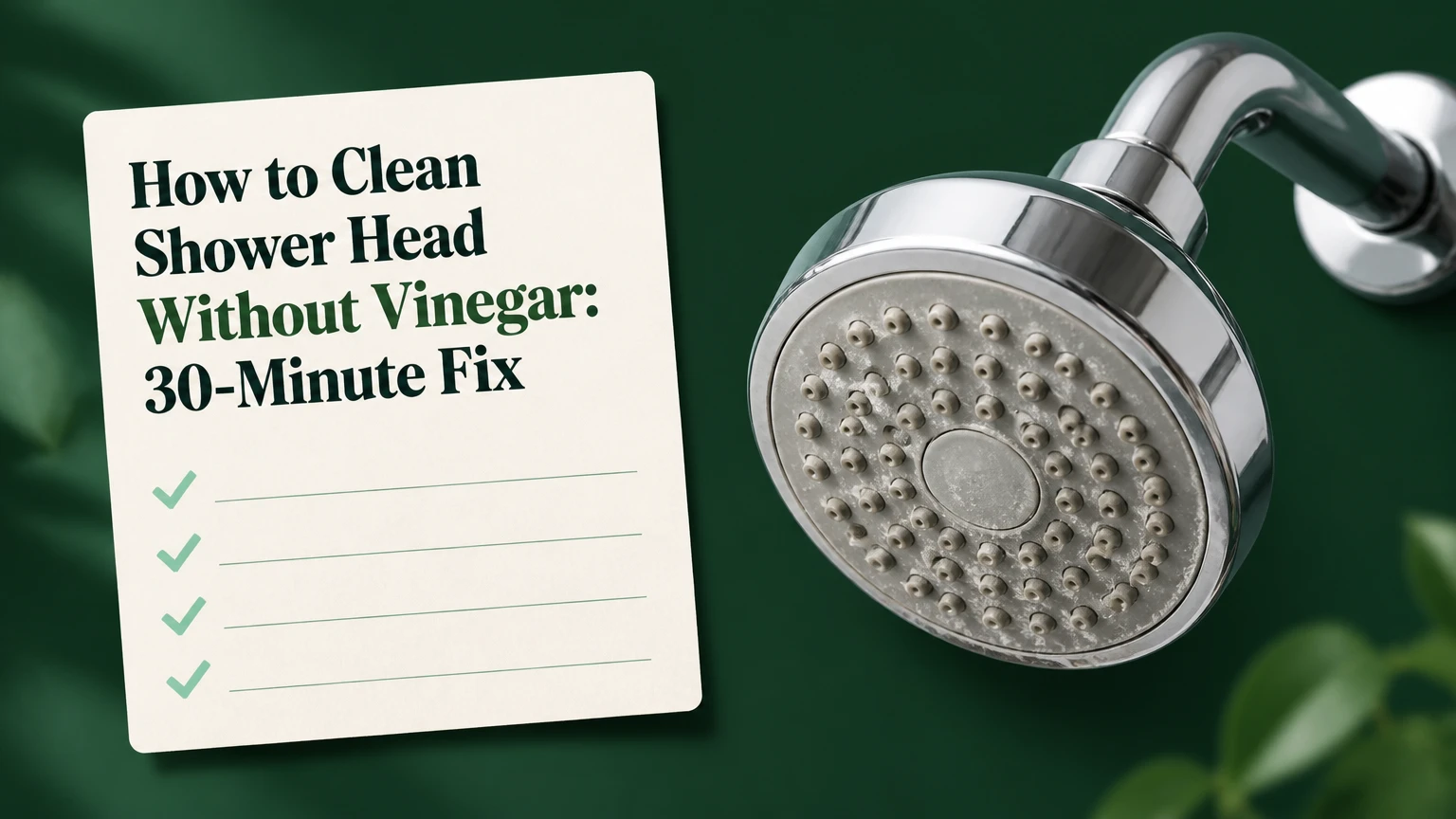
To clean a shower head without vinegar, dissolve mineral scale with citric acid or a labeled commercial descaler, then scrub the nozzles and flush the head thoroughly. Citric acid is the best general-purpose option: use 2-3 tablespoons in 1 liter of warm water, soak for 30-60 minutes, and rinse before use.
Key Facts
Citric acid dissolves calcium carbonate limescale without vinegar’s strong odor.
A typical cleaning solution uses 2-3 tablespoons of citric acid powder per 1 liter of warm water.
Baking soda scrubs surface grime but does not reliably dissolve heavy limescale.
Commercial descalers work quickly, but contact time and dilution must follow the product label.
Flexible silicone nozzles should be massaged or brushed, not pierced with metal pins.
Persistent low pressure can come from the inlet screen, flow restrictor, plumbing, or water supply rather than the spray face.
How to Clean Shower Head Without Vinegar
The safest effective process has six stages: identify the finish, remove loose debris, prepare the cleaner, soak or apply it, scrub the outlets, and flush the internal passage. The most important variable is chemical compatibility, because an acid that removes limescale can also dull vulnerable plated or painted finishes when exposure is too long.
Before You Start
| Requirement | Typical specification |
|---|---|
| Total time | 30-75 minutes, including soaking |
| Active work | 10-20 minutes |
| Difficulty | Easy, with adjustable wrench needed for removal |
| Citric acid solution | 2-3 tablespoons powder per 1 liter warm water |
| Tools | Plastic container or bag, rubber band, soft toothbrush, microfiber cloth |
| Optional tools | Strap wrench, adjustable wrench, tweezers, plumber’s tape |
| Safety equipment | Nitrile gloves, eye protection, ventilation |
Turn off the shower before removing a showerhead. Protect the wall fitting with a cloth if using a wrench, and place a towel beneath the connection to catch residual water.
Do not mix citric acid or any commercial descaler with bleach, chlorine products, ammonia, or another cleaner. Chemical mixtures can release irritating or hazardous gases. Use one product at a time, and rinse the showerhead between products.
Step 1: Identify the Finish and Construction
Check whether the showerhead has chrome, stainless steel, brushed nickel, oil-rubbed bronze, matte black, plastic, or a painted coating. Look for rubber or silicone spray nozzles, a removable inlet screen, and a flow restrictor inside the threaded connection.
Chrome and stainless steel generally tolerate brief exposure to a mild citric acid solution, while painted, PVD-coated, oil-rubbed bronze, and matte black surfaces require more caution. Manufacturer instructions take priority over generic cleaning advice.
You’ll know this step is complete when: you can identify the visible finish and locate the threaded inlet, spray nozzles, and any removable screen.
Common mistake: assuming a dark finish is solid metal. Many matte black showerheads use a surface coating that can discolor under acidic or abrasive treatment.
Step 2: Remove Loose Debris and Prepare the Cleaner
Rinse the showerhead under warm water and wipe away soap film with a microfiber cloth. For citric acid cleaning, dissolve 2-3 tablespoons of powder in 1 liter of warm water, using a plastic container rather than an unlined metal vessel.
Warm water speeds dissolution, but boiling water is unnecessary and can soften plastic components or damage seals. Stir until no visible crystals remain. A 2-3 tablespoon concentration is a practical household range for ordinary limescale; heavy deposits may need a second treatment rather than an indefinitely stronger solution.
You’ll know this step is complete when: the solution is clear and the spray face has no loose hair, soap residue, or sediment blocking the acid.
Common mistake: sprinkling dry citric acid directly onto a wet finish. Undissolved crystals can remain in seams and create concentrated contact points.
Step 3: Detach the Showerhead or Attach a Cleaning Bag
A detachable showerhead should be removed and submerged when possible, because immersion cleans the spray face and the inlet passage. Wrap the connection with a cloth, turn the showerhead counterclockwise with an adjustable or strap wrench, and avoid twisting the wall pipe.
For a fixed showerhead, fill a sturdy plastic bag with enough solution to cover the spray face. Slide the bag over the head, secure it tightly with a rubber band, and support the bag if its weight pulls on the shower arm.
A bag method is convenient, but a leaking bag can damage some wall finishes and wastes solution. A bucket method gives more consistent coverage and allows inspection of the inlet screen.
You’ll know this step is complete when: the limescale-covered face and, ideally, the inlet opening are submerged without stressing the shower arm or threaded fitting.
Common mistake: using a thin grocery bag. Thin plastic can split at the corners; use a heavy-duty resealable bag or a small cleaning bag designed for soaking.
Step 4: Soak for the Correct Time
Soak a chrome or plastic showerhead in the citric acid solution for 30-60 minutes. Inspect the surface at 30 minutes, especially if the showerhead contains decorative plating, rubber seals, or unknown materials.
Do not assume that a longer soak is always better. Extended acid exposure may dull finishes, weaken certain elastomers, or loosen deposits that later collect in the inlet screen. A second 30-minute treatment is usually safer than an overnight soak.
Commercial descalers require a separate approach. Some products use sulfamic, lactic, phosphoric, or other acids and specify dilution, maximum contact time, or direct application. Follow the label exactly, keep the contact period short, and never transfer a commercial product into an unlabeled container.
You’ll know this step is complete when: the white crust looks softened, thinner, or visibly cracked, and the silicone outlets flex more freely.
Common mistake: leaving a commercial descaler submerged for hours. Fast-acting formulas can damage plating long before they improve cleaning.
Step 5: Scrub the Spray Face and Silicone Nozzles
Remove the showerhead from the solution and scrub the spray face with a soft toothbrush. Rub flexible silicone nozzles with your thumb or a microfiber cloth while rinsing; flexing the rubber often dislodges softened fragments more safely than poking them.
For a metal spray plate, use a nylon brush or soft cloth. Avoid steel wool, safety pins, drill bits, and hard wire brushes. Scratches create rough areas where mineral deposits and soap residue can accumulate, while a pierced silicone outlet may produce a permanently distorted stream.
Use a wooden toothpick only on a rigid plastic or metal opening when the manufacturer permits it. Do not force an object into a self-cleaning rubber nozzle.
You’ll know this step is complete when: most outlets produce a clear opening and no large flakes remain around the spray face.
Common mistake: judging success by appearance alone. A clean-looking face can still conceal scale behind the inlet screen or flow restrictor.
Step 6: Flush, Reassemble, and Test
Rinse the showerhead under running water, then flush it for at least 60 seconds with the inlet facing down or outward. If the head is detached, briefly reverse-flush the inlet by directing water into the outlet face, provided the manufacturer does not prohibit that method.
Inspect the threaded connection and replace a damaged washer. Reinstall the showerhead by hand, then tighten it slightly with a wrench through a cloth. Plumber’s tape is normally applied to tapered pipe threads, not to a connection that seals with a rubber washer.
Run the shower on cold or warm water for 1-2 minutes before bathing. Collect the first water in a bucket if loosened mineral flakes or cleaner residue appear.
You’ll know this step is complete when: the spray pattern is even, the water runs clear, and the connection remains dry during a full-pressure test.
Common mistake: tightening aggressively to stop a leak. Excess force can damage the shower arm, washer, or plastic threaded collar.
Which Method Works Best Without Vinegar?
Citric acid is the best overall alternative for ordinary limescale because it combines strong mineral-dissolving action, low odor, low cost, and controllable contact time. Mechanical cleaning is safer for delicate finishes, while a commercial descaler is faster for severe deposits when the product label permits use on the showerhead material.
| Method | Limescale action | Typical time | Typical cost | Best use |
|---|---|---|---|---|
| Citric acid powder | Chemical dissolution | 30-60 minutes | $1-$3 per treatment | Chrome, plastic, ordinary hard-water scale |
| Labeled commercial descaler | Fast chemical dissolution | 2-10 minutes | $2-$8 per treatment | Heavy buildup and urgent cleaning |
| Baking soda paste | Mild abrasion, no reliable scale dissolution | 15-30 minutes | $0.25-$1 | Soap film, odor, light surface grime |
| Dish soap and nylon brush | Surfactant cleaning and abrasion | 10-20 minutes | $0.25-$1 | Oils, body products, loose debris |
| Water and silicone massage | Mechanical dislodging | 5-10 minutes | $0 | Flexible nozzles with isolated blockage |
Why Does Citric Acid Remove Limescale?
Citric acid dissolves limescale by reacting with calcium carbonate and helping keep calcium in a water-soluble citrate complex. The reaction releases carbon dioxide and water while converting an insoluble mineral crust into material that rinses away more readily.
Hard water commonly contains dissolved calcium and magnesium. When water evaporates on the spray face, calcium carbonate and related mineral deposits remain behind. Acidic cleaners attack that alkaline deposit; soap, bleach, and plain water do not perform the same chemical job.
Citric acid powder is also easier to store and measure than liquid vinegar. The powder has no vinegar odor, but it is still an acid and can irritate skin or eyes, so gloves and rinsing remain appropriate.
Can Baking Soda Remove Hard-Water Scale?
Baking soda can remove light surface grime through mild abrasion, but baking soda alone is a poor choice for thick calcium carbonate deposits. Baking soda is mildly alkaline, so it does not provide the acidic reaction needed to dissolve established limescale.
Apply a paste of baking soda and water to a plastic or uncoated surface, leave it for 10-15 minutes, and scrub gently with a soft brush. Use the paste for soap residue, body oils, or light discoloration rather than deep nozzle blockage.
Do not combine baking soda with citric acid and expect a stronger cleaner. The acid and bicarbonate neutralize each other, producing fizz but reducing the acid available to dissolve mineral scale. Use them sequentially only when the showerhead has been thoroughly rinsed between treatments.
How Should You Use a Commercial Descaler?
Use a commercial descaler only according to its label, because CLR, sulfamic-acid products, lactic-acid products, and bathroom scale removers have different dilution and material restrictions. Apply the shortest stated contact time, test an inconspicuous area, rinse immediately, and flush the showerhead before use.
| Product category | Typical active chemistry | Typical contact range | Finish caution | Rinse requirement |
|---|---|---|---|---|
| CLR-type descaler | Organic acids and chelating agents | 2-5 minutes when label allows | Test chrome and avoid vulnerable coatings | Cold-water rinse plus 1-2 minute flush |
| Sulfamic-acid descaler | Sulfamic acid | 2-10 minutes by label | Avoid unapproved brass, stone, and coatings | Copious water rinse |
| Lactic-acid bathroom cleaner | Lactic acid | 5-15 minutes by label | Usually milder, still patch-test | Full spray-face and inlet rinse |
| Ready-to-use spray descaler | Product-specific acid blend | 1-10 minutes by label | Do not assume immersion is allowed | Wipe, rinse, and flush |
The commonly repeated instruction to dilute every commercial descaler 50/50 is not universal. Concentration, immersion permission, and maximum contact time vary by formulation, so an invented dilution can make the cleaner ineffective or unsafe.
Never use a commercial descaler on a finish that the label excludes. Do not use it alongside bleach. If a strong chemical odor remains after rinsing, continue flushing and ventilating the area rather than reinstalling the head for immediate bathing.
Which Showerhead Finishes Need Different Treatment?
Matte black, oil-rubbed bronze, painted, and specialty-coated showerheads need a mild-cleaning approach before acid immersion. Chrome and stainless steel are usually more tolerant, but even those finishes can become dull if a concentrated cleaner remains on the surface too long.
| Finish or material | First-choice method | Acid guidance | Abrasive guidance |
|---|---|---|---|
| Chrome-plated metal | Citric acid, 30-60 minutes | Patch-test; avoid overnight soaking | Soft nylon brush only |
| Stainless steel | Citric acid or labeled descaler | Rinse promptly to prevent spotting | No steel wool or carbon-steel brush |
| Brushed nickel | Mild citric solution, short exposure | Follow manufacturer guidance | Brush with the grain, not across it |
| Matte black or painted metal | Dish soap, water, microfiber cloth | Avoid acid unless approved | No baking soda on visible coating |
| Oil-rubbed bronze | Mild soap and soft cloth | Avoid unapproved descalers | Do not polish or scrub aggressively |
| Plastic or ABS | Citric acid, short monitored soak | Usually tolerant, inspect seals | Soft brush only |
| Silicone spray plate | Citric acid solution, monitored | Rinse thoroughly | Massage, never pierce |
A finish is not fully protected merely because the base material is metal. Plating thickness, clear coats, adhesives, and decorative treatments determine chemical resistance.
For a delicate finish, remove the head if practical and clean the inlet screen separately with warm water. Use diluted dish soap on the exterior, then spot-test any citric solution on an unseen area for five minutes before broader use.
What If the Showerhead Stays Clogged?
Persistent low pressure after descaling usually indicates an obstructed inlet screen, flow restrictor, hose, shower arm, or household supply rather than remaining deposits on the spray face. Remove and inspect the threaded inlet before repeating a stronger chemical treatment.
Check the Inlet Screen
Many showerheads contain a small mesh screen inside the threaded collar. Remove it carefully with blunt tweezers or a plastic pick, rinse it from the reverse side, and reinstall it in the original orientation.
A screen can catch flakes released during soaking. That is why flushing matters. A visually clean spray face does not prove that the internal water path is clear.
Check the Flow Restrictor
A flow restrictor is often a small plastic disk or insert near the inlet. Do not remove it automatically, because it may be required for water efficiency, local plumbing rules, warranty terms, or the fixture’s intended spray performance.
Clean the restrictor under running water and reinstall it. If the showerhead becomes too forceful after removal, the restrictor was performing a designed function rather than causing a fault.
Check the Hose, Arm, and Supply
A kinked handheld hose can reduce flow even when the showerhead is clean. A partially closed shutoff valve, clogged diverter, pressure-balancing valve, or whole-house filter can create the same symptom.
Compare another shower or faucet. If several fixtures have low flow, the cause is probably upstream. If only one showerhead remains weak after screen cleaning and flushing, replacement may be more economical than repeated descaling.
How Much Time and Money Does Cleaning Take?
A home citric-acid cleaning typically costs $1-$3 and takes 30-75 minutes, including soaking. Commercial products can reduce active labor to a few minutes, but the chemical cost and finish risk are higher.
| Situation | Method | Active time | Total elapsed time | Typical cost |
|---|---|---|---|---|
| Light soap film | Dish soap and cloth | 10 minutes | 10 minutes | $0.25-$1 |
| Isolated plugged nozzle | Silicone massage and brush | 5-10 minutes | 10 minutes | $0-$1 |
| Ordinary limescale | Citric acid soak | 10-20 minutes | 30-75 minutes | $1-$3 |
| Severe mineral crust | Two citric treatments | 20-40 minutes | 1-2.5 hours | $2-$5 |
| Urgent heavy buildup | Labeled commercial descaler | 10-15 minutes | 15-30 minutes | $2-$8 |
| Failed or corroded head | Replacement | 15-30 minutes | 15-30 minutes | $15-$150 or more |
Prices are typical household ranges in the United States and vary by package size, retailer, material, and fixture design. A one-pound bag of citric acid may provide many treatments, making its per-use cost lower than the purchase price suggests.
How Often Should You Descale a Showerhead?
Descale a showerhead every 1-3 months in hard-water areas and every 3-6 months in softer-water areas. Clean sooner when the spray pattern becomes uneven, the flow weakens, or white deposits return quickly around the nozzles.
Monthly light maintenance reduces the need for aggressive treatment. After each shower, wipe visible water from the spray face when practical, and periodically flex silicone outlets under running water.
The correct interval depends on water hardness, shower frequency, fixture design, and whether the showerhead has a filter. A household with visibly chalky faucet aerators should expect shorter intervals than a household with minimal mineral residue.
Common Mistakes and How to Fix Them
| Mistake | Result | Recovery |
|---|---|---|
| Overnight acid soak | Dull plating or softened seals | Rinse immediately and stop further chemical exposure |
| Universal 50/50 descaler dilution | Ineffective or overly aggressive solution | Discard or dilute only according to the label |
| Bleach for limescale | Disinfects some surfaces but leaves mineral scale | Rinse fully, then use citric acid separately |
| Metal pin in silicone nozzle | Torn or distorted spray outlet | Massage the nozzle; replace if permanently damaged |
| No inlet-screen inspection | Low pressure persists after cleaning | Remove, reverse-rinse, and reinstall the screen |
| Over-tightening the connection | Damaged threads or cracked plastic collar | Replace washer or damaged fitting |
| Mixing baking soda with acid | Neutralization and wasted cleaner | Rinse thoroughly, then use one method alone |
Bleach is not a limescale remover because chlorine chemistry does not dissolve calcium carbonate deposits in the way an acid does. Bleach can also create dangerous chlorine-containing fumes if mixed with an acid, so the two products must never contact each other.
A second citric-acid treatment is preferable to a stronger improvised mixture. Aggressive chemistry often creates a finish problem before it solves a plumbing problem.
Which Method Fits Your Situation?
Choose citric acid for ordinary limescale on a compatible chrome, stainless, or plastic showerhead. Choose a labeled commercial descaler when speed matters and the manufacturer confirms material compatibility.
- For matte black or oil-rubbed bronze: use warm water, mild dish soap, and a microfiber cloth on visible surfaces; clean the inlet screen mechanically.
- For a fixed rain showerhead: use a supported cleaning bag, ensure the spray face is covered, and avoid loading the shower arm with a heavy solution bag.
- For a handheld wand: detach the wand and hose if possible, clean the head separately, and inspect the hose washer and inlet screen.
- For severe scale: use citric acid for 30-60 minutes, scrub, flush, and repeat once before considering a stronger product.
- For a blocked single nozzle: flex the silicone outlet under running water before soaking the entire fixture.
- For a rental or shared bathroom: use the bag method only with a leak-resistant bag and protect painted or stone surfaces beneath it.
FAQ
Can I Clean a Showerhead With Lemon Juice Instead of Vinegar?
Lemon juice contains citric acid, but its concentration varies and its sugars or pulp can leave residue. A measured citric acid powder solution is more predictable for limescale because 2-3 tablespoons per 1 liter provides a repeatable concentration without sticky organic residue.
Is Citric Acid Safer Than Vinegar for Chrome?
Citric acid has less odor and is often more concentrated, but it is not automatically safer for chrome. Both are acids, and either can dull plating after prolonged contact. Use a monitored 30-60 minute soak, rinse completely, and follow the showerhead manufacturer’s finish instructions.
Can I Use Hydrogen Peroxide to Remove Showerhead Scale?
Hydrogen peroxide is not a reliable limescale remover. Hydrogen peroxide may address some organic residue, but it does not replace an acid for calcium carbonate deposits. Never combine hydrogen peroxide with vinegar, citric acid, bleach, or another cleaner in the showerhead.
Should I Remove the Showerhead Before Cleaning It?
Remove a showerhead when the connection is accessible and the fixture is easy to hold, because detachment permits better inlet-screen inspection and reverse flushing. Use a supported bag for a fixed head when removal could twist the wall pipe or damage the fitting.
Why Did Cleaning Make the Water Pressure Worse?
Cleaning can loosen mineral flakes that migrate into the inlet screen or flow restrictor, temporarily reducing flow. Remove the screen, rinse it backward under a faucet, flush the showerhead for 1-2 minutes, and inspect the hose or diverter if pressure remains low.
When Should I Replace Instead of Clean the Showerhead?
Replace a showerhead when nozzles are permanently torn, plating is flaking, the inlet threads are cracked, or two cleaning cycles fail to restore an acceptable spray. Replacement is also sensible when a basic fixture costs less than repeated chemical treatments and repair time.
The Bottom Line
The most reliable answer to how to clean shower head without vinegar is a monitored citric acid soak followed by soft brushing, inlet-screen inspection, and a thorough water flush. Use 2-3 tablespoons of citric acid per liter of warm water for 30-60 minutes, choose mechanical cleaning for delicate finishes, and reserve commercial descalers for label-approved, short-contact applications.