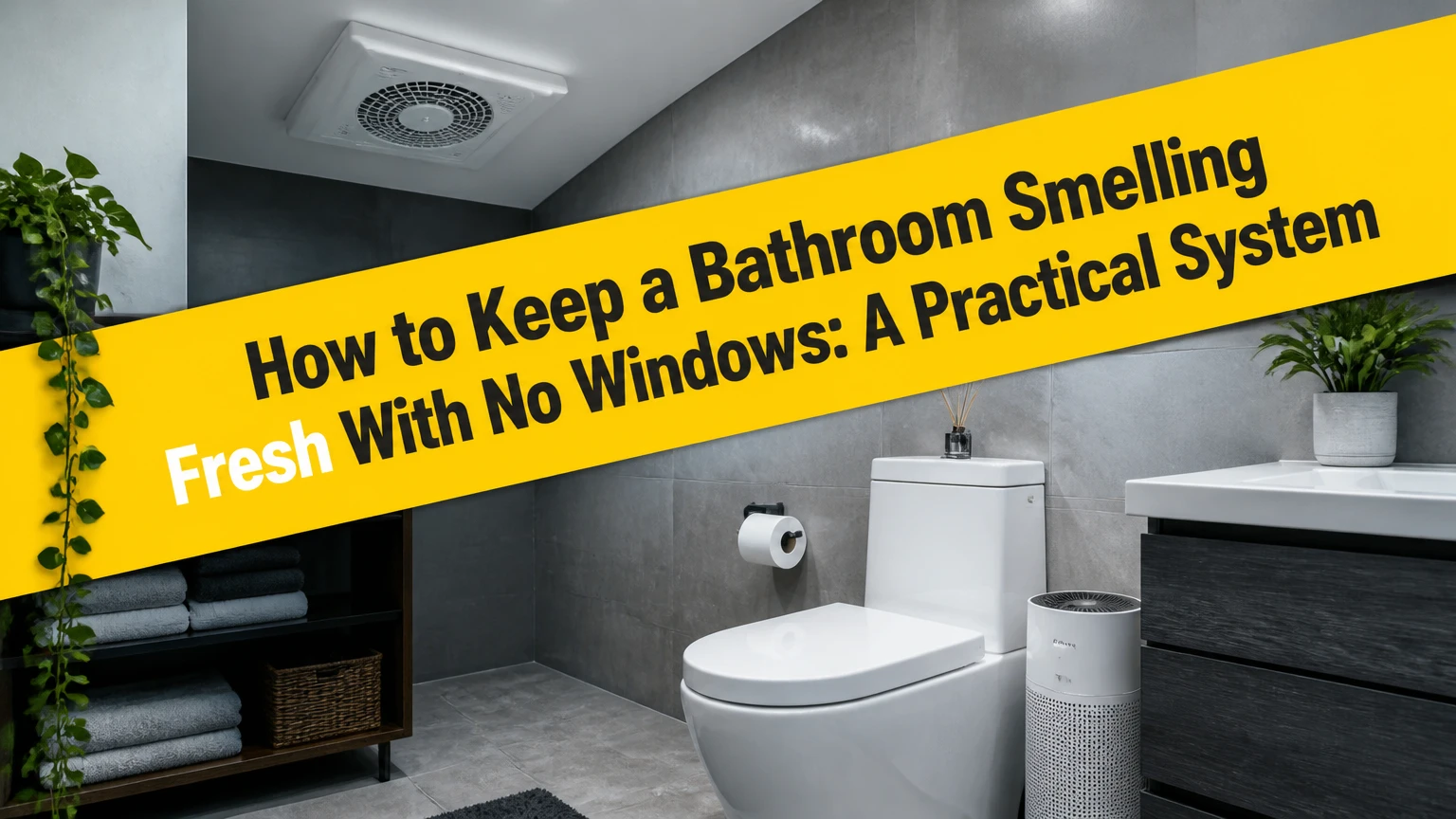
To keep a bathroom smelling fresh with no windows, remove odor sources, exhaust or dehumidify moisture, dry textiles, and clean drains and hidden surfaces on a schedule. The most effective setup is a properly ducted exhaust fan used during showers and for 20-30 minutes afterward, supported by humidity monitoring and source-focused cleaning.
Key facts at a glance
A windowless bathroom needs mechanical air exchange or deliberate moisture removal because fragrance cannot replace ventilation.
Run a correctly installed exhaust fan during a shower and for 20-30 minutes afterward.
Keep relative humidity below 60% for routine mold-risk control; a small hygrometer can verify whether the room dries adequately.
A HEPA filter captures particles such as dust and some mold spores, while activated carbon helps reduce gaseous odors.
Baking soda and vinegar neutralize each other when combined, so the mixture is not a reliable drain-cleaning treatment.
Persistent rotten-egg, sewage, or earthy odors require source diagnosis before air freshening.
Why Do Windowless Bathrooms Smell Stale?
Windowless bathrooms smell stale when humid air, contaminated surfaces, and insufficient air exchange allow odor compounds to remain in the room. Shower vapor condenses on grout, ceilings, cabinet interiors, towels, and shower curtains, where soap residue and organic debris can support microbial growth.
The odor pathway is usually more specific than “bad air.” A sour smell often comes from damp textiles, a sewer odor may come from a dry P-trap or failed toilet seal, and an earthy smell can indicate mold or prolonged dampness. Identifying the odor narrows the repair.
The U.S. Environmental Protection Agency states, “The key to mold control is moisture control.” That principle matters more than any fragrance product. A pleasant scent added to wet drywall or a contaminated drain produces a cleaner-smelling problem, not a clean bathroom.
What determines freshness?
Four conditions control bathroom odor:
- Source removal: Clean urine residue around the toilet base, soap film, drain biofilm, mildew, and waste bins.
- Moisture removal: Exhaust humid air outdoors or lower humidity with a dehumidifier.
- Drying: Spread towels, empty the bathmat, and remove standing water from ledges and floors.
- Air treatment: Use activated carbon or a mild fragrance only after the first three conditions are controlled.
How to Keep a Bathroom Smelling Fresh With No Windows
Use the following sequence after every shower and during weekly cleaning: run the exhaust fan, remove standing water, spread textiles to dry, clean odor sources, flush seldom-used drains, and inspect areas that remain damp. The complete routine takes approximately 10-20 minutes after installation, while the weekly clean takes 30-45 minutes.
Before you start
| Requirement | Typical value | Practical note |
|---|---|---|
| Hygrometer | $8-$20 | Place it at breathing height, away from the shower spray |
| Post-shower fan time | 20-30 minutes | Extend the period if humidity remains above 60% |
| Weekly cleaning time | 30-45 minutes | Include the toilet base, drain covers, and floor edges |
| Monthly inspection | 15-20 minutes | Check caulk, fan grille, cabinet panels, and floor drains |
| Basic supplies | 5-7 items | Microfiber cloths, detergent, toilet cleaner, brush, gloves, and drain brush |
Step 1: Remove odor sources before adding fragrance
Clean the toilet bowl, underside of the seat, hinges, floor around the base, sink overflow opening, shower drain cover, and waste bin. Use a bathroom detergent for general soil and a product labeled for the specific deposit, such as a descaler for mineral buildup or an enzyme product for organic residue.
Urine can accumulate below the toilet seat hinges and on textured flooring even when the bowl looks clean. Wash the waste bin weekly if it contains used tissues, hygiene products, or damp wipes.
You will know it worked when: the room smells neutral immediately after cleaning, without an air freshener.
Common mistake: spraying fragrance before cleaning the toilet base or bin. Fragrance can conceal a source temporarily and make later diagnosis harder.
Never combine chlorine bleach with vinegar, ammonia, toilet bowl acid, or other cleaners. Open the door if possible, run the exhaust fan, and follow the product label’s contact time.
Step 2: Dry the room after every shower
Pull the shower curtain or door fully open, squeegee water from the walls, remove puddles from the floor, and hang towels in a single layer. Do not leave a bathmat folded over the side of a tub because its underside can remain damp for many hours.
A shower curtain liner deserves special attention. Wash fabric curtains according to their care label, scrub plastic liners with detergent, and replace liners with persistent black spotting, cracking, or a sour odor that remains after washing.
You will know it worked when: the mirror clears, walls feel dry, and towels no longer smell sour by the next morning.
Common mistake: hanging two wet towels on one crowded hook. Air cannot circulate between compressed layers.
Step 3: Run the exhaust fan correctly
Turn the fan on when the shower starts and leave it running for 20-30 minutes afterward. Keep the bathroom door slightly open after bathing if the home’s layout allows safe airflow, but do not block the door gap if the fan requires undercut airflow.
A fan only works as intended when it discharges outdoors through a clean, intact duct. A fan that vents into an attic, ceiling cavity, or wall may move air without removing moisture from the building.
The Home Ventilating Institute commonly uses 1 cubic foot per minute, or 1 CFM, per square foot for bathrooms up to 100 square feet as a sizing rule. Local building codes and continuous-ventilation standards may use different requirements, so an installer should confirm the specification rather than selecting a fan by noise rating alone.
You will know it worked when: a tissue held near the door gap moves toward the bathroom, the mirror clears progressively, and the room’s humidity falls after showering.
Common mistake: choosing a high-CFM fan but leaving the door completely sealed. A fan needs replacement air to move its rated volume.
Step 4: Measure humidity before buying equipment
Place a hygrometer in the bathroom for several days. Relative humidity that repeatedly remains above 60% after showers indicates inadequate drying, weak ventilation, a cold surface problem, or water leakage.
The EPA recommends keeping indoor humidity below 60%, ideally between 30% and 50%, to limit conditions that support mold growth. A brief spike during a shower is normal; the concern is slow recovery or persistently high readings.
You will know it worked when: humidity returns near 50%-60% within roughly 30-60 minutes after bathing, depending on room size, weather, and fan performance.
Common mistake: placing the hygrometer directly above the shower. Steam hits the sensor and produces a misleading local reading.
Step 5: Clean drains without creating a chemical reaction
Remove the drain cover and lift out hair and visible sludge with a brush or plastic drain tool. Apply a suitable enzymatic drain product according to its label when organic biofilm causes odor, then flush as directed.
Baking soda followed by vinegar is a popular household tip, but the acid and alkaline ingredients largely react with each other, producing carbon dioxide, water, and a salt. The fizz may loosen superficial debris, but it does not reliably remove established biofilm or repair a dry trap.
Run water for 30-60 seconds in every seldom-used sink or floor drain. Water restores the P-trap barrier that blocks sewer gases. Do not use boiling water in PVC plumbing unless the manufacturer permits it.
You will know it worked when: the drain smells neutral after the water sits unused for several hours.
Common mistake: repeatedly pouring cleaner into a drain without removing hair, sludge, or the trap blockage causing the odor.
Step 6: Wash textiles on a fixed schedule
Wash hand towels and bath towels every 3-4 uses, or sooner if they remain damp. Wash bathmats weekly in ordinary use and shower curtains or liners every 2-4 weeks, following the material’s care instructions.
Dry all textiles completely before returning them to the bathroom. A towel that smells fine when wet can develop a sour odor after sitting in a humid, unventilated room.
You will know it worked when: textiles remain neutral-smelling after drying overnight.
Common mistake: adding more detergent to solve a musty towel problem. Excess detergent can remain in fibers and retain soil; correct drying and an appropriate wash cycle matter more.
Step 7: Inspect hidden moisture and stagnant air
Check beneath the sink, behind the toilet, around the tub edge, inside the vanity, under the bathmat, and along silicone joints. Look for swollen wood, peeling paint, soft flooring, blackened caulk, condensation, or a localized damp smell.
Keep cabinet doors slightly open after bathing if plumbing and storage allow it. Remove cardboard packaging, damp cleaning cloths, and excess products that restrict airflow inside the vanity.
You will know it worked when: no surface remains cool and damp several hours after bathing, and the smell does not return when the fan is off.
Common mistake: replacing black caulk without finding the leak or condensation source. New sealant can hide moisture damage temporarily.
Which Freshness Solution Fits Your Bathroom?
Mechanical ventilation is the best long-term control because it removes humid, contaminated air. Dehumidifiers help when outdoor ducting is impractical, carbon filtration helps with residual odors, and passive absorbers provide small-area support rather than room-scale moisture control.
| Option | Typical cost | Main function | Best use | Key limitation |
|---|---|---|---|---|
| Exhaust fan | $150-$500 installed | Removes humid air outdoors | Owned bathrooms and remodels | Needs ducting, power, and replacement air |
| Compressor dehumidifier | $150-$300 | Condenses water from air | Humid rooms with no effective exhaust | Heat, noise, tank emptying, electrical safety |
| Thermoelectric dehumidifier | $40-$100 | Small-scale condensation | Very small powder rooms | Low extraction capacity |
| HEPA plus carbon purifier | $50-$200 | Captures particles and some gases | Residual odor and airborne particles | Does not lower humidity |
| Activated carbon bags | $10-$30 | Adsorbs some odor compounds | Cabinets, bins, and small zones | Slow, limited capacity, replacement required |
| Baking soda container | $2-$8 | Neutralizes limited acidic odors | Small enclosed spaces | Weak room-scale effect and spill risk |
| Fragrance diffuser | $10-$50 | Adds scent | Final finishing step | Masks unresolved odors and may irritate occupants |
Is a dehumidifier better than a bathroom fan?
A bathroom fan is better for shower moisture when it vents outdoors, while a dehumidifier is a useful fallback when ducted ventilation is unavailable or ineffective. A fan removes moisture from the building; a dehumidifier collects it in a tank and returns slightly warmed air to the room.
For a small bathroom, a compact unit rated around 10-20 pints per day may be adequate, but ratings are usually measured under warm, humid test conditions. Small thermoelectric units often remove far less water in real bathrooms, sometimes only a few hundred milliliters per day.
Keep any mains-powered appliance away from splash zones and use a properly protected outlet. Empty the tank before it overflows, clean the filter as directed, and avoid placing a portable unit where it blocks the toilet, door, or required clearance.
Does an air purifier remove bathroom smells?
An air purifier removes some airborne particles and gaseous odors only when it contains a meaningful activated-carbon filter. HEPA media target particles; HEPA alone does not chemically capture every odor molecule, and neither filter corrects damp grout, a dirty drain, or sewer gas.
Place the purifier outside direct splash range and operate it after cleaning or during periods of persistent residual odor. Replace carbon and particle filters on the manufacturer’s schedule, because saturated carbon loses adsorption capacity.
Do charcoal bags or baking soda work?
Charcoal bags and baking soda can reduce mild odors in enclosed areas, but they cannot dry a humid bathroom or eliminate a plumbing defect. Carbon works through adsorption, while baking soda neutralizes some acidic compounds; both have finite capacity and need replacement.
Use carbon bags inside a vanity, near a waste bin, or behind a toilet where airflow reaches them. Use a stable, covered baking soda container rather than an open bowl in a household with children or pets.
What Should You Use for a Renter, Owner, or Tight Budget?
Renters should combine source cleaning, textile drying, a door-safe airflow routine, and portable humidity control. Owners should prioritize a correctly ducted exhaust fan because permanent moisture removal produces better results than repeated fragrance purchases.
| Situation | First action | Supporting action | Typical budget | Expected result |
|---|---|---|---|---|
| Renter, no drilling | Confirm fan operation and use 20-30 minutes post-shower | Hygrometer plus carbon bag | $15-$80 | Better drying and less residual odor |
| Owner, existing weak fan | Clean grille and test airflow | Electrician or duct inspection | $20-$150 | Restored airflow if blockage is the cause |
| Owner, no exhaust fan | Install outdoor-vented fan | Add timer or humidity switch | $150-$500 | Permanent moisture and odor control |
| Low budget | Wash textiles and clean drain, toilet, and bin | Set a post-shower timer | $5-$30 | Source reduction without equipment |
| High humidity, no duct route | Use a correctly placed dehumidifier | Monitor with hygrometer | $50-$300 | Lower humidity with manual maintenance |
| Fragrance-sensitive household | Use no scenting products | Carbon filtration after source removal | $10-$200 | Neutral air with fewer irritants |
A timer is more reliable than memory. A humidity-sensing switch can extend fan operation when moisture remains high, but the sensor must be installed and calibrated according to the manufacturer’s instructions.
Why Does the Bathroom Still Smell Bad?
Persistent bathroom odors usually indicate an identifiable source rather than a lack of fragrance. Diagnose the odor by character, location, timing, and whether it appears after showers or when plumbing remains unused.
| Odor or symptom | Likely cause | Diagnostic check | Corrective action |
|---|---|---|---|
| Rotten egg or sewage smell | Dry P-trap, blocked vent, or sewer-gas leak | Run water in every drain, then recheck after 1 hour | Refill trap; call a plumber if odor returns |
| Sour towel smell | Damp textile or detergent residue | Remove all towels and mats for 24 hours | Wash, rinse thoroughly, and dry completely |
| Earthy or musty smell | Mold, wet drywall, or hidden leak | Inspect vanity, caulk, ceiling, and toilet base | Repair moisture source and remove affected material |
| Smell near toilet base | Failed wax or rubber seal, urine residue | Check movement, staining, and floor softness | Clean surface; have the seal inspected |
| Odor from sink overflow | Organic buildup in overflow channel | Smell near the overflow opening | Brush and clean with a compatible product |
| Fan runs but humidity stays high | Clogged grille, failed flap, poor duct, or no outdoor termination | Tissue test and external vent inspection | Clean, repair, or professionally assess ducting |
| Chemical smell | Cleaner residue or incompatible products | Stop products and ventilate | Leave room, follow label guidance, seek help if symptoms occur |
If an exhaust fan is audible but airflow is weak, vacuum the grille, inspect for a stuck backdraft damper, and verify that the exterior termination is open. A fan cannot compensate for a crushed duct or a duct that ends inside the building.
Mold covering more than a small localized area, recurring water damage, soft flooring, or suspected sewer-gas leakage deserves professional assessment. Do not paint over mold or seal wet materials behind new caulk.
Common Mistakes That Keep Odors Coming Back
Using fragrance as the primary fix
Fragrance changes the perceived odor but leaves moisture, bacteria, biofilm, and sewer gas in place. Essential oils and plug-in products can also irritate people with asthma, allergies, or fragrance sensitivity.
Leaving the fan on without checking its destination
A fan that vents into an attic or ceiling cavity transfers moisture into the structure. Confirm the duct terminates outdoors, and do not assume a visible grille proves correct installation.
Keeping the bathroom door permanently closed
A closed door can restrict replacement air and reduce fan performance. During drying, leave the door ajar when privacy, pets, children, and household airflow make that safe.
Mixing drain and bathroom chemicals
Bleach, acids, ammonia, and some drain products can produce toxic gases or dangerous heat when mixed. Use one product at a time, rinse according to the label, and never improvise a chemical combination.
Overestimating passive absorbers
A charcoal bag near the toilet cannot dry a ceiling or remove a plumbing odor. Passive products are local finishing tools, not substitutes for ventilation, leak repair, or cleaning.
Ignoring the toilet brush and waste bin
A wet toilet brush holder and an unwashed waste bin can create strong odor even in a clean-looking bathroom. Empty liquid from the brush holder and clean both items weekly.
How Much Does a Fresh Bathroom Setup Cost?
A basic routine costs approximately $5-$30, a portable humidity-control setup costs $50-$300, and a professionally installed exhaust fan typically costs $150-$500. The final price depends on electrical access, duct length, exterior wall or roof access, local labor, and whether repairs are needed.
| Upgrade | Typical purchase or installed cost | Setup time | Ongoing requirement |
|---|---|---|---|
| Hygrometer | $8-$20 | 5 minutes | Replace battery annually or as needed |
| Fan timer switch | $20-$60 plus installation | 30-90 minutes | Confirm timer operation monthly |
| Compact thermoelectric unit | $40-$100 | 5 minutes | Empty tank and clean intake |
| Compressor dehumidifier | $150-$300 | 5 minutes | Clean filter and empty tank |
| HEPA-carbon purifier | $50-$200 | 5 minutes | Replace filter every 3-12 months |
| Outdoor-vented exhaust fan | $150-$500 installed | 2-5 hours | Clean grille every 3-6 months |
| New shower-curtain liner | $8-$30 | 10 minutes | Wash monthly or replace when degraded |
The cheapest effective upgrade is often not an absorber. Cleaning the fan grille, replacing a saturated liner, washing bathmats, or installing a timer can improve the room faster than buying another scent product.
The Bottom Line
The reliable way to keep a bathroom smelling fresh with no windows is to control moisture first, remove odor sources second, and add filtration or fragrance only as a finishing measure. Run a properly ducted fan during showers and for 20-30 minutes afterward, keep humidity below 60%, dry textiles fully, maintain drains and P-traps, and investigate any odor that returns after cleaning.
FAQ
Can I keep a windowless bathroom fresh without an exhaust fan?
Yes, but moisture control becomes more difficult. Use a hygrometer, keep the door open after bathing when practical, squeegee surfaces, dry textiles outside the room, and operate a suitable dehumidifier. If humidity repeatedly exceeds 60% or mold returns, installing outdoor-vented mechanical ventilation is the more reliable correction.
How often should I clean a bathroom with no windows?
Clean the toilet, sink, floor, and waste bin weekly; wash bathmats weekly and towels every 3-4 uses; clean the shower curtain or liner every 2-4 weeks; and inspect drains, caulk, cabinet interiors, and fan airflow monthly. Increase frequency when several people share the bathroom.
Should I leave the bathroom door open all day?
Leave the door ajar during the drying period if household conditions permit, because replacement air improves exhaust performance. A permanently open door is not required when the fan works correctly and humidity returns to an acceptable range within about 30-60 minutes.
Are bathroom plants a solution for stale air?
Bathroom plants do not provide enough ventilation or dehumidification to solve stale air, mold risk, or sewer odors. Plants can add decorative value, but wet potting soil may introduce another earthy smell, especially in a dim room with slow evaporation.
Why does my bathroom smell worse after rain?
Rain can increase indoor humidity and alter air pressure around plumbing vents, exposing weak drainage traps or sewer-gas defects. Check floor drains and sink P-traps, inspect for leaks, and have plumbing ventilation assessed if the odor repeatedly follows rain.
Can a plug-in air freshener make a bathroom smell clean?
A plug-in air freshener can add fragrance but cannot make contaminated air clean. Use it only after cleaning, drying, and plumbing checks, and avoid it if occupants experience headaches, asthma symptoms, skin irritation, or sensitivity to fragranced products.